
The background of the study explains what readers need to know before they can understand your research problem. It connects relevant context and prior findings to the question your study will address.
Decide what each finding allows you to say. A textbook-access survey and a learning simulation describe different kinds of evidence.
Putting them together does not prove that free textbooks improve every student's grades. Keep the distinction while explaining why both matter to your question.

Outline your study background in Atlas
Compare papers, inspect supporting citations, and save a checked outline.
What the background of the study does
A useful background connects the issue to what is known, what remains unclear, and why the proposed study should address that uncertainty.
The University of Waterloo's CARS guide calls these moves a territory, a niche, and a way to occupy that niche.
Explain the topic, show the need for more work, and state what your study will do. For first-week textbook access, explain how students get their books. A history of schools since ancient times would delay that point.
Harvard's writing guide warns against broad openings that delay the issue. You can narrow the focus without starting far from it. Check what your course or journal asks for before choosing the headings.
Separate background from neighboring sections
Background is one job of a paper's opening. A journal may place it under Introduction. A thesis may give it a Background of the Study heading. In either case, it explains the prior work and context behind the research problem.
The surrounding sections have related but different jobs:
- Introduction: presents the opening argument and may include context, purpose, scope, and an overview of the document.
- Literature review: examines prior work in greater depth, including relationships among theories, methods, findings, and debates.
- Problem statement: names the specific unresolved issue the study will investigate.
- Significance: explains why answering that question could matter and to whom.
The Chalmers thesis-writing guide gives background, gap, purpose, and scope their own roles. Their placement can vary by field. Use the background to trace the evidence, then name the unresolved issue in the statement of the problem.
If your draft spends pages judging each study's methods, move that detail into the literature review. Keep the findings and limits that help readers follow your question in the background. Follow your course's format to decide where each belongs.
Choose evidence for the research question
Set the scope first
Write a draft question before choosing sources. Asking how students get their course readings in the first week gives you a way to narrow the broad topic of open textbooks.
Each chosen paper should explain the issue, supply a useful finding, or show what is still unclear.
For each source, note who or what was studied, where and when the work took place, and how the authors did it. Keep the finding beside its supporting passage.
Write down why the finding belongs. A survey may describe what students said, while a test may show what they learned.
Connect claims across papers
Cornell's writing guide suggests a chart of sources and evidence. Use it to see where findings agree, differ, or ask other questions. A list of summaries will still need those links when you turn it into a draft.
If the chart still reads like one summary per paper, use the research synthesis steps to group findings around the claim you need to make. Keep each source's limits beside that claim.
If you expect free access to raise grades, a study that found no clear overall gain gives readers a reason to question that expectation. Keeping it in the background makes the debate visible, as the Wordvice guide recommends.
A source's age matters differently for each claim. An older survey can explain how authors studied access, while current price or cost claims need current evidence. Choose new work when it changes the argument, and retain older work when its ideas or methods help explain the question.
Build a chronological or thematic outline
Follow changes over time
Use chronological order when the changes matter. A new rule might affect book access, then a study tests that change, and later work challenges its findings. Show what changed at each stage and the evidence for that change. Listing papers by year alone will not explain their links.
Group findings by theme
Use thematic order when papers address parts of one problem. For textbook access, themes could cover how students get books, what they learn, and why an overall score may hide effects on one group.
The Elsevier writing guide links prior work with the problem the study will address.
Lead with the idea the reader needs, then show how the papers support or limit it. A list of authors tells readers who wrote. A link between how students get books and what tests measure gives them a reason to read those studies together.
You can combine the two forms. Within a theme, show how an idea changed over time. Choose the order that makes the path to your question clear. Your reference manager's sort order need not become the order of your draft.
A background of the study example
Map sources to the draft
This invented campus study asks how students get first-week readings. The outline maps its draft to three real, older papers and their limits. A current review would need a wider search for new work.
| Paragraph role | Source or decision | Usable evidence | Limit to retain |
|---|---|---|---|
| Establish the access issue | Jhangiani and Jhangiani, 2017 | Survey of 320 students in British Columbia courses using open textbooks | Self-reported experiences from a selected sample |
| Distinguish access from outcomes | Clinton and Khan, 2019 | Meta-analysis found no reliable overall learning difference in included comparisons | A pooled finding does not describe every student or eliminate confounding |
| Explain a possible mechanism | Grimaldi and colleagues, 2019 | Simulation examines detection when assumed benefits depend on prior access | Modeled effects are not observed improvements |
| State the remaining question | Compare the scopes of these papers | The selected set does not answer the proposed course's first-week access question | A wider search is needed before claiming novelty |
| Introduce the proposed study | Hypothetical local investigation | Ask how students obtain readings and what delays they describe | No local data or results have been collected here |
Table 1: The outline keeps student reports, pooled results, and a model distinct as it leads toward a study question.
Read the linked narrative
One reason to study open textbooks is to ask how students get their course readings. Jhangiani and Jhangiani's 2017 survey asked 320 students about buying and using textbooks. They were taking courses with open textbooks in British Columbia during 2015. Their reports help frame access questions, though the authors warn that who chose to reply and what they recalled could affect the findings.
What students say about access and what they learn are distinct questions. Clinton and Khan's 2019 meta-analysis pooled study results and found no reliable overall learning difference between open and commercial textbooks. That does not prove that access makes no difference to each student.
Grimaldi and colleagues' simulation study used a model where gains depend on who would otherwise lack a book. The result depends on the assumptions built into that model.
These papers do not tell us how students get readings in the first week of the course we plan to study. After a wider search for new work, we could ask students when and how they get those readings and what delays they face. That would study access without assuming that an open textbook must raise grades.
This original teaching draft links the survey, pooled results, and model to a question about one course. The question remains provisional because the selected sources need a wider search and supply no local campus findings.
Check what the figure shows
The source figure shows a model that creates scores and assigns prior book access before randomly splitting students into open-resource and comparison groups. It lowers scores for those without access in the comparison group, then tests the difference. Because these students and scores are simulated, the model does not supply the real test results a classroom trial would need.
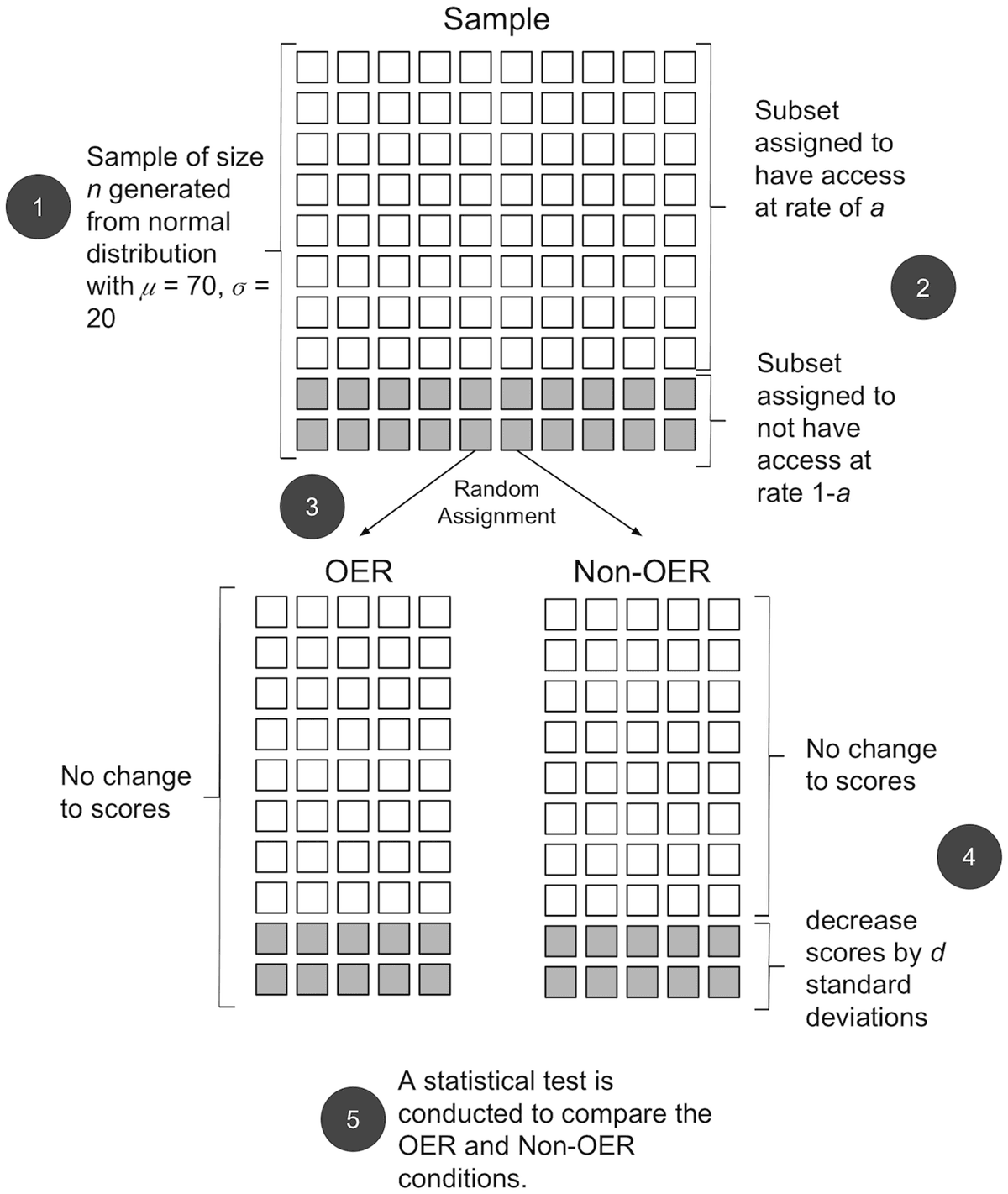
The shaded groups represent modeled students without prior access. Original Figure 1 by Grimaldi and colleagues, PLOS ONE, reproduced unchanged under CC BY 4.0.
The paper's authors disclose OpenStax roles, including jobs there or its founder role. Keep that in mind when you read the paper. Check what the model assumes before using it to plan a study. To show that this mechanism caused a campus's results, you would need to test it with real data.
Check the proposed research gap
A gap claim needs more than a search that found no match. Check whether you read enough sources, including new work, to support it. Then try the terms other authors use. First-week access might be called timely access or a delay in getting course materials.
Search those terms and check the sources cited by the closest studies. Look for newer work that cites them too. Keep a note of where, when, and how you searched. Those notes help you state how far your gap claim can go.
The survey already cited rules out a claim that nobody has studied textbook access. For now, say that these papers do not answer how students get first-week readings in this course. That claim concerns the chosen papers. To say more about the field, search further.
A new campus alone may not make a study worth doing. Does it send readings through a route prior studies did not examine? Must students get books before finishing sign-up? Find local evidence before treating those as facts.
The Waterloo CARS guide explains that the niche is the reason for the study. If newer work answers the question, rethink what your study will add.
Assemble the evidence outline in Atlas
Add copies of your chosen papers that you have permission to use to one Atlas project. Name them so you can find each source, such as Survey 2017, Meta-analysis 2019, and Simulation 2019.
Wait until they have finished processing before choosing them in chat.
Open a chat. In Ask a question, type @ and select each intended source. A focused request could be:
Use these three papers to outline a background for a study of first-week access to course readings. Group the findings by theme. Keep what students said, pooled test results, and results from the model distinct. For each draft claim, name the source and cite the passage that supports it. State who was studied or what was assumed, and keep the limits. What questions do these papers leave open? Do not claim that nobody else has studied those questions.
Select Send and check each claim. Open its numbered citation and read the text around the cited passage.
If the answer says open textbooks raised grades but cites the simulation, it has overstated that source. Edit it to describe what the model assumes, or ask Atlas to revise the outline from that passage.
If the answer merges papers in a way you cannot trace, ask what each one adds to the claim. For a missing or unhelpful citation, ask for the passage from the source by name and check it yourself. You still need to judge what the paper supports.
After checking the outline, select New, then Note in the project sidebar. Keep the order, source links, limits, and further-search questions there. Wait for Saved before closing it.
Draft in your own words from the checked outline. Check newer work to see what your study could add.
Revise the narrative before submission
Read the draft once without checking the sources. Each part should bring the reader closer to the research problem. If an old fact seems interesting but plays no role in that path, cut it or move it elsewhere.
Read the first line of each paragraph to see where the ideas lead. If they form a list of names, group the text around findings or questions.
Does the next study look at a new group, challenge a claim, or test a different result? Cornell's source-chart advice can help when the link is unclear.
Finally, check each cited claim. A finding about people who replied cannot speak for all students. An overall score difference near zero does not prove that every group has the same result. A model cannot prove a real effect on grades. Keep the words that limit a claim to what its source shows.
Once the draft leads to a question you can defend, use it to set the research objectives. The background shows how you reached the problem. The objectives state what the study will do to address it.
Outline your study background in Atlas
Compare papers, inspect supporting citations, and save a checked outline.