
A statement of the problem explains what your study will address, what is still unclear, and why you need to find out. Start with context, gap, and consequence: what the sources show, what they leave open, and why that gap matters.
Oklahoma State's writing guide uses these three parts to frame the research need.
Build the statement from claims you can check. Three papers that omit your setting may suggest a useful question. They cannot prove that no one has studied it. Keep the gap open to review until you have searched more widely.

Check the evidence behind your problem statement
Compare prior findings and their limits before drafting your study problem.
Parts of a statement of the problem
A topic names an area, such as access to campus writing support. A problem statement explains the specific issue that calls for a study. A center's records may show who booked a session while leaving the reasons for not booking unclear. That missing account could give you a study problem to explore.
The Oklahoma State guide asks writers to define the issue, show why it matters, and connect it to a purpose or question. Use three prompts to make that link clear:
- Context: What do sources show about the group and setting?
- Gap: What is still unclear, disputed, or missing from that account?
- Consequence: What can you not explain or decide while the issue stays open?
A study may clarify a theory or explain why findings differ. It does not need to address a crisis. State the value of the knowledge you seek without inventing harm.
Write for your reader
Give the reader enough background to follow your claim. Purdue OWL asks writers to consider what the audience knows and which terms need to be explained. Define a measure or service before claiming that its limits matter.
Build the evidence outline before drafting
Name the group, issue, and setting you want to study. "Students need better support" is broad. "Access to writing-center sessions for evening students at one campus" gives you a group and service to check against prior work.
Read the methods and discussion as well as the abstract. A broad title may hide a sample drawn from one class. A count of bookings may measure use without explaining why some people did not attend.
Keep four parts in each source note:
- Finding: what the source shows, with its group and measure.
- Limit: what it leaves open and where you found that limit.
- Your inference: the meaning you propose, kept apart from the author's claim.
- Next check: the search or source that could confirm or change your view.
The literature review workflow covers how to find, screen, and compare papers before writing from them. Keep a search note with terms, databases, dates, and scope. A search limited to recent English-language papers in one database may miss relevant work.
Try to overturn the proposed gap
Look for a paper that answers your question. Search other terms for the same service or group and follow useful references. The Oklahoma State literature check asks writers to find work that addresses the problem and work that leaves an issue open.
A new paper may change an apparent absence into a question about conflicting results. Read its setting and methods before deciding what remains to be studied. Keep that change in your notes so the final paragraph reflects what you found.
Statement of the problem example
The campus, sources, findings, and locators below are fictional teaching material. They are invented to show how a source limit should survive the move from notes to a paragraph. They are not published studies or tested Atlas results.
You plan to study evening students at Northbridge Campus. You have a study of daytime attendees, a local booking report, and a service timetable. Your first claim is: "No research explains why evening students avoid writing centers." Check the sources before keeping that claim.
| Fictional source and locator | What it shows | Limit to keep | Role in the problem |
|---|---|---|---|
| Daytime study, Methods and Discussion paragraph 4 | Interviews with daytime attendees about booking sessions | No evening students or nonattendees in the sample | Related account that does not cover the group you plan to study |
| Northbridge booking report, table 2 and data notes | Fewer bookings from evening-course students than daytime-course students | No group sizes, available session counts, or reasons for nonattendance | Local question, without a rate comparison or cause |
| Service timetable, hours section | Sessions end before the evening teaching block | No account of student availability or other support use | Possible access constraint to investigate |
Table 1: Fewer bookings could reflect a smaller group of evening students. Without the group sizes, you cannot say they attend at a lower rate. The timetable also leaves options open: students may use daytime sessions, online help, or other support.
A defensible working paragraph would read:
The selected daytime study describes booking experiences among attendees but excludes evening students and nonattendees (Daytime study, Methods). At Northbridge Campus, records show fewer bookings from evening-course students. The report lacks group sizes needed to compare use rates (Booking report, table 2 and data notes). The timetable places sessions before evening teaching, suggesting a possible access constraint that these sources do not explain (Timetable, hours section). Learning when evening students can attend and where else they seek help would guide a review of the schedule. The proposed study will explore those experiences, subject to wider literature review and confirmed access to students.
These are teaching locators. Replace them with real citations in your required style. Do not put the invented titles in a bibliography.
The paragraph keeps the sample limit, missing group sizes, and possible versus proven cause. It gives a reason to study the issue without claiming that new hours will solve it.
Draft your own version
Use these prompts, with source notes behind each answer:
- In [group or setting], sources show [checked finding].
- They leave [specific issue] unclear because [source limit or conflict].
- That gap makes it hard to [explain or decide something], for [supported reason].
- This study will ask [bounded question], within [feasible scope].
Remove the brackets and connect the ideas in your own words. If you cannot support a sentence, return to the sources before adding confident language.
Revise unsupported gap and consequence claims
A claim about all research is stronger than a claim about the papers you read. "No research has studied this" needs a basis beyond a small source pack.
A working note can instead say: "These three sources do not explain access for evening students at Northbridge. A wider search is needed to place this question within prior work."
If you find a related study, check the group, setting, measures, and results. The ResearchMethod guide warns that a new place alone is a weak reason for a gap. Explain why the setting could change the issue or why the prior findings do not answer the question you need to ask.
Keep causes and consequences within the evidence
"Restricted hours cause low attendance and poor grades" joins claims that the example does not support. The timetable shows hours and the report shows bookings. Neither shows why students stayed away or what effect use had on grades.
A narrower consequence is that the campus lacks an account of whether its schedule fits evening students' needs. That matters to a schedule review without pretending you have measured harm. The Oklahoma State significance prompts ask what understanding or practical outcome the gap limits.
The problem statement names the unresolved issue. The significance-of-the-study guide develops who could use the proposed knowledge and why, while keeping hoped-for benefits apart from proven results. Use that distinction when the proposal needs both sections.
Do not promise that the study will solve the issue. You may aim to describe experiences or test a cause. Whether the findings support a change is a later judgment.
Compare the problem evidence in Atlas
Atlas can help turn selected source text into an outline you can inspect. Bring the papers or records and a scope note naming your group, setting, and question. You still need to check how well this source pack covers the literature.
- Add the sources to a project and confirm that processing has finished.
- Start a chat. Type @ in Ask a question to mention the sources and scope note.
- Choose Project only to keep new retrieval within the supplied project files.
- Ask for an outline that keeps cited findings apart from your own ideas.
A focused prompt is:
Compare the mentioned sources for my study. Organize the answer into context, possible gap, and consequences. Cite each finding and keep its group, setting, measure, and limits. Mark my own interpretations separately. Say what these sources do not establish and what I need to check next. Do not certify that the gap is exhaustive or novel.
Check citations before writing
Open each numbered citation and read the surrounding passage. Does it support the sentence and preserve its limits? In the example, you would need both the booking counts and the data notes to judge what they mean.
The AI source-checking guide explains how to test that link between claim and source.
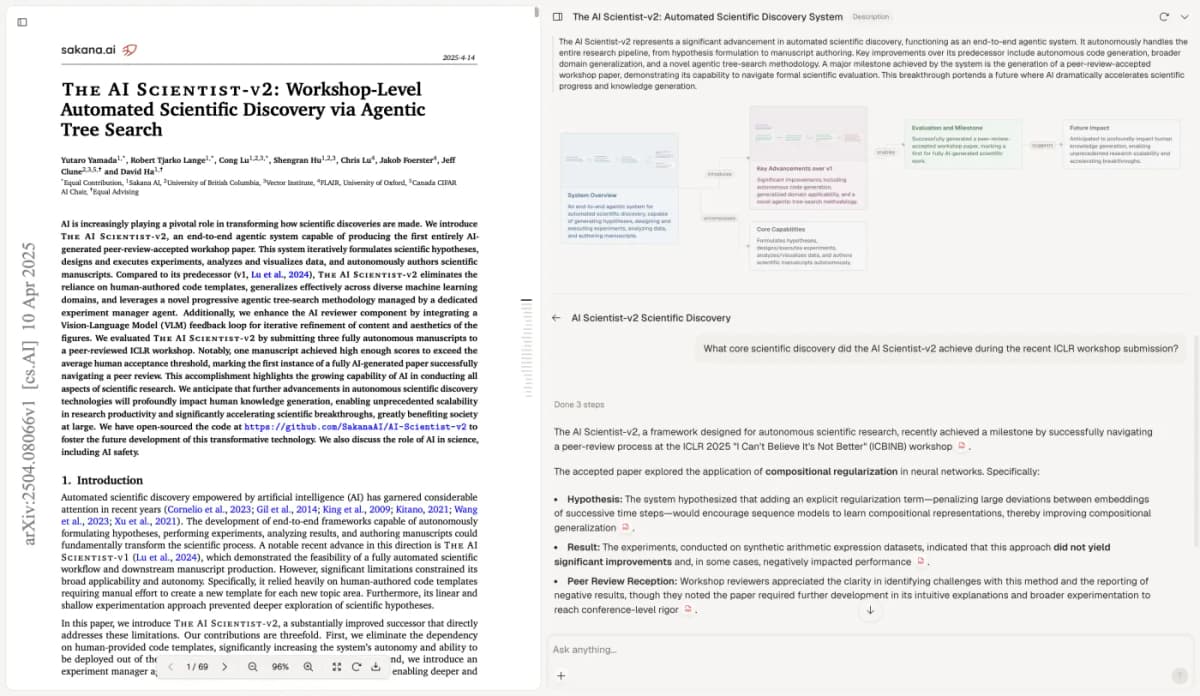 Keep the source open while checking how the answer uses it.
The displayed AI Scientist-v2 paper by Yutaro Yamada and colleagues is licensed under CC BY 4.0. The capture is copied unchanged.
This first-party screenshot illustrates source review with an unrelated scientific paper. The invented Northbridge sources do not appear in it, and no tested problem-statement result is claimed.
Remove unsupported claims or mark them as open checks. A missing citation calls for more review. A citation's presence alone does not settle what the passage means.
Select New → Note to save the checked outline. Keep source locations, your inferences, and outstanding searches with it. Wait for Saved after editing. Write the final statement in your own words from that reviewed work.
Check the statement against your study plan
Place the paragraph beside your question and method. Would that method yield the evidence needed to address the problem? The Oklahoma State alignment check connects the problem to researchable scope and methods.
If you plan to ask students about their experiences, do not promise a causal estimate of the effect on grades. If the problem concerns nonattendees, you need a way to reach them. Attendee records alone will not tell you why others did not attend.
Match roles and required format
Keep the roles of the problem and study plan clear. As ResearchMethod's guide explains, the problem gives the reason for the study, a question asks what it will explore, and an objective names an action. A hypothesis offers an answer to test. The research objectives guide covers that next stage.
Check your school's format. It may put a general statement and numbered research questions under one heading. A journal may expect the rationale within the introduction. Wordvice's guide notes that placement depends on the kind of paper and required structure. Use the evidence outline within that format rather than impose a fixed length.
Discuss scope and access with your supervisor or team. Trace each factual clause to its source, search more widely for the gap, and check the required format. Keep open checks in your note until they are resolved. The final statement should justify a study that your evidence and plan can support.
Check the evidence behind your problem statement
Compare prior findings and their limits before drafting your study problem.