
A research paper introduction explains what the reader needs to know before reaching your study question. It connects relevant prior work to your reason for doing the study, then states the purpose and scope of the paper.
Start by deciding what each paragraph must do. Check the claims that connect those paragraphs before polishing their wording.
A smooth transition cannot repair a claim that its source does not support.
The worked example uses two real learning studies and a made-up local course. It has a source-linked outline and a new draft you can learn from.
The local study has not been done, and these two papers cannot prove a gap across the field.

Trace your introduction to its sources
Compare prior findings with your study question and stated rationale.
What the introduction needs to do
Help readers see the path from the topic to your specific question or argument. Include the prior findings they need, the reason for your work, and what the paper sets out to address. A brief method statement or roadmap can fit, depending on the genre. The Manchester introduction guide describes these functions while noting that their order and inclusion vary.
The CARS model offers three useful moves: set the research context, establish a reason for the work, and introduce the present study.
You can raise a question or extend prior work without claiming that no one has studied the topic. Waterloo's CARS guide sets out these options. Use the moves to check your logic rather than impose three fixed paragraphs.
An abstract summarizes the whole paper. A full literature review gives more space to the body of prior work. A problem statement names the issue, while background supplies context. The introduction brings those functions together for this paper. Chalmers' section guide separates purpose, context, and scope. Check your journal or assignment to decide how much belongs here.
Build the background from checked claims
Write the current study question and your own reason for asking it in a short note. Then choose prior findings that help a reader understand that question. Use explicit criteria for each claim: who was studied, what was compared, what was measured, and when. This gives the evidence review a clear basis before the draft grows.
Give each source a job
A source can define a term, report a finding, explain a method, or qualify a claim. Record that role beside the sentence you want to write. If three papers all serve the same role, decide which detail the reader needs from each. Synthesizing research papers can help you compare their contributions before you select the background.
Avoid a chain in which each sentence starts with a different author's name but the question never comes into view. The Mensh and Kording writing editorial recommends outlining each paragraph's role before writing it in full. Try one plain sentence that explains how a paragraph brings the reader closer to your purpose.
Preserve the claim's limits
Read the source passage and nearby text. A result from one task or test delay does not support an unrestricted claim about learning. Keep the comparison and timing in your notes even if the final prose is brief. Cite the claim where you use it so readers can check the same source.
Treat a statement such as "no previous study has examined this" as a separate research claim. A phrase bank can show how to express a gap, but the phrase cannot establish one. The Manchester resource can help with wording once you have checked your claim. Before asserting novelty, check a wider, updated set of sources through your literature review process and seek expert review.
Worked background-to-question outline
This teaching set contains Roediger and Karpicke's 2006 work on tests and delayed retention, and Karpicke and Blunt's 2011 work with science texts and concept mapping. The planned local study is our own example. The outline keeps each published contribution separate from that proposed question and its rationale.
| Paragraph role | Checked source contribution | Planned wording or purpose | Limit to retain |
|---|---|---|---|
| Define the topic | The 2006 study abstract compares recall practice and restudy of prose. | Introduce retrieval practice as recalling studied material from memory. | These experiments concern specific tasks and test delays. |
| Show a relevant distinction | The 2006 findings differ between five-minute and delayed tests. | Explain why the time of testing matters to our question. | Avoid an always-better claim. |
| Extend the background | The 2011 original paper compares retrieval with concept mapping and assesses conceptual learning. | Show that prior work includes more than simple recall. | Concept mapping and rereading are different comparisons. |
| State the local purpose | Hypothetical author note, with no published local finding. | Ask about recall practice versus rereading in one planned introductory biology course. | The selected papers do not establish an unstudied population or a field-wide gap. |
Table 1: The links support the historical study claims. The last row records an original teaching choice that still needs literature review and study planning.
Narrow a claim before drafting
The 2006 abstract reports a restudy advantage at five minutes and a prior-testing advantage at delayed tests. This changes the sentence you can write. "Retrieval always beats rereading" drops a condition that matters to the result.
A source-faithful version could say that prior testing favored delayed retention in those experiments, while restudy favored immediate recall. That narrower sentence also explains why our local question names a delay. It does not promise that the planned study will reproduce the finding.
Make the rationale your own
For this made-up course, the author wants to compare two ways to study the same text, with a test one week later. This is the author's reason for the project.
It is not a claim about a known problem in the class. We have no survey of local study habits, no proof that teachers need to change their practice, and no approved design.
You can describe how you want to extend prior work while the wider case for doing so remains open. Waterloo's guidance gives several ways to explain that purpose. If a later search finds a similar course study, revise your reason around what your work adds.
Keep claims of novelty tied to what you can show.
Turn the outline into paragraphs
This new draft shows how to get from background to a question for the made-up project.
To use it in a real paper, you would need to check the sources and update the search. You would also need to match the text to the work you did.
Write the background and transition
Retrieval practice means trying to recall what you have studied without looking at it. Roediger and Karpicke compared recall tests with restudy of prose. Students who restudied recalled more after five minutes. Those who had taken tests recalled more at longer delays. Thus, the time of a test matters when we compare ways to study. (Roediger and Karpicke, 2006)
Karpicke and Blunt compared retrieval with concept mapping using science texts. Retrieval led to better scores on tests of conceptual learning, including questions that asked students to connect ideas. This task differs from rereading. The two studies offer related starting points, with distinct tasks and measures to keep in view. (Karpicke and Blunt, 2011)
The first paragraph ends with the point our question needs: test timing. The second adds a related study and names the task it used. The reader can follow how the ideas connect while seeing that the studies did not test the same things.
State the question and scope
For the planned local project, we want to compare recall practice with rereading after students study the same short biology text. We focus on one course task and a test one week later. These prior studies give us a reason to ask the question. They do not prove that it is new across the field.
Our planned question is: In this introductory biology course, how does recall of the text one week later differ between recall-practice and rereading groups? We still need to plan the groups, texts, time spent, test, and required review. There are no results yet.
These last paragraphs use the author's stated purpose and an untested question. They should not be pasted into a finished paper as a report of work already done.
Choose tense to match the study's status, then check that the methods can address the question without quietly changing its scope.
How you end the section depends on the paper. You might name the approach or give a brief map of what follows. Scribbr's guide separates papers that report a study from those that build an argument. It makes the roadmap optional.
Check your journal's rules and recent papers of the same type. A familiar IMRAD structure may need less explanation than an unusual argument.
Check the source links in Atlas
Add the named papers, study-question note, and author-rationale note to one project. Keep your own notes clearly labeled. Start a fresh chat, mention the sources with @, and choose Project only beside + to scope new retrieval. A fresh chat avoids carrying earlier outside discussion into this comparison.
- Ask: "Use these two papers and my labeled study notes to build a background-to-question outline. For each prior finding, give the source, task, comparison, test delay, and supported claim. Keep my rationale separate and flag unsupported gap statements."
- Open the citations and find the supporting text. Precise page or passage navigation is available for some sources. When it is absent, find the named section and read the surrounding text yourself. Check both the claim and its limits.
- Correct an answer that says retrieval always outperforms rereading. Ask for the immediate and delayed findings in the 2006 source, then revise the outline. If the answer claims no local or similar study exists, mark that claim unsupported pending a wider search.
- Select New, then Note, and enter your checked outline, source locations, corrections, and open questions. Wait for Saved before closing. Keep the author and supervisor's review decisions with the note.
For each planned paragraph, retain its job, factual claims, source passages, author-owned rationale, and unresolved checks. This makes it easier to organize research notes when the question or literature changes. A generated comparison still needs your source review before it becomes manuscript prose.
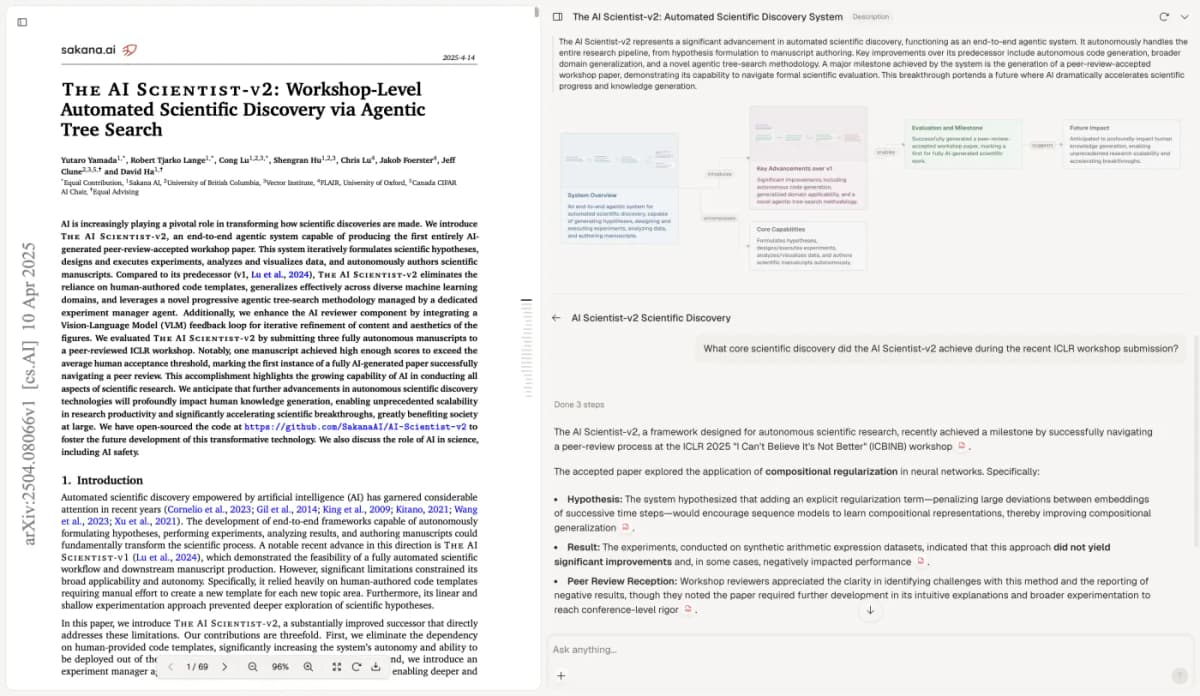
This Atlas screenshot shows a source page beside a cited answer about an unrelated paper. It illustrates where source inspection can happen, with no claim that the example introduction or its research gap was validated in the product.
Paper shown: The AI Scientist-v2, Yamada et al., under CC BY 4.0. The displayed paper content is unchanged.
Review the introduction against the paper
Read the full draft and check whether the final question follows from the background you actually gave.
If a sentence could be removed without affecting that path, consider moving it to the literature review or cutting it. Keep the context that explains your terms and choices. Use the research paper conclusion guide to check whether the ending returns to the question and scope established here.
Before using the section, check these points with the author or supervisor:
- Each factual claim has a source that supports its scope.
- The reason for the study is explicit and evidence-based where it makes factual assertions.
- The question, method, and stated contribution describe the same work.
- Planned activities and completed findings are clearly distinguished.
- Gap and novelty claims reflect an updated search and scholarly judgment.
- Length, citations, optional findings, and roadmap follow the target venue.
The PLOS writing guidance recommends an outline and feedback from peers. If readers cannot explain why the study follows from the background, review the path between the ideas. A word change may not fix a missing step in the logic.
Atlas helps you compare supplied sources and save checked notes. The author must make the case for the study and review the writing. Before using the final section, match its claims, question, and scope to the paper. Resolve open research choices with the people who own the work.
Trace your introduction to its sources
Compare prior findings with your study question and stated rationale.