
A research paper abstract gives readers a short account of your paper's purpose, approach, main findings and meaning. Draft it from the completed paper so every claim fits the work you actually report.
Start with the submission instructions and four notes from the paper. Keep a source location behind each note while you draft. The example below shows how those checks lead to an abstract that preserves the study's scope, even after you remove detail.

Check your abstract against the paper
Trace the proposed claims to your completed paper before submitting.
What a research paper abstract does
Readers use the abstract to decide whether the full paper addresses their question. Purdue's abstract guide connects the purpose, approach, findings and implications to the paper's major sections. This makes the abstract a compact account of the whole work.
An introduction has a different job. It develops the context and problem that lead into the paper. PLOS One's introduction instructions ask for context, the key literature and the study aim. The abstract also tells the reader what the completed work found.
Match the summary to the paper type
For a study that tests a change, give the design and main result. For a paper about texts, name the works you read, how you read them and the claim you make. The Indiana University guide calls these forms informative and indicative. The first reports what was done and found. The second can state a work's scope and argument. Check which fits your task.
Do not add a sample or test to a paper that has none. A paper based on texts can state which works it reads and what it argues. Each claim still needs to match the paper, even when there is no number to check.
Read the abstract requirements first
Find the current assignment sheet or author instructions. Record the word limit, required headings, keyword rules and any restriction on citations. Check whether the submission form has a separate abstract field as well as an abstract in the manuscript.
General ranges are useful for planning. They are weaker than an explicit venue rule. Purdue gives a typical short range, while the current PLOS One abstract instructions set a maximum of 300 words. That example applies to PLOS One, so check your own venue before using it.
Separate headings from content
A structured abstract uses named headings. An unstructured abstract may put the same reader information into one paragraph. Required headings can change what you emphasize and how you divide the space.
Scribbr's formatting guidance also directs writers back to their institution or journal. A sample from a different discipline can teach you a useful move without giving you the correct submission format.
Keep a brief requirements note beside the paper. If two instructions conflict, resolve which governs your submission before polishing the prose. Counting words in the wrong format creates work you may need to repeat.
Map the completed paper to abstract claims
Read the full paper and write a short note for each job the abstract must do. Wisconsin's writing center advises drafting the abstract after the paper. You then summarize the actual argument and outcome rather than an early plan.
The research paper outline guide covers the earlier task of planning sections and source-supported points. For an abstract, return to the completed manuscript so a planned claim does not become a reported finding.
The diagram below shows four jobs within the abstract. Start with the question the paper asks. Say what you did to answer it, then report what you found. End with why the finding matters.
The key labels context in blue, content in black and conclusion in red. The labels carry the meaning even when you cannot see the colors.
Here the question gives context, the work and finding give content, and the meaning forms the conclusion. Use these jobs to check your draft rather than treating the figure as a required set of headings.
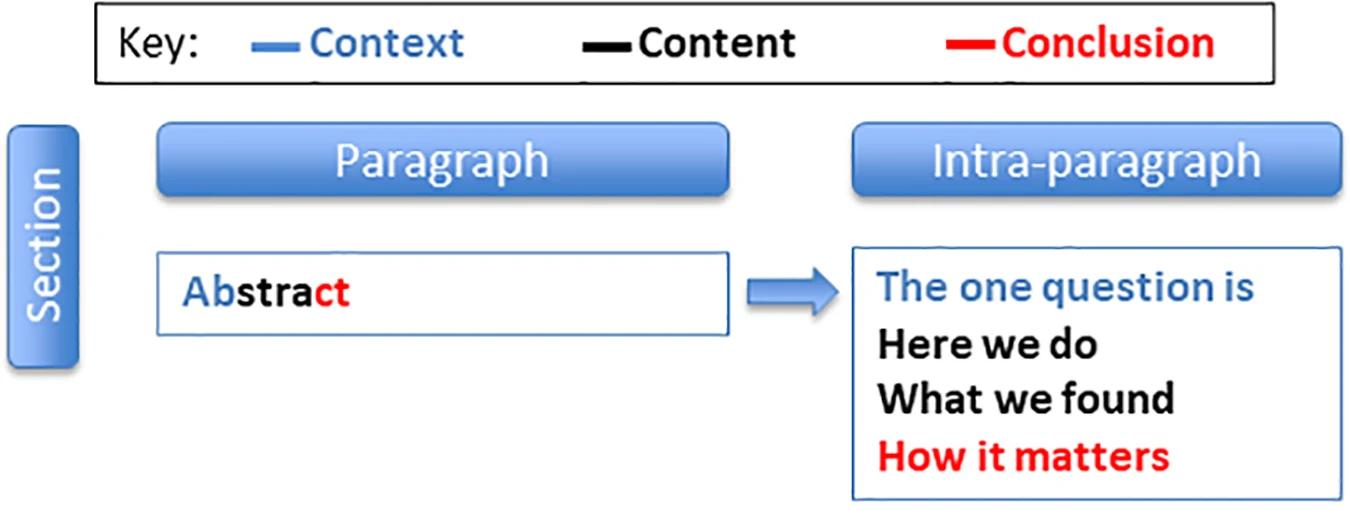
Abstract-row excerpt from the corrected Mensh and Kording figure, published by PLOS Computational Biology Staff (2017) under CC BY 4.0. The crop retains the restored key and abstract row; their text and colors are unchanged.
Keep a private passage check
For each proposed sentence, keep a page, section, table or other locator. Write what that passage supports and what it leaves open.
The Mensh and Kording guidance explains how the abstract carries the paper's central message. Your private checks help retain that message during compression.
These checks belong in your working notes. A submitted abstract may exclude references. PLOS One explicitly excludes abstract citations, but that does not remove the need to verify the claims behind the prose.
Keep the completed draft and source material easy to reopen. A research paper organizer can help you find those files and notes again. You still need to decide which finding is central enough for the abstract.
Work through a checked abstract example
The following paper is made up for teaching. Its source locations and findings are also made up. They let you practice the writing steps and make no claim about a real campus or study.
Suppose the paper reads a service schedule alongside two accounts from students who travel to campus. It asks what these records show about evening access. The schedule lists opening hours. Both students say those hours clash with the times they can visit. The paper ends by asking for more research before judging access for the whole campus.
| Abstract job | Paper location | Proposed content | Check before keeping |
|---|---|---|---|
| Purpose | Introduction, aim | Examine evening access in supplied records | Keep the question's scope |
| Approach | Methods, document comparison | Compare a schedule and two interview excerpts | Do not imply an experiment |
| Finding | Results, accounts C1 and C2 | Both accounts describe timing conflicts | Keep the group visible |
| Meaning | Discussion, limits | Wider study is needed to assess campus access | Do not claim a tested solution |
Table 1: The table keeps the proposed content beside its paper location and scope check. Indiana's accuracy principle requires the abstract to stay within the original document. A plausible sentence still needs support from that document.
Turn the checked rows into prose
This short teaching abstract shows the four jobs together. It is not sized for a particular venue.
This paper asks what supplied records show about evening campus access. It compares a service schedule with two accounts from students who travel to campus. The schedule listed opening hours, while both accounts said those hours clashed with the times they could visit. These records raise questions for further study. They do not show what all students experience or test whether changing the hours would help.
Each sentence has a source in the made-up paper. The ending keeps the study's scope clear. Changing the hours is a possible next step to test. The supplied record does not show what that change would do.
Correct a stronger claim
Suppose an early abstract ends by saying that longer opening hours improve access for all students. The schedule records hours. The two accounts describe experiences. Neither establishes the effect of a schedule change or the experience of all students.
Replace that ending with a conclusion bounded by the paper. The example above says the records identify questions for wider research. Scribbr's discussion guidance calls for the main conclusion and relevant limits. Apply that idea without converting a descriptive result into a causal claim.
If the real paper contains an experiment or quantitative estimate, report the central result with the precision your venue requires. Verify its group, measure, units and uncertainty against the paper. Do not borrow numerical detail from another abstract just to make the sentence look specific.
Cut words without changing the finding
Remove background that the reader does not need to understand the question. Cut repeated aims and phrases that praise the work without explaining it. Indiana's brevity and clarity guidance supports precise wording and familiar terms.
Keep details that change what the finding means. In the example, removing two commuter accounts could make the result seem campus-wide. Removing the absence of an intervention test could leave the final claim stronger than the study supports.
Review the result before the word count
Read the finding and conclusion as a pair. Ask whether the ending follows from the reported outcome.
PLOS One's results and discussion guidance asks writers to explain findings without overstating conclusions. The abstract needs that same care.
Next, count the words using the venue's rules. A shorter abstract can still omit its main finding, while an abstract within the limit can still overclaim. Fix the meaning first, then choose which detail to compress.
Choose tense by sentence function
Past tense can describe completed work. Present tense can express an argument or interpretation that the paper advances. Wisconsin's discipline examples show that tense choices vary across fields and functions.
Avoid reporting completed work as something you will do. If the paper itself is still a proposal, it belongs to a different abstract task. Keep expected outcomes distinct from findings already in the record.
Check proposed sentences in Atlas
Add the permitted completed paper and current abstract requirements to one project. After the sources finish processing, start a chat. Type @ and select the paper and requirements so the question names the intended material.
Ask for a passage check before asking for polished prose:
Using this completed paper and these abstract instructions, propose a purpose, approach, finding and conclusion sentence. For each sentence, show the supporting passage and flag wording that goes beyond it. Keep missing results open. Then compare the proposed abstract with the required headings and word limit.
Open the citation behind each proposed claim. Check the source name and surrounding passage. A precise PDF page or passage may be available, but reopen the source by name if the citation location is not enough to judge the claim.
In the teaching example, reject any answer that turns two accounts into all students or states that a schedule change has been tested. Separate what the paper reports from what the requirements demand.
Our guide to synthesizing research papers helps with comparing source contributions when the task uses several files.
Choose New, then Note, to retain the checked sentences, paper locations and unresolved questions. Wait for Saved before leaving. Atlas supports source reading and working notes. You verify the data, scientific meaning and submitted text.
Review the abstract beside the final paper
Read the abstract alone. Check whether a reader can identify the question, approach, main outcome and meaning without an unexplained abbreviation or a reference to a missing table.
Then read it beside the final paper. Confirm that revised findings, counts and qualifications also appear in the abstract. Recheck the current instructions before submission. PLOS One's submission guidance illustrates how a venue can require the abstract in both the manuscript and a separate form field.
If you use a summary tool for an initial reading pass, compare its output with the full paper before adapting it. Our research paper summary AI comparison explains where full-text review and source checks matter in that workflow.
Keep your private claim checklist with the paper version used for the final abstract. When a coauthor changes a result or conclusion, those links show which sentences need a fresh check.
Check your abstract against the paper
Trace the proposed claims to your completed paper before submitting.