

A case brief is a short study outline of a judicial opinion. It helps you explain what happened, what the court decided, and why. Each entry should lead you back to the passage that supports it.
Read the assigned opinion before drafting. Then use your course headings to record the material facts, court history, issue, rule, holding, and reasoning. Keep the court’s legal answer separate from what it did to the judgment.
This guide works through a historical opinion, Erie Railroad Co. v. Tompkins, to show that source-reading process. It does not assess the case’s current precedential status. Use the example to check your own outline, rather than as a substitute for reading.

Check the passages behind your case brief
Trace your brief entries back to the assigned opinion.
What a case brief contains
A student case brief is a study aid. You use it to prepare for class. It condenses an assigned decision into notes you can use during class and later review. Your professor’s rubric controls the headings and level of detail. The Wisconsin Law School briefing guide makes that course-specific purpose clear.
Common headings are facts, procedural history, issue, rule, holding, and reasoning. Facts describe events that matter to the decision. Procedural history tracks the case through the courts. The issue is the legal question; the holding is the court’s answer. Reasoning explains how the court got there. Record the disposition—the action taken on the judgment—as a separate entry when useful.
A legal research memo has a different job: analyzing a legal question for a particular matter. A student brief explains an assigned opinion. Do not turn it into advice about what a client should do or a prediction about a new dispute.
Read and mark the opinion
Start with a complete copy of the assigned reading and your course instructions. Check the case name, court, decision date, and citation so you do not brief a different stage of the dispute. If the professor assigns an edited excerpt, note that boundary in your study notes.
Read once for the dispute
On the first pass, follow the story and the court’s answer. Resist writing a full paragraph for every fact. Ask which events help explain the legal issue and why the court treated them as relevant. The LexisNexis study guide recommends reading the opinion before building the brief.
On the next pass, mark likely passages for each heading. Keep the page or paragraph number beside the mark. You can shorten the wording later without losing the route back to its source.
When a detail seems important but its role is unclear, leave yourself a question rather than guessing.
Mark who is speaking
Separate the court’s own explanation from quoted lower-court text and each party’s argument. Also mark where a concurrence or dissent begins. A useful note can say “railroad argues” or “majority concludes”; those few words prevent two different positions from becoming one supposed rule.
A syllabus or headnote can help you navigate, but check the opinion text for the court’s reasoning. The LSAC briefing materials offer teaching examples you can compare with your own headings.
Use a model to understand the method, then return to your assigned text.
Worked case brief with passage checks
The example below uses Erie Railroad Co. v. Tompkins, 304 U.S. 64 (1938). GovInfo’s official record identifies the decision.
References use printed U.S. Reports pages, not PDF viewer positions. Open the original opinion alongside the outline to check each paraphrase.
These brief entries show how a source location makes each part of the outline inspectable.
| Brief entry | Short study note | Passage to check |
|---|---|---|
| Material facts | Tompkins was injured by a passing train while walking beside the track in Pennsylvania. | Page 69, opening account. |
| Procedural history | A federal trial judgment favored Tompkins; the appellate court affirmed. | Page 70, lower-court history. |
| Issue | Should the Court disapprove the approach established by Swift v. Tyson? | Page 69, majority opening question. |
| Rule | Outside matters governed by federal constitutional or statutory law, the Court directs application of state law and rejects federal general common law. | Page 78, third part. |
| Holding | The appellate court erred by treating liability as general law and declining to decide the state-law issue. | Page 80, fourth part. |
| Disposition | The judgment was reversed and the case remanded for further proceedings. | Page 80, closing majority paragraph. |
Table 1: Worked study outline: paraphrases of the historical opinion, with printed-page checks for each entry.
Add reasoning from the assigned passage
The table is a starting outline. To complete your brief, explain the reasoning at the depth your course requires. In this example, pages 78–80 connect the rule to state authority and the lower court’s error. Read the surrounding discussion before writing your own explanation of that connection.
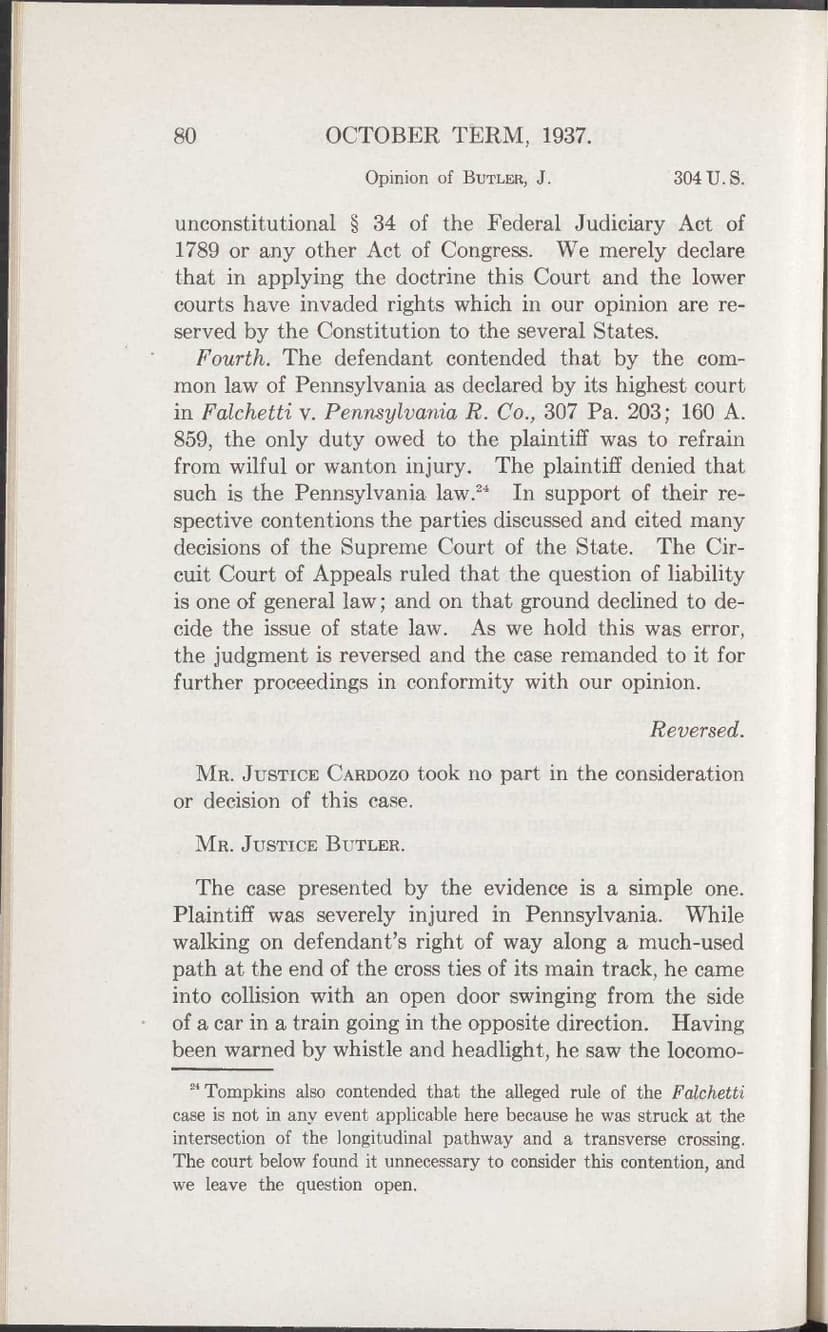
The majority ends above Justice Butler’s separate opinion on printed page 80, and the footnote leaves a question open (GovInfo).
The page shows why section boundaries matter: a separate opinion begins below the majority’s result. Its running header alone does not tell you who wrote every paragraph on the page. Check where the text starts and ends, including footnotes, before assigning a passage to a speaker.
Check common source-reading errors
A polished outline can still attach the wrong claim to the court. Review the source labels before you shorten the brief. The Wisconsin guide distinguishes the reasoning needed for the decision from other comments, and treats separate opinions as distinct material.
Keep an argument as an argument
An unchecked note might say, “The Court held that the railroad owed only a duty to avoid willful or wanton injury.” On page 80, that duty formulation is presented as the defendant’s contention, which the plaintiff disputed.
A corrected note identifies it as an argument; the holding concerns the appellate court’s failure to decide the state-law issue. The footnote also preserves an open question.
Test each entry in your own brief. Is the passage a party’s argument, a lower court’s view, or this court’s answer? Add the speaker to the note when the distinction matters. If the source does not settle a point, keep it unresolved.
Separate the answer from the result
“Reversed” tells you what happened to the judgment. It does not, by itself, explain the legal answer or every issue that remains. The LexisNexis tutorial distinguishes the holding from the judgment.
Keeping both entries helps you explain the decision without claiming that a remand settles the whole dispute.
Check broad rule statements too. Preserve exceptions and limiting language that matter to the assigned issue. If you cannot explain how a rule supports the holding, reread that part of the opinion. Do not fill the gap with a rule from a different case just because it sounds familiar.
Check your outline in Atlas
Atlas can support a cited outline from documents you supply. Start with a permitted copy of the assigned opinion and the course rubric. Follow your school’s rules for AI use and document handling.
An AI legal document summarizer can assist review, but its output still needs passage checks.
Use this sequence to build and review a study note:
- Add the permitted sources. Wait until the opinion and rubric finish processing. Name them clearly so a later class excerpt cannot be confused with the full opinion.
- Select the opinion with
@. Ask for the material facts and procedural history first. Request citations for each entry and ask it to preserve who is speaking. - Ask a focused issue question. Request the question the court addresses, its answer, and supporting passages. Ask for the disposition separately so the outline keeps both.
- Check the rubric. Mention the rubric and opinion together to compare required headings with the draft. A rubric supports format choices; it does not establish the court’s holding.
- Open each citation. Read the surrounding passage, heading, and footnotes. Correct speaker errors, missing limits, and unsupported entries. A citation’s presence does not prove that the paraphrase is right.
- Save the corrected note. Use
New → Note, add your checked outline and page references, and confirmSaved. Keep questions for class beside the entry they affect.
A useful first question is: “From @Assigned Opinion, outline the material facts and procedural history. Cite each entry. Separate party arguments from statements by the court, and mark anything the text leaves unresolved.” Follow with a focused question about the issue and holding rather than requesting an unsupported complete answer in one step.
These steps support study summarization. They do not verify current precedential status or resolve disputed legal interpretation. If a cited passage is missing or unclear, inspect the original document yourself and keep the uncertainty in the note.
Use the brief in class
Bring the brief as a map back to the opinion. You should be able to explain why a fact matters, how the court answers the issue, and which passage supports your account. If an entry merely repeats a phrase you cannot explain, return to that passage before class.
When a problem asks you to apply that rule to new facts, the IRAC method guide shows how to move from a checked case rule to analysis. Keep the court's holding separate from your application.
Revise your brief after class discussion to capture what you learned. Tommy Sangchompuphen’s ABA guide recommends updating the brief as class adds context. Keep the professor’s explanation distinct from the court text so you can see what each source contributes.
For several assigned cases, keep each opinion and brief clearly named. A legal document organizer can help maintain that separation. Compare cases only after their individual entries are checked, and retain the source references when you build your course outline.
Check the passages behind your case brief
Trace your brief entries back to the assigned opinion.