
Legal Research Memo: Format, Analysis, and Source Checks
Plan a legal research memo with a clear question, brief answer, facts, rule-to-fact analysis, counterarguments, and checks for current law and citations.
- Byline

Summary
A legal research memo answers one legal question. It weighs the facts and checked law to predict an outcome.
A common office memo has a question, short answer, facts, discussion, and conclusion. Use the form your office or course requires.
You can outline supplied texts with source links. A qualified legal reviewer must check the law, facts, and citations before using the memo.
A legal research memo answers a defined question for a legal reader. It states the likely result and explains the rule drawn from checked law. It applies that rule to the facts and deals with points that cut the other way. The aim is an objective prediction.
CUNY Law's office-memo guide places the question and brief answer before the facts and discussion.
For a real matter, the legal researcher must still find and validate the law. Atlas can help sort texts you have chosen. Add them to one project, mention the sources in chat, ask for an issue-by-source outline, and open each cited passage.
Treat that outline as a draft for qualified review. A link to a case or statute does not show that it is current or governs the matter.

Atlas

Organize supplied sources in Atlas
Compare supplied texts, inspect citations, and save a review outline.
What a legal research memo answers
The question presented asks how a legal rule may apply to key facts. The brief answer gives a tentative result and the main reasons. The discussion then shows the path from source to rule, from rule to facts, and from adverse points to a reasoned view. CUNY Law describes this as work for another lawyer, who needs to follow each step.
An office memo should give serious attention to the hardest fact and the strongest adverse reading. That makes the prediction more useful to its reader. The University of Oregon's objective-writing chapter also frames the memo as a neutral assessment rather than a pitch for one side.
Memo versus court brief
An office memo helps its reader assess a question. A court brief asks a tribunal to adopt a position. Both rely on law and careful citations, but they serve different readers. CUNY's writing guide asks memo writers to predict and address the other side's best point.
Use the format your supervising lawyer, office, or course requires. This page teaches a drafting method through an educational example. It does not answer a live legal question.
Set the memo format and audience
Start with the assignment. Who will read the memo? What question do they need answered? How much of the record do they know?
CUNY Law says its structure is common, while offices may set their own form. Columbia Law's memo checklist gives a useful review of the parts.
A common office memo has these sections:
- Heading: To, From, Date, and Re, so the reader can identify the assignment.
- Question presented: The legal issue, relevant setting, and facts that drive the answer.
- Brief answer: The tentative answer and a short account of the rule and key facts.
- Facts: An evenhanded record of facts needed for the analysis, including adverse ones.
- Discussion: The authority, rule, comparison to the facts, counterargument, and issue-level result.
- Conclusion: The answer and any limit or open check the reader must know about.
These labels are a planning aid. CUNY's sample format and the Columbia checklist show what each part does. Follow local instructions if they call for a different order, heading, citation form, or level of detail. If you are comparing model documents to learn a community's writing conventions, the genre analysis guide shows how to study each section's purpose without treating one example as a universal template.
Draft the answer after the analysis
You can leave a blank brief-answer field while you test the law against the facts. Once the discussion is sound, write the short answer from that work. CUNY's guide calls for a clear answer and a short account of why it follows.
If a source or key fact remains unchecked, name the open point for the reviewer instead of writing a firm prediction.
Frame the question and material facts
Write one issue at a time. Name the legal subject and the fact that may change the answer. The Columbia checklist asks whether the question includes the issue and key facts without assuming a result.
For a live memo, the writer also names the court or place whose law applies and the case's stage. This article supplies neither, because its example teaches structure alone.
Sort the facts before drafting
Make three small groups from the provided record:
- Known: A document or witness account supports the fact. Record where it appears.
- Disputed: Sources conflict or the fact is contested. Name both accounts.
- Assumed or missing: The question depends on a fact the record does not yet establish.
The facts section should give the reader the record needed to follow the discussion. A fact that hurts the tentative answer can be as important as a helpful one.
CUNY Law asks writers to include key facts on both sides. The Columbia checklist also checks for an evenhanded account.
Do not turn a fact statement into a legal conclusion. “The file records a notice on Tuesday” is a fact to verify. “The notice met the legal deadline” is a conclusion that needs a checked rule, a date calculation, and a reasoned application. Keep the source location beside the fact so a reviewer can reopen it.
Check the authority before stating a rule
A passage can support what a source says. It cannot by itself show that the source remains good law or governs the case at hand. The Library of Congress case-law guide says free case-law sites can help find cases but may lack an effective citator.
A qualified legal researcher should check the law's current status and fit with the right tools for the matter.
Check text, then legal status
First, check the text. Does the cited page state the rule or reason you put in the memo? Open the opinion or statute and read the surrounding passage.
The Columbia memo checklist asks writers to support rules, explain cases, and check citations. CUNY Law asks writers to tell a holding from other language and show why a case matters.
Next, check the source's legal status and fit. A qualified reviewer must look at the current text, later treatment, court, date, and any exception. The Library of Congress guide describes using a citator to update cases found through free sites.
Keep an unchecked status flag in the outline until that work is done. An Atlas citation takes you back to source text. It is not a legal citator result.
Build a rule with its limits
State the rule as narrowly as the checked sources permit. If sources seem to clash, show the tension for the reviewer. CUNY's discussion guide calls for a rule explanation before applying it, with attention to exceptions and the reasons given in cases.
If the source set is incomplete, mark that gap. A supplied folder cannot prove that no other law exists.
Apply the rule to facts and counterarguments
The next table is fictional and non-legal. It uses an invented office policy about booking a shared room to show the shape of an issue-rule-application outline. “Policy A” and “Policy B” are labels for imaginary supplied texts, not statutes, cases, or legal authorities. There is no jurisdiction, holding, or legal outcome here.
Assume the invented question is whether a team member's room booking met a workplace policy that asks for manager approval before a booking is final. The supplied record has a policy page, a message thread, and a booking log. The facts are deliberately incomplete, so the sample stops at an outline for review.
| Issue and supplied text | Record fact | Analogy or distinction | Counterpoint | Passage to open | Status or gap |
|---|---|---|---|---|---|
| Approval step, fictional Policy A | A manager's message says “looks fine” after the booking request. | The message may fit Policy A's approval step if it refers to this room and time. | It may refer only to a draft request. | Policy A, “Approval” paragraph; message thread, Tuesday entry. | Check the full thread and who sent it. This is policy text, not law. |
| Final booking step, fictional Policy B | The booking log shows a later confirmation mark. | The log may show the process was completed. | The mark's meaning is not defined in the supplied excerpt. | Policy B, “Final booking” paragraph; log, row for the room. | Obtain the log key and full policy version. This is policy text, not law. |
Table 1: The table keeps each proposed step traceable. It does not decide whether either policy was met. The writer would reopen the named passages and resolve the open facts before reaching a view on that policy question.
For a real legal memo, the same columns would need actual checked law, a sound fact record, a status check by a qualified researcher, and legal analysis by the person responsible for the matter.
Turn the outline into discussion
A short discussion of the fictional policy could begin:
Policy A calls for manager approval before a booking is final. The manager's Tuesday message may meet that step, but the thread excerpt does not show whether “looks fine” referred to this booking. The full thread is needed before the memo can say that approval occurred.
The passage gives the rule, fact, possible fit, and limit. In a real legal discussion, the writer would also show how checked law has been used in similar settings. The writer would weigh the best contrary reading. CUNY Law's discussion guide and Columbia's checklist both call for this work.
Compare supplied texts in Atlas
Use Atlas only with materials you are permitted to place in the project. Add the supplied texts and fact record, then type @ in chat to select the sources you mean. Ask: “For each issue in my outline, what does each selected text say? Put the supporting passage beside it, and mark what the text does not answer.” Atlas's documented source comparison workflow can help collect candidate passages, but it does not conduct a current-law search.
Open each answer citation and compare it with the full passage. If a rule and fact have been merged into one unsupported claim, ask Atlas to separate them. Save the checked outline and open questions in a note for the qualified reviewer. The public Atlas guides for source mentions, cited answers, and notes support these actions; they do not establish that the tool checks legal validity, authority status, or all relevant law.
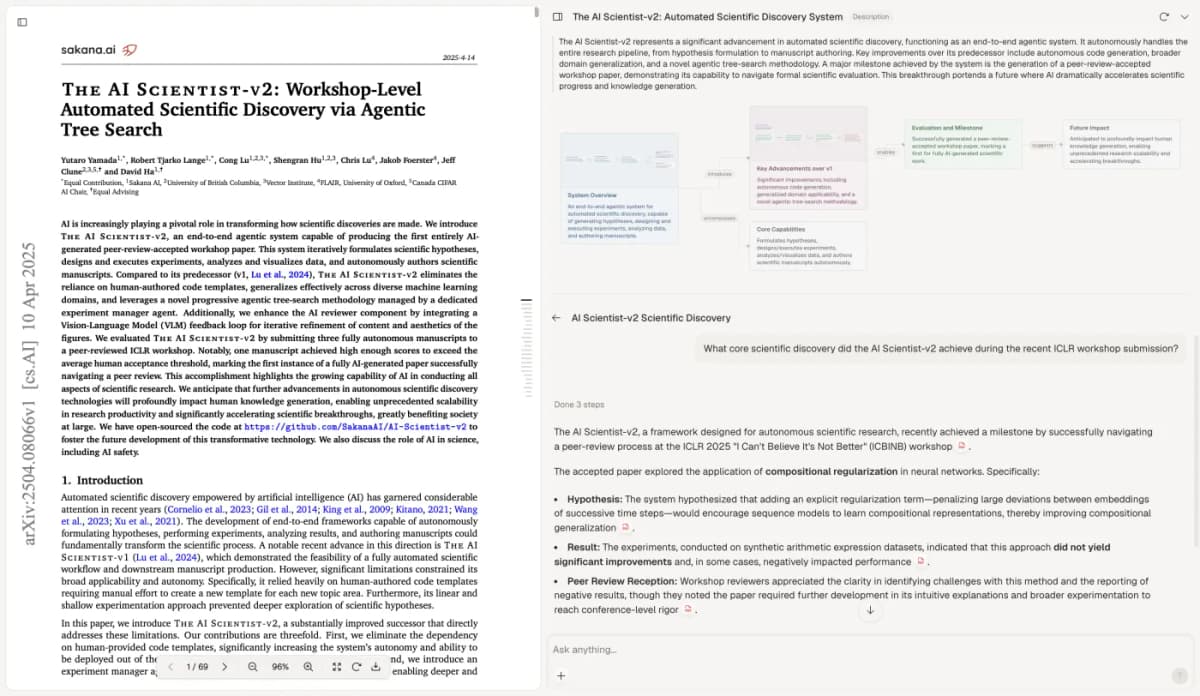
This first-party Atlas image shows a paper beside a cited answer, so the reader can see where a passage check starts. The paper in the image is unrelated to the fictional office policy or any legal matter. It illustrates citation inspection only.
For adjacent tasks, the legal document organizer covers file and source organization, while legal document analysis covers reading supplied legal documents. Neither replaces the authority-status and legal-judgment review required here.
Review the draft before relying on it
The final review is substantive. Columbia Law's checklist asks writers to test the question, brief answer, facts, rule support, case comparison, contrary view, and citations.
CUNY Law also calls for a fair prediction that a legal reader can follow.
Ask the qualified reviewer to check the record and each passage used in the memo. They must also check the current law, later treatment, court, adverse sources, and citation form with the tools for the matter.
The Library of Congress guide explains why finding a case online is only the start of that status check.
The brief answer and conclusion should match the analysis that survived those checks. If a key source or fact remains open, name what could change the answer.
Keep the tentative Atlas outline distinct from the verified memo. A qualified legal professional retains responsibility for the final advice and duties tied to the matter.
Atlas
Organize supplied sources in Atlas
Compare supplied texts, inspect citations, and save a review outline.
Frequently Asked Questions
It is an objective, predictive memorandum that addresses a specific legal question by connecting relevant authorities to material facts, considering counterarguments, and explaining a reasoned conclusion.