
Genre Analysis: Compare Rhetorical Moves Across Model Texts
Genre analysis shows how to compare purpose, audience, section functions, and rhetorical moves across model texts, with a source-backed worked example.
- Byline

Summary
Genre analysis asks how a kind of text helps writers and readers do a shared task.
Compare model texts from one setting. Mark what each part does for its reader, then look for shared moves and exceptions.
A small set can guide your next draft, but it cannot prove that every text in the genre must follow one template.
Genre analysis asks what a kind of text helps people do, and how its writers do that work. Compare texts written for the same readers and task. Look for shared choices, but do not assume that each text follows one formula.
A rhetorical move is an action a part of a text takes for its reader: it might set out a problem, offer proof, or ask for a choice. Name that action rather than copy a heading.
Suppose you study short project update emails sent to a team lead. You could ask Atlas to compare three emails you may use. Then open each cited text before you decide whether it reports progress, explains a delay, or asks for help.
The results give you leads. Your labels still depend on the readers and the setting. Purdue OWL's genre guide also starts with model texts, their goal and readers, and what each part does.

Atlas

Compare model texts in Atlas
Compare selected texts, inspect citations, and save checked notes.
What genre analysis asks
A genre is more than a shared format. People know a lab report, grant bid, or complaint because it helps writers and readers do a known task. Genre analysis asks what readers expect and how each text serves that task.
You can study a whole text, one section, or one line. “Background” names a place; a line beneath it might set out a problem and make the case for a new approach. The University of Rochester move-step framework calls these actions moves. Its guide is for research papers that report data.
The Writing Spaces guide to moves shows that even short daily texts can do several jobs. Read for those jobs; do not assume all genres share one checklist.
Genre analysis asks what a passage does for its reader, not just what it discusses. Two reports may both mention staff, yet one seeks more funds while the other explains a missed date. For patterns in interview topics, see thematic analysis. If the question concerns how a participant orders events and makes meaning across an account, see narrative analysis. Here the comparison concerns recurring communicative work in texts written for a shared situation.
Choose a bounded set of model texts
Name the writing situation precisely. “Emails” is too broad. “Weekly project updates from team members to a lead before Monday planning” offers a closer match in writer role, audience, purpose, and timing. Write that boundary above your notes before choosing models.
You need more than one model to see variation. A single polished text shows one possible choice, but cannot show which choices recur. The Writing Spaces chapter recommends several examples and warns that a small set gives only tentative patterns.
Three permitted texts can teach the method in a class if you state their limits; a broad claim about a community needs a better justified sample. Choose models that fit the same task and record why. If an “update” is an urgent incident alert, keep it only if that variation is part of your question.
Save a source reference for each text, such as its title, page, or paragraph. Do not collect private workplace messages without permission, and remove personal details from teaching examples.
Before reading closely, create a short sampling note:
- Genre boundary: What recurring writing situation and reader task define this set?
- Selection rule: Which texts are included, and why were they available?
- Possible mismatch: Does any text come from a different audience, institution, or moment?
- Claim limit: What can these examples suggest, and what cannot they establish?
This note protects your interpretation later. If a move appears in two of three examples, you can say it appeared twice in your selected set. You cannot call it a required convention for every project update email.
Record purpose, audience, and context
Read each text once without labeling moves. Note the likely reader, the apparent immediate purpose, the writer's role, and the situation that prompted the text.
Use visible cues, such as an addressee, a request for approval, a reference to a deadline, or an attached status summary. Mark an inference as uncertain when the text does not settle it.
For the project update example, one message might go to a manager who allocates resources; another might go to peers coordinating handoffs. Both are updates, but a request for a decision will matter differently to those readers.
“The test is complete” may tell a lead that a key step is done. For a peer, it may mean their next task can start. The same line can do a new job in a new setting.
Purdue's genre guide asks about a text's broad goal and readers, then what each small part does.
Use both scales. A document's overall purpose explains why its sections exist; a sentence-level move shows how a writer tries to accomplish that purpose. Neither scale alone tells the whole story.
Label what each passage does
For each passage, ask: What does this part do for its reader, and what evidence supports that reading? Write a short verb phrase. “Reports completed work,” “explains a blocker,” and “requests a decision” are move labels.
“Testing,” “budget,” and “next week” are topics. If a passage does two jobs, record both; if you are unsure, keep the competing labels beside the source reference.
Take this fictional line from an update email: “The draft is ready for review; could you confirm the two unresolved requirements by Thursday?” The first clause reports progress. The second requests a decision and supplies a deadline.
Labeling the whole line “status” would hide the part that asks the reader to act. A heading such as “Progress” would not resolve that ambiguity either.
The Writing Spaces authors recommend action words for move labels and show that one sentence may perform multiple actions.
Their worked classroom examples are useful method demonstrations, but their labels need not become your codebook. Define your labels against your texts.
If you change a label after reading another model, revisit earlier passages so your comparison stays consistent.
Keep your evidence short and traceable. A working record can hold a text ID, paragraph or page, a brief paraphrase, proposed move, reader served, and an alternative reading.
For a long research article, a reverse outline can help: after each paragraph, write both what it says and what it does.
That follows Purdue OWL's reverse-outlining approach and stops a subject summary from standing in for analysis.
Compare moves and exceptions across texts
Now put the labels side by side. The matrix below is an invented teaching example, not a study of real emails.
Imagine three permitted project updates to the same lead. P1 and P2 are placeholder paragraph references: in a real analysis, replace them with exact locations and check the passages. The last column captures why an apparent exception could matter.
| Fictional model and reference | Shared move: report progress | Optional move: ask for a decision | Exception to inspect |
|---|---|---|---|
| Email A, P1–P2 | States that the draft is complete | Asks the lead to approve a scope choice | None observed in this short text |
| Email B, P1–P3 | Lists completed tests | No direct request | Gives a risk and proposed workaround instead |
| Email C, P1–P2 | Reports a completed handoff | Asks which team owns the next step | Opens with the request before the progress report |
Table 1: This hypothetical three-text matrix separates a shared progress-reporting move from a request that appears only in two models. Email B does not merely “lack” a feature. Its risk and workaround may serve the same lead's planning task through a different action.
Email C changes the order, perhaps because its decision is time-sensitive. Those interpretations are possibilities to test against the full messages and their context, not facts about fictional authors' intentions.
For real models in Atlas, add the permitted texts to one project, type @ in chat, and select the exact texts you want compared. Ask: “For each selected update, identify passages that report progress, request a decision, or explain a blocker. Use one row per text, cite each proposed label, and mark unclear cases.” Atlas can propose a comparison across the selected sources, as described in its multiple-source synthesis guide.
Open every citation that matters and check the surrounding text; if a row combines texts or lacks a source, ask for each source separately. Then save your checked matrix and unresolved questions in a project note.
Atlas cannot verify that your move categories fit the writing community or that the three models represent it.
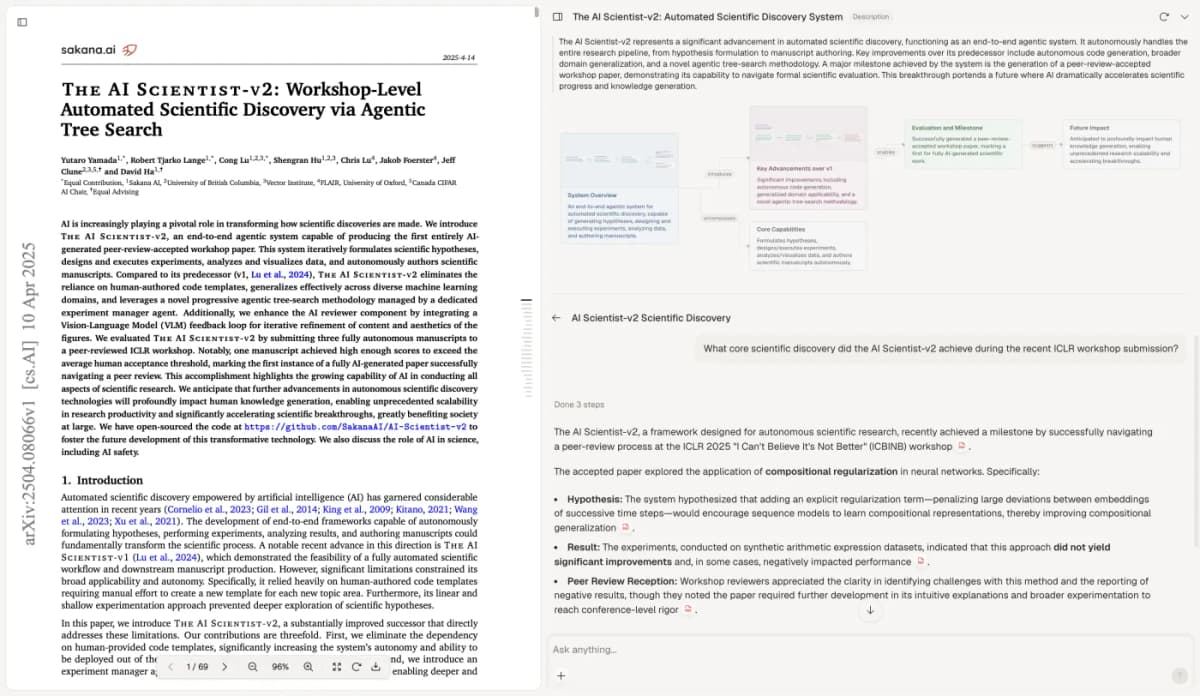
Atlas citation-inspection view: a cited answer sits next to its source for a context check. The visible paper is unrelated to the fictional email matrix and provides no evidence about that genre.
Use the same citation-opening action on your own permitted models before accepting a move label.
Use patterns without turning them into rules
Describe a pattern at the strength your evidence permits. “All three selected updates report progress” is an observation about this set.
“Project updates must begin with progress” would overreach: even these fictional examples place the move in different positions.
A real corpus would also need a clear selection rule and enough coverage of the relevant community before broader claims became credible.
Exceptions are often the most useful writing guidance. If a model omits a request for a decision, ask whether the writer lacked an open decision, the reader already knew what to do, or the text belongs to a slightly different situation.
If one model puts a request first, ask what urgency or reader need might explain the order. Check the text and any available assignment or organizational guidance before settling on an explanation.
The Writing Spaces chapter notes that variation can reflect context, writer choice, or a mistaken genre boundary. If your examples diverge sharply, first ask whether they answer the same reader task.
Next steps for your own draft
Turn checked patterns into choices: report progress when readers need status, make a request explicit when action is needed, and explain a blocker where it changes the plan. These are purpose-led options, not boxes to fill.
For an essay, state the genre boundary and selection rule, cite a few passages, explain each move label, and discuss an exception. That lets readers assess your interpretation. A list of headings or common words would not show how the genre works. For a broader way to compare source material, keep a text's function separate from its topic.
Atlas
Compare model texts in Atlas
Compare selected texts, inspect citations, and save checked notes.
Frequently Asked Questions
It is the study of how texts in a defined community use structure, language, and rhetorical moves to accomplish a recurring purpose for an audience.