
Narrative Analysis: Trace a Story Before Comparing Cases
Learn narrative analysis through a worked case map. Follow sequence, turning points, narrator positioning, and source evidence without losing the story.
- Byline

Summary
Narrative analysis asks how a person makes meaning through a story, including its sequence, telling, and context.
Map one account as a whole before comparing it with another; keep passages and alternative readings attached.
Atlas can compare selected written accounts with citations to inspect, while the researcher interprets narrative form.
Narrative analysis studies how people make meaning through stories. The account itself matters: where the teller starts, what changes, and how it ends.
A list of topics can tell you that two people discussed a job change. It may miss that one framed the change as a rescue. The other may have felt a loss of control.
Imagine a fictional worker who tells a departure story. Her manager praised her work. A promised new role stalled. She took another job.
The stalled role looks like a turning point. Yet the worker may later say she planned to leave all along. Check the full account before you decide what changed her course. Keep the event order beside the source text so you can test both readings.

Atlas

Compare story sources in Atlas
Compare selected accounts, open citations, and keep a case note.
What narrative analysis studies
The unit of study is a story as told, not just a line about a topic. Ask what happened in the teller's version and why the story starts where it does. Ask how the teller presents people and their motives. Your study question guides which of those features matter. There is no one code list that fits every story.
Wong and Breheny's method guide treats stories as whole accounts told within social life. A story can say something about identity as well as events. Suppose a person says, “I was the only one who asked why.” The line describes an act and casts the teller as the one who questioned the group. Check the rest of the story before treating that role as stable.
The Rutgers methods chapter shows one way to trace the scene, the problem, the teller's view, and the ending. These parts help you ask how the story works. A short account may lack an ending. A teller may return to the same event twice.
The chapter's labels are prompts, not boxes each person must fill. Its worked story also shows why a close read matters before you compare cases.
Choose what to examine in a story
Start with your study question. To learn how people make sense of a life change, look at the events they choose and what those events mean to them.
To study a turning point, look at order and what the teller repeats. To study an account told to an interviewer, note the prompt, the audience, and the roles the teller gives people.
Content, order, and telling context
These angles are often called content, structure, and the context of telling. A practitioner guide explains each. The Rutgers chapter shows content and structure at work in a case.
The labels help you tell readers what you looked at. They do not settle the meaning. A study may use more than one angle.
In our fictional job story, a content reading asks what fair treatment means to the teller. A structural reading asks why praise comes first and the stalled role comes next.
A reading of the telling context asks whether the interviewer's prompt led to a story about unfairness. Each claim needs text from the account. The last also needs the interview prompt. If the question instead concerns recurring moves in documents written for an audience, genre analysis uses those documents as its unit. Here, keep the teller's sequence and interview context in view.
Narrative versus thematic work
Narrative and thematic work can overlap. What you keep in view differs. Thematic analysis may group lines about unfair jobs across people. A narrative reading follows how one teller made the job part of a start, a break, and an ending.
You can compare the accounts later. Keep enough of each story to retrace its path. The Delve guide calls this intact story a narrative block. Its own coding scheme is one option, not a rule for every study.
Keep each account intact before coding
Read the full account before you choose a part to study. Note who told it, to whom, and under what prompt. Then check the text around your chosen part. The story may start several questions before its apparent turn. It may end with a caveat you would miss in a short quote. Keep the teller's order in view, even if you also map the time order of the events.
The NCBI Bookshelf method steps ask for notes on how a speaker presents self and others. Make those notes before you compare cases. They help keep the story from becoming a bare event list.
The analyst shapes the material too. Their questions, follow-ups, transcript choices, and excerpts affect what readers see. Record those choices so someone else can follow how you built the case.
Mark where the story may start and end. What drew it out? Where does the teller shift from a broad view to one event? Where do they return to the present and say what it means now? This boundary is part of your method and the evidence you should report.
Some stories are spread through a long talk. Link the parts and note the questions between them. Do not join them as if they were one speech. The Delve account-boundary guide gives practical cues, while warning that real accounts may wander.
If pauses, laughter, voice, or gesture matter, the record must capture them. Text may show words and speaker turns but leave out the rest. Do not read an emotional pause into a mark a transcriber added. State what was recorded and how it became text. Match each claim to the cues you still have.
Map sequence, turning point, and narrator position
A short case map gives the researcher a way to keep an interpretation close to the account. It is a working note, not a prescribed framework or automatic coding result. For one selected story, record:
- Boundary and setting. Name the passage range, interview prompt, teller, and relevant context. Keep the full account available.
- Narrated sequence. Write the events in the order the teller presents them. Mark a separate event timeline only if the difference matters.
- Proposed turning point. Identify where the account changes direction, then record the passage that supports your choice and one passage that could challenge it.
- Positioning. Note how the teller describes themself and others: responsible, overlooked, newly capable, uncertain, or something else supported by their words.
- Interpretive memo. State what you think the story is doing, what alternative reading remains plausible, and what more you would need to check.
The map should point back to the source. A page, line range, time mark, or citation link lets you test your reading. A polished summary with no passage trail is hard to revisit.
When you compare cases, keep each map beside its full account. A shared label such as “turning point” may hide two very different stories. The Rutgers case example is a useful reminder to keep the teller's own sense of the event in view.
A worked case narrative and counterreading
The next two accounts are fictional teaching examples. They are not study data, Atlas outputs, or quotes from a paper. Labels such as A1 show where a real case note would point to a source.
Case A: a departure story
In Case A, Mira tells a story about leaving a research team. She starts with her leader praising a proposal (A1). She then waits for a new role that never comes (A2).
A colleague gets the role, and Mira takes another job (A3). Near the end, she says she had looked for work before that choice (A4). The order points to the colleague's role as a cause. A4 makes that reading less sure.
Mira casts herself as someone who tried to stay. She uses the praise to explain why she hoped for the role. Those are features of her story. They do not prove the role was promised or caused her move.
A first memo might say: The story uses a missed hope to explain a move Mira may have planned already. A second reading is that she planned the move first, then used the role choice to make it easier to explain. Both readings need a check against A1 through A4 and the rest of the talk.
To test the second reading, reopen A1 through A4. Check the prompts and any earlier mention of job search. If the record cannot settle the timing, keep that doubt in the memo.
The task is to explain how Mira's account works. It is not to turn her story into a proven record of the past. Wong and Breheny make the same broad point about stories and the wider social accounts people draw on when they tell them.
Case B: a stay story
In Case B, Leo starts with requests for a clear role (B1). He takes on work beyond it (B2). A new manager lets him define the role, and he stays (B3).
The manager's reply may be the turn. Leo casts himself as someone who kept asking and found a way to stay. Mira's story ends in exit. Both tellers want their work seen, but their paths are not the same. A case map keeps that difference in view before a theme joins them.
Compare cases without flattening their stories
Write a memo for each case before you put them side by side. A shared topic is only a start. In these made-up accounts, both people want their work seen.
Mira tells an exit story. Leo tells a stay story. That split matters more to this study question than the broad label “workplace recognition.”
| Fictional case | Story through-line | Provisional turn | Reading to test |
|---|---|---|---|
| Mira | Praise, delayed promise, colleague's appointment, departure | Appointment appears to make leaving explainable | Earlier job search may mean the decision preceded the event |
| Leo | Unclear role, extra work, manager response, decision to stay | New authority changes the role | Ask whether he describes a real change or a promise still untested |
Table 1: The two-row map keeps each account's order in view. A claim across cases could be: Both tellers use a manager's reply to explain a job choice. One leaves; the other stays.
That claim is much narrower than “recognition makes workers stay.” A claim about cause would need other data and a study built to test it. The NCBI method steps likewise move from case notes to a search for patterns before drawing a conclusion.
One person may tell of a sharp break. Another may describe slow change with no single turn. Do not force both into a neat “turning point” cell. Note where the second story resists the label.
In real work, check the source text and cases that do not fit. They may change your claim. For broader ways to sort qualitative findings, see the qualitative data analysis guide. Here, the aim is to keep story form as well as shared content.
Check passages and save a case note
Ask about selected accounts
Atlas can help check written accounts you have a right to use. Add them to a project. In chat, mention the files you want to compare. Ask one bounded question: “For each account, list the event order. Show a cited line for a likely turn and a cited line that may challenge it. Keep the cases apart.”
The interview analysis guide covers wider tool choice. This task is a source check for your own case reading.
Open the citations
Open the citations for each key claim. Check the right file and the lines around the cited text. Does the source support the order? Did the answer pass off your own memo as the teller's words? The source-checking guide explains why the nearby text matters. If a turn has no sound source, ask again with the right file named. You can also leave it as an open question. Atlas can compare several chosen sources and show citations. A cited line still needs your judgment.
Keep the checked note
Save a note for each case. Include its bounds, event order, source lines, another reading, and what you still doubt. Revise the note if a new talk or a fuller text changes the context. The research-note guide offers ways to keep checked findings easy to find later.
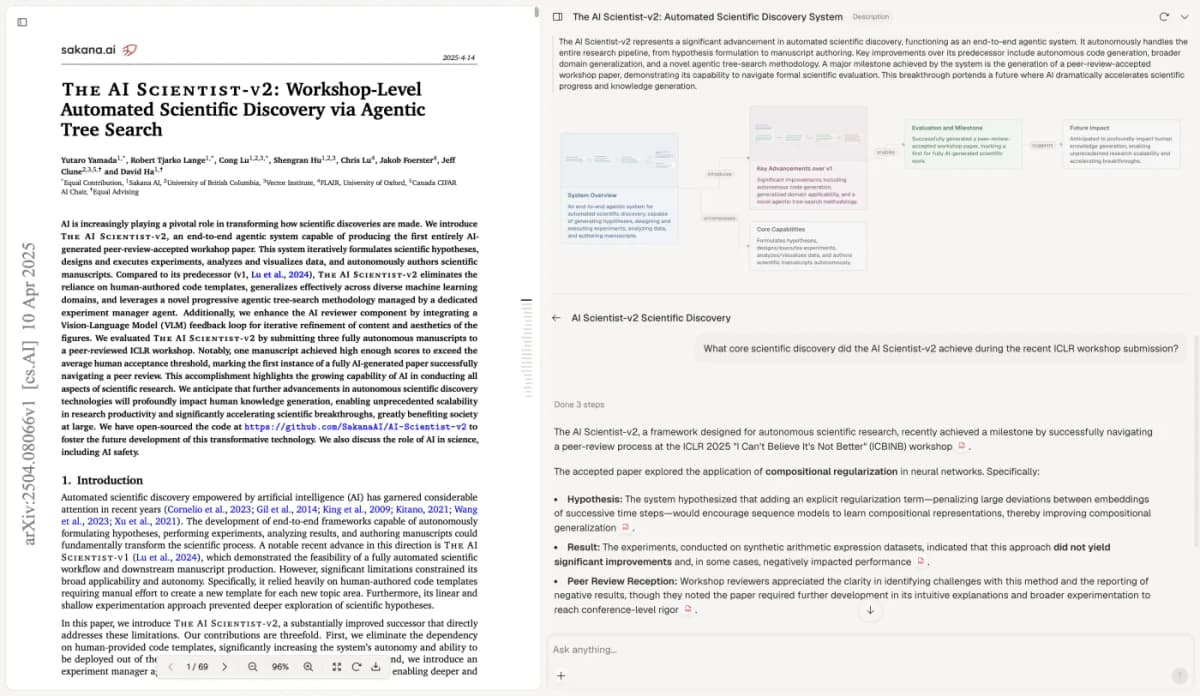
The image below shows Atlas with a source beside an answer. The visible paper has no link to Mira or Leo. The image shows the place to inspect cited material; it does not show Atlas doing narrative analysis.
Report interpretation and source limits
Narrative analysis gives a reasoned reading of stories. The text does not explain itself. State what you gathered and why you treated parts of it as stories.
Name the lens you used. Show how you moved from each case to a claim across cases. Give readers enough source text to follow the move, within the limits of your data use rights. The Rutgers chapter also stresses the analyst's role in the final story.
Stories are told in a setting. Ask for a turning point, and you may get a neat episode. Use another prompt, and the same person may tell a less settled tale.
A life story written for readers has yet another audience. Wong and Breheny describe personal, social, and person-to-person layers of a story. Use those layers to ask how the setting influenced what was said. Do not treat the account as a clear window onto past events.
A map with source links helps you return to the story when your reading changes. It does not prove that one turn is the only valid one. Nor does it show that every teller used the same form.
Say when words, sound cues, or context are missing. If another case challenges your pattern, show the challenge. The Delve guide also warns against cutting accounts into small pieces that erase their order. Keeping the hard case visible is part of the finding.
Atlas
Compare story sources in Atlas
Compare selected accounts, open citations, and keep a case note.
Frequently Asked Questions
It is a family of approaches for interpreting stories as accounts, including what happened, how the teller orders and presents events, and the context in which the story was told.