

AI interview analysis covers two jobs. Hiring tools help recruiters review job interviews. Research tools find themes and quotes in talks with users or customers.
For hiring, use a tool built for that job. Check its legal, bias, data, and test rules before its scores affect a person. This guide uses Crosschq as an example. Coaching a person before an interview is a third and separate job.
For research, use Atlas when you already have transcripts or notes. It can find themes, gaps, and conflicts across them, then link each claim to the source text. Use a coding tool for formal study work, a UX library for recordings and clips, or a simple prompt for a low-risk first pass.
The risks differ for a researcher studying customer calls and a recruiter judging people. Atlas serves the research job. It can compare and check transcript sources. It does not record calls, make transcripts, score job candidates, or replace the researcher's judgment.

Build interview themes with cited evidence
Add transcripts, compare interview themes, and verify each cited passage.
Research and hiring are different jobs
Hiring tools can affect who gets a job. Use a written review method, keep a person in charge, and check for bias, data risks, and laws that apply. A vendor score should never make the choice by itself. Research interviews need a different result: themes, quotes, open questions, conflicts between people, and source text that the researcher can read.
Guides from Looppanel, Insight7, Age of Product, and Brass Transcripts cover this research job. They focus on transcript text, patterns, and checks by a person. For hiring, Crosschq discusses scores and predictions about job candidates. Harvard's career guide covers how candidates can prepare for interviews and offers.
These are different jobs. If a tool will affect hiring or rank candidates, use a hiring process built for that purpose. Check its legal, ethical, and test basis before you rely on it.
AI interview analysis criteria
Start with what you have. If you still need to record the call or turn speech into text, choose a tool for that step first. If you already have transcripts or notes, decide whether each finding must link back to text you can read.
Then choose by work style:
- Use Atlas when you need to compare several interviews and link each theme to the source text.
- Use a qualitative research suite when your team needs formal coding, memos, and a full study project.
- Use a UX research repository when recordings, clips, tags, interview libraries, and stakeholder sharing are central.
- Use a prompt when there are few sources, the risk is low, and a researcher can check each theme against the transcript.
- Use hiring tools only to review job candidates. Use a research tool for UX studies and other interviews.
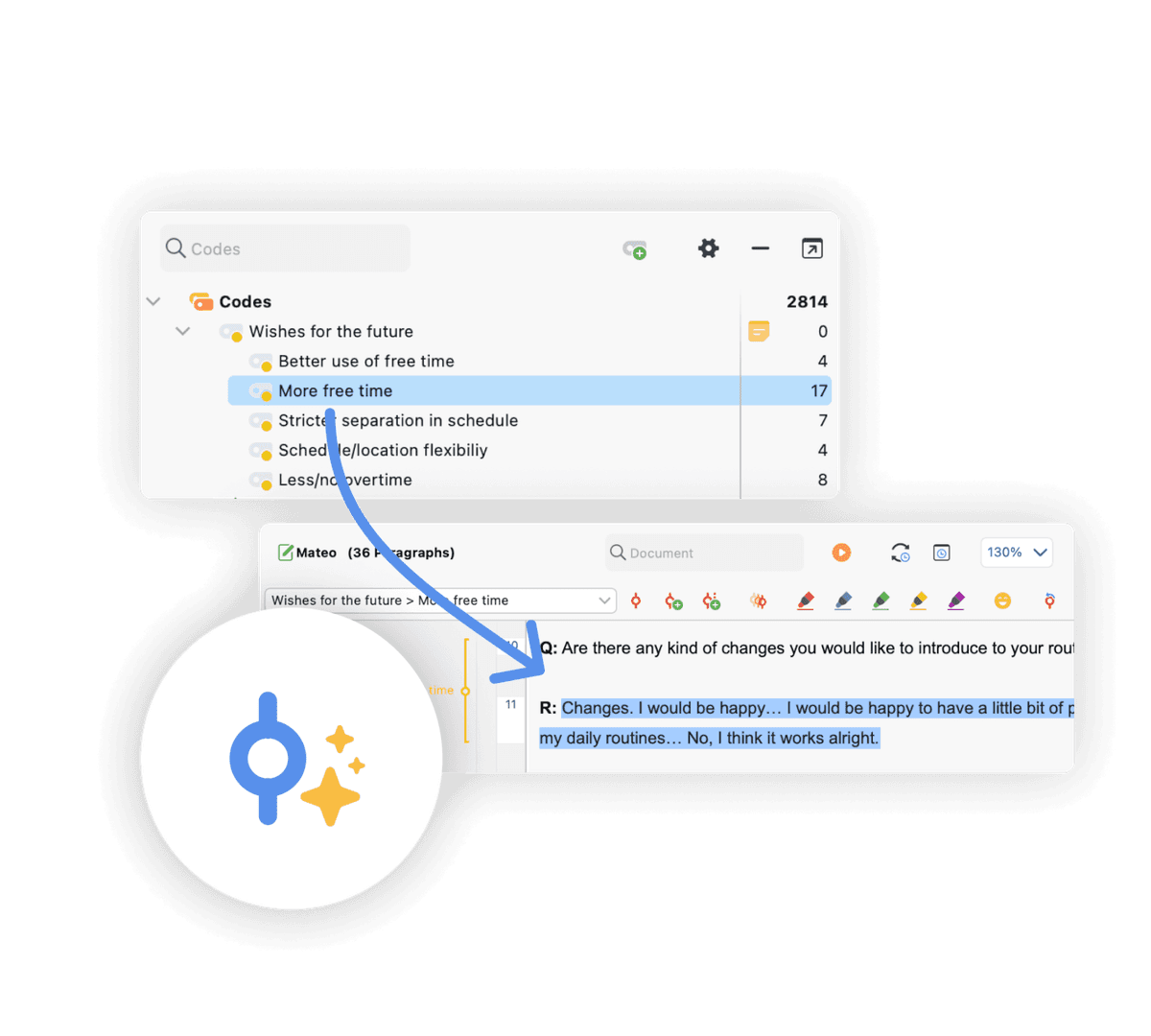
MAXQDA's official interface makes the formal-study lane concrete: a named code remains connected to highlighted interview text. That trace is useful when a research team must review how a theme was assigned, while a hiring score requires a separate governed process.
AI interview analysis tools compared
Use this table to match the tool to your next step: recording, formal coding, a UX library, sourced themes, or hiring review.
| Option | Best fit | Interview input | Analysis output | Evidence path | |---|---|---|---| | Atlas | Cited synthesis after transcripts exist | PDFs, text notes, websites, YouTube sources, or other uploaded sources | Themes, gaps, conflicts, and source-separated tables | Open citations and inspect source passages | | Looppanel | UX and product research workflows | Recordings, transcripts, tags, clips, and repository material | Interview analysis, clips, notes, and insights | Trace findings back to transcript or clip evidence | | Insight7 | Customer and interview transcript analysis | Interview transcripts or customer research material | Themes, summaries, insights, and evidence-oriented outputs | Check each insight against the transcript text | | Brass Transcripts | Prompt-based thematic analysis reference | Existing transcript text | Prompt-generated themes and thematic summaries | Manually verify every theme against transcript passages | | Age of Product workflow | Product-discovery prompt workflow | Customer or user interview material | Themes, sentiment, recommendations, and follow-up ideas | Treat as practitioner workflow, then validate manually | | Crosschq | Hiring-interview intelligence | Hiring interview material | Candidate and talent-decision analysis | Keep separate from research synthesis and validate hiring claims |
Use the table to choose the right kind of tool first. Recording a call, finding themes, coding a study, and reviewing a job candidate each require different checks. A tool that names themes still needs a researcher to test them against the transcript.
Atlas interview comparison workflow
Atlas fits after the interview text exists. Add transcripts, PDFs with transcripts, notes, web pages, or YouTube sources to a project.
Then ask a narrow question.
Across these five customer interviews, what themes explain why users abandoned setup, and what source passages support each theme?
Ask for a table with one source per row. Include the theme, transcript quote, nearby context, any conflict or gap, source link, and your check notes.
Treat the first answer as a draft. Keep each key claim tied to its source text.
Atlas can compare many sources and build tables that keep them apart. Source badges link its answers back to PDFs, web pages, YouTube sources, papers, notes, and other files it supports. Open a badge, read the nearby text, and decide whether the theme is strong enough to keep.
Reject a row when its quote barely relates to the theme or one interview is being treated as proof of a broad pattern.
Also reject rows that hide a conflict or make a cautious comment sound certain. Save only the rows that still hold up after you read the source.
Best AI interview analysis tools
Atlas
Atlas is best for comparing interview transcripts you already have. It can build a theme table, link claims to source text, and keep a trail from each finding to the passage behind it.
It does not record calls, make transcripts, score job candidates, or prove that a theme is sound.
Looppanel
Looppanel is built for UX research. Its guide covers transcripts, tags, clips, and findings from user interviews.
Choose it when a team needs one library for interviews and clips. Check that each AI finding links back to the transcript or clip.
Insight7
Insight7 focuses on customer interview transcripts. Its guide shows how AI can find themes, sum up patterns, and turn transcript text into findings.
It fits teams that want a set process for customer interviews and can have a person check the text behind each finding.
Brass Transcripts
Brass Transcripts offers a prompt guide for finding themes in transcript text.
Use that approach when there are few sources and the team can check every theme by hand.
Age of Product workflow
Age of Product gives teams a prompt-based way to find themes, views, advice, and next steps in user interviews.
Use it to shape a first pass. Read the source text before you put a finding in a roadmap, report, or team decision.
Crosschq
Crosschq serves the hiring side of this search. Its page discusses AI scores and predictions about job candidates.
Hiring scores and candidate ranks need a hiring review process. UX and customer interviews need a research process that links themes back to source text.
AI interview verification checks
Check each AI finding before you use it:
- Does the cited passage directly support the theme, or is the AI extrapolating?
- Does nearby transcript context weaken or qualify the claim?
- Do multiple interviews support the theme, or is it one participant's isolated statement?
- Are disagreements, edge cases, and missing segments visible?
- Is the output preserving participant context, role, source, or timestamp when available?
- Is the language overstating what the interview data can prove?
- Would you be comfortable showing the source passage beside the finding in a research readout?
Source links make this check faster. They do not prove the answer is right.
If the research question depends on a person's whole account, narrative analysis helps preserve sequence, turning points, and telling context before comparing across interviews.
The researcher still chooses the sample and codes, explains the results, and decides whether a theme is strong enough to use.
Choose an interview analysis tool
Match the tool to the part of the work you still need to do:
- Choose Atlas when the transcripts exist and you need themes, gaps, source text, and check notes across them.
- Choose a full research tool when the study needs formal coding and project structure.
- Choose Looppanel or Insight7 for a set UX or customer research process.
- Use a prompt for a light first pass that you can check by hand.
- Use hiring software only for job interviews.
Do not trust a theme until you can show the transcript text that backs it up. Keep the finding, source, nearby context, conflicts, and review notes together.
For other source checks, compare tools for organizing legal files, working with articles, and reading papers with AI.
Build interview themes with cited evidence
Add transcripts, compare interview themes, and verify each cited passage.