

A research paper appendix holds useful detail that would get in the way of the main text. It may contain a full interview guide, a long table, or extra steps. Keep enough methods and results in the paper for readers to judge its claims.
Link each item to a purpose in the paper. Then check the file, version, callout, and rules for sharing it. Neat labels alone do not make a folder of unused files helpful to readers.

Check the support behind your appendix
Match main-text claims with supporting files and unresolved checks.
Decide what belongs in an appendix
Keep the core claim and the evidence needed to understand it in the main text. Extra detail can go at the end if it helps readers inspect the work. Scribbr's guide separates the core argument from useful support.
A full interview guide may support the methods section. A long table may add detail to a shorter main result. Do not move a result that changes the conclusion to the back just to save space. UCSD's paper guide keeps methods, results and discussion in the main paper.
A journal may ask for extra files outside the main document rather than a section at the back. These are often called supplements. Check the instructions before choosing where each item goes. Use the format your venue requests.
Label and refer to each appendix
Make the callout useful
A callout tells readers where to find the supporting material. Write it where the material matters: “The full interview guide appears in Appendix A.” That is more useful than an unexplained list at the end. Tell readers what the item helps them check.
Purdue OWL's style guide explains labels, titles and text callouts for APA papers. It is one style example. Your course, editor or journal may ask for a different format.
Keep names and order consistent
Use one clear title for each item and keep its label consistent in the main text and final file. Under common APA guidance, one item is labeled “Appendix”; multiple items use letters. Check the rules before applying table and figure numbering within them.
Portsmouth's library guide says to follow your department's rules first. Your course brief may ask for a different layout. Record which rules you used, and avoid mixing styles.
Worked appendix index for a study
Suppose a fictional paper describes how students choose study spaces. Its author has a draft paper, an interview guide, a code list, and extra tables. This is a made-up planning example. It contains no real study data or findings.
Use the index to show why each file belongs and what remains to be checked before it joins the final manuscript.
| Main-text purpose | Proposed item | File or version check | Decision to resolve |
|---|---|---|---|
| Explain questions asked in interviews | Appendix A, full guide | Compare final guide with the methods description | Confirm it is the version used, not a later draft |
| Explain how themes were defined | Appendix B, code list | Match terms to the main analysis | Keep key definitions in the paper too |
| Provide extra detail behind a main table | Appendix C, supporting tables | Check values and labels against final results | Do not move a conclusion-changing result out of view |
| Document changes after pilot interviews | Proposed Appendix D, pilot guide | File not supplied | Keep the entry unresolved; do not invent the missing guide |
Table 1: The index is fictional and connects each supporting item to a main-text purpose and a human check.
Repair a missing-file claim
A draft note might say, “Appendix D confirms the pilot questions.” But the pilot file is missing, so the claim has no support you can check. Change it to “Check the pilot questions against the original guide.” Ask the author to find the file before marking the entry ready.
Do not write the guide from memory and call it the original. If no one can find the file, the author must decide how to report the gap. A source-analysis workflow can help separate the paper's claim from the files you have.
Review proposed transcript material
Suppose the author wants to attach a full transcript so readers can check the work. It may not be ready to share. Review consent, clues to people's names, and details about others. Does the whole record need to be public? The paper still needs to explain how interviews were analyzed, even if you cannot share the transcripts.
An interview analysis workflow can help you review excerpts and their source. It does not grant rights to process or share them. Settle access and sharing first.
Check privacy and reuse rights
Share only permitted material
Removing names may not hide who a record is about. Places, roles and dates can still reveal people when read together. Check consent and your institution's rules before sharing files. Keep signed consent forms out of the public package because they can reveal names.
Purdue's guide flags privacy and copyright concerns. Check them even when a file is useful to the reader. Usefulness does not mean you can share it.
Check the source and the version
You may need permission to reproduce a published questionnaire or scale. A citation is not the same as permission. Even a file you wrote may include content from another source. Check those rights before adding it.
Record the final file name and date so you can find changes that break a callout. Purdue Global's writing guide describes these files as support for the paper. Make that link clear in the index. You do not need to include every unused draft.
Compare the files in Atlas
- Add the manuscript, available supporting files, and submission instructions to one project. Use only material you have permission to process. Do not treat a file named in the manuscript as present until you have it.
- In Ask a question, use @ to select those sources. Ask: “Match main-text claims and callouts to supporting files. Give each item its purpose, file version, cited passage and unresolved check. Mark missing material; do not fill it in.”
- Open the citations for each proposed match. Check that the cited guide, table, or passage supports the stated purpose. Ask a follow-up if a match relies only on a similar file name.
- Correct the pilot-guide entry and any version mismatch. A multi-source synthesis method helps you keep each document’s contribution clear rather than treating all drafts as one source.
- Select New → Note and save the checked index with open questions and owners. Wait for Saved. This is a working note; the author still approves the actual files, sharing rights and submission layout.
The capture shows a document beside a cited answer. Compare the two when checking whether a claim has support. The visible AI research paper is unrelated to this fictional manuscript and is not an appendix example or a test of the prompt.
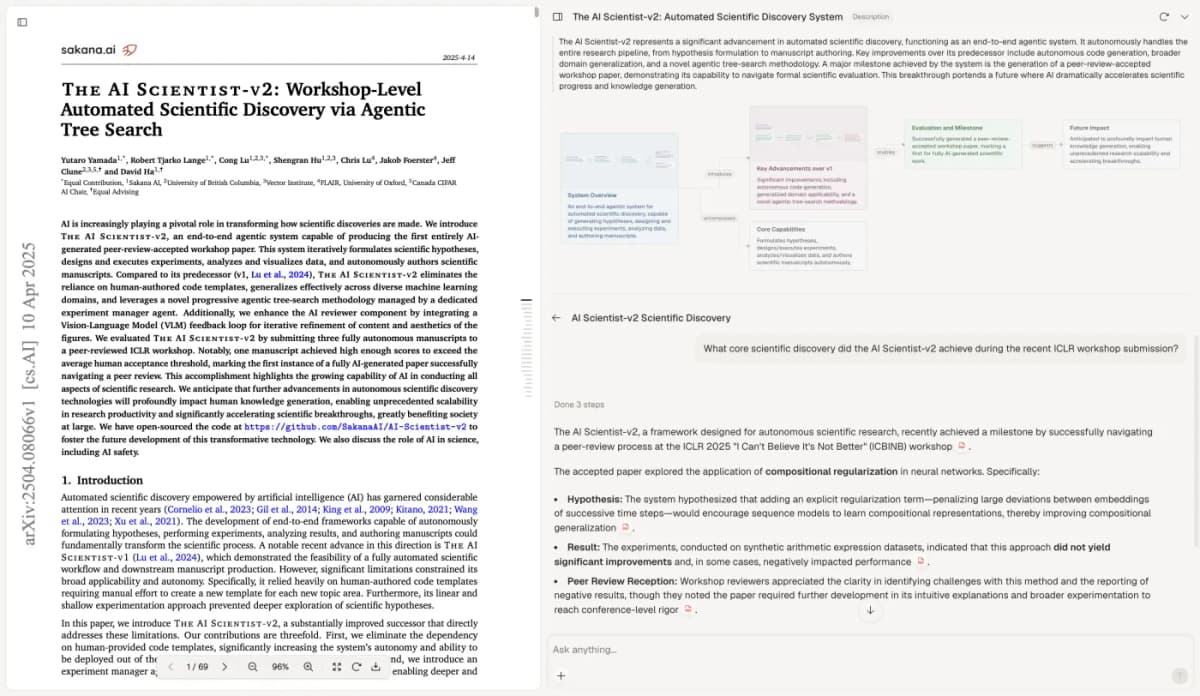
Use the source text to check each match before adding it to the index.
The visible paper is The AI Scientist-v2, by Yutaro Yamada and colleagues, under CC BY 4.0. Part of its first page appears in this unchanged Atlas capture.
Review the final submission package
Open the final paper and each file. Follow every callout and check labels and versions. Make sure the text does not claim a missing file is present. Read the core argument without the back matter. Does it still make sense, or did a key explanation move out of sight?
Then check the package against the actual rules. Scribbr's examples and Portsmouth's local rules are aids. They do not guarantee acceptance. Record who will resolve each open issue before you submit.
Check the support behind your appendix
Match main-text claims with supporting files and unresolved checks.