

The results section of a research paper reports what the study found through its data and analysis. Organize it around the questions or outcomes the work set out to examine.
Give readers enough evidence to follow each finding, using prose, tables, figures, or source excerpts as the method requires.
Start with checked outputs, then write the claims those outputs support. The worked example below corrects a sentence that uses the wrong group behind a percentage. It shows how a short source checklist can catch an overclaim before it becomes part of the manuscript.

Trace your results claims to their sources
Compare supplied findings, open citations, and save a checked results note.
Report what the study found
ICMJE's manuscript guidance asks authors to present findings in a logical order and report the primary and secondary outcomes named in Methods.
The main observations deserve clear prose; the text should not recite every value already shown in a display. This guidance is for medical journals, so also check your own field's rules.
The SJSU results handout ties findings to the research questions and shows how text and visuals work together. A reader should know which question a finding addresses and where its evidence sits. The order of files on your computer is rarely a useful order for that reader.
Check the journal or department instructions before choosing headings or length. Some formats combine Results and Discussion; others keep them apart. Qualitative findings may include meanings reached through analysis. Keep that analytic account grounded in the data, and distinguish it from broader claims about causes, prior literature, or what people should do next.
Gather the verified inputs before drafting
Use the final outputs and their labels
Gather the result tables, figure files, analysis notes, and source records your team has checked. Keep their version or date in the working note. If two tables show different counts, find out why before choosing the one that makes the paragraph read more smoothly.
For each result, record the question, the people or records included, the measure, the relevant output, and any missing data. The APA quantitative reporting table requests participant flow and missing-data details.
Those details affect which group a finding describes. They belong in the reporting plan, not only in a last-minute footnote.
Map questions to the findings you have
Place each planned question beside its checked result. Mark secondary or exploratory work as such where the design and reporting rules require it. ICMJE's statistics guidance distinguishes planned and exploratory analyses. Keep that distinction visible when deciding which finding leads the section.
If an outcome lacks an expected pattern, retain the finding and its evidence. If an analysis was not completed, do not fill the gap with a plausible sentence. Record what is missing and resolve it with the team.
A writing outline can organize available findings, but it cannot turn an unfinished analysis into a result.
Retain source locations for qualitative findings
For qualitative work, gather the supported themes, categories, or accounts and the data excerpts behind them. Keep the context needed to understand each excerpt, using the identifiers and privacy rules of the actual project. The APA qualitative reporting table asks authors to show how findings were reached and grounded in evidence.
A single vivid quote is not the full analysis. Check how the finding fits the wider source set and which cases complicate it.
Retain those decisions in your records, so the final text can explain the finding without treating a memorable line as proof of everyone's experience.
Trace a worked paragraph to its evidence
This student library-hours survey is invented to teach reporting. No survey took place, no students were recruited, and these findings describe no real campus. The teaching record says that 30 students submitted the survey. Twenty-four answered the item asking whether evening opening hours fit their study needs. Of those 24, 18 chose the favorable response. Six left that item blank. The record includes no before/after comparison and no significance test.
Check the group behind the percentage
An early sentence says: “Seventy-five percent of all students found the new hours effective, showing a significant improvement.” The record cannot support these claims. “All students” goes beyond those who answered, “effective” changes what the question asked, and “improvement” needs a before-and-after check.
Use the checklist to tie the wording back to the evidence. The rows are a working review aid, not a statistical results table or a substitute for the analysis files required by a real study.
| Claim to check | Fictional source record | Reporting decision |
|---|---|---|
| Group covered by the hours item | Survey summary, item H1: 24 answers from 30 respondents | Say “respondents who answered the hours item”; retain the six blanks |
| Finding for that group | Checked teaching note H1: 18 of 24 favorable answers, recorded as 75% | Report the count and percentage with the right denominator and item wording |
| Claim of significant improvement | No comparison period or inferential output in the teaching record | Remove the claim; report the available description without inventing a test |
Table 1: Each reporting decision follows the available fictional source record. ICMJE's numeric reporting advice asks for counts alongside values such as percentages. A denominator is the group used to form a percentage. Here the group is the 24 who answered the item. The other six students left it blank. The finding cannot describe all students.
Revise the paragraph without adding findings
A revised fictional paragraph could read:
Thirty students submitted the survey. Twenty-four answered the item about whether evening library hours fit their study needs; six left it blank. Of the 24 who answered, 18 (75%) selected the favorable response.
The paragraph gives the total, the item count, the blanks, and the finding for those who answered. It does not claim a change in learning or library use. The item asked for a view about hours; it did not track those other outcomes.
In a real paper, refer to the actual numbered table or figure that holds the detail. Scribbr's display guidance reinforces the link between prose and displays. Do not insert “Table 1” merely to make a draft look complete if the manuscript has no corresponding table.
Keep the outcome label precise
The question asked how hours fit study needs. It did not measure grades, visit counts, or whether hours caused a change. Use words that match what the study measured. If a label is unclear, return to the survey form and Methods before changing the claim.
APA's quantitative standards connect measures, analysis, and reported results. Here, “favorable response to the hours item” keeps the finding tied to the question. To call it a “success,” you would need to define success and show how the study measured it.
Match the reporting to the evidence type
Numbers need their counts and uncertainty
For quantitative work, report the statistics that your actual analysis and journal require. Keep sample sizes and units clear. If you report an estimate, include the relevant measure of uncertainty where appropriate. Copy values from the checked output and have the researcher or analyst verify them.
ICMJE's statistical reporting guidance warns against relying on p-values alone and asks for meaningful information about estimates and precision. The fictional survey above has descriptive counts only.
It supplies no test, confidence interval, or evidence of a change. Do not add those details through a writing prompt.
Qualitative findings explain the supported meaning
Qualitative results often present themes, groups of ideas, or accounts built from close study of the data. JARS–Qual's findings guidance includes the meanings researchers drew from the data. A blanket rule to “never interpret anything in Results” would leave out part of that work.
Explain the finding and support it with source excerpts. The same guidance says quotes should add to the account of findings rather than replace it.
Past studies and the wider meaning of a finding still need their own place under the chosen method and journal format. A page of quotes alone leaves readers to work out what the study found.
Use the results versus discussion guide to place findings, explanations, and comparisons with prior work under your chosen format.
For a longer degree project, use your dissertation introduction to check which question the chapters promise to answer. The Results section should report findings for that question; revise the opening if the final study changed.
Let displays carry the detail
Use a table when readers need to look up precise related values. Use a figure when the shape of a pattern helps answer the question. The prose should point out the finding and refer to the display, with enough context to understand it.
Check titles, units, labels, notes, and sample sizes in both places.
Editage's results guide offers practical display examples, while ICMJE's display guidance asks authors to avoid repeating the same data in text, tables, and graphs. Choose the form that helps readers inspect the finding rather than adding a chart simply because a section looks sparse.
Correct claims the outputs do not support
Use statistical terms only when justified
“Significant” has a technical meaning in statistical reporting. A large-looking count or favorable response does not establish it. In the fictional example, the source record includes no inferential test. Remove “significant improvement” instead of guessing a test result or asking a model to infer one.
ICMJE cautions against loose statistical language. Check every such word against the real analysis and its design. If the analyst has not verified the wording, leave that item open in the working checklist.
The manuscript should not turn a pending check into a settled claim.
Keep causal claims within the design
The survey can report views about opening hours. It cannot show that the hours raised grades, nor can it establish why a student gave a particular answer. Even a correct percentage does not supply that missing link. Correct the wording before comparing the finding with past research.
Use the research synthesis workflow when you later compare findings across studies. Keep their measures and designs distinct. Evidence from a different paper does not change what your own survey measured, and it cannot supply a missing result for your manuscript.
Report outcomes beyond the favorable story
Check the section against the planned outcomes and final outputs. Include findings that do not fit the pattern you expected. The APA quantitative table's analysis guidance distinguishes primary, secondary, and exploratory work. Keep those labels when the findings are harder to explain than the headline you hoped for.
For qualitative findings, check accounts that challenge a theme as your method requires. JARS–Qual's evidence guidance addresses data that conflict with or challenge a finding. Explain how those cases affect the account. Do not choose only quotes that make all views sound alike.
Check supplied result text in Atlas
Atlas can help compare a draft with the verified text notes you supply. Use material the project permits you to add. The study team must check the analysis files, values, and final paper. Atlas helps you read and compare supplied sources; it cannot verify a test or certify the results.
-
Add the verified result notes, relevant Methods text, and results draft to one project. Confirm that the sources have finished processing.
-
Start a chat and use @ to select the exact notes and draft.
-
Ask: “Compare each result claim with these checked notes. Give supporting citations. Flag changed outcome labels, unclear groups behind percentages, and claims of change or significance without a supplied output. Do not calculate new results or fill missing values.”
-
Open the numbered citation for each claim. Read the source and nearby text, then check the relevant output directly. A citation alone does not verify the arithmetic, test choice, or full report.
-
Correct the wording. If the answer calls the fictional H1 count a significant improvement, retain the descriptive count and note that the supplied record has no comparison or test.
-
Choose New, then Note. Save the checked claim list, source locations, corrections, and outstanding numeric checks. Wait for Saved before closing.
The real capture below shows a paper beside a cited Atlas answer. Its ColPali paper is unrelated to the fictional survey. The image shows where to inspect source support; it does not depict a live results audit or a numeric-accuracy test.
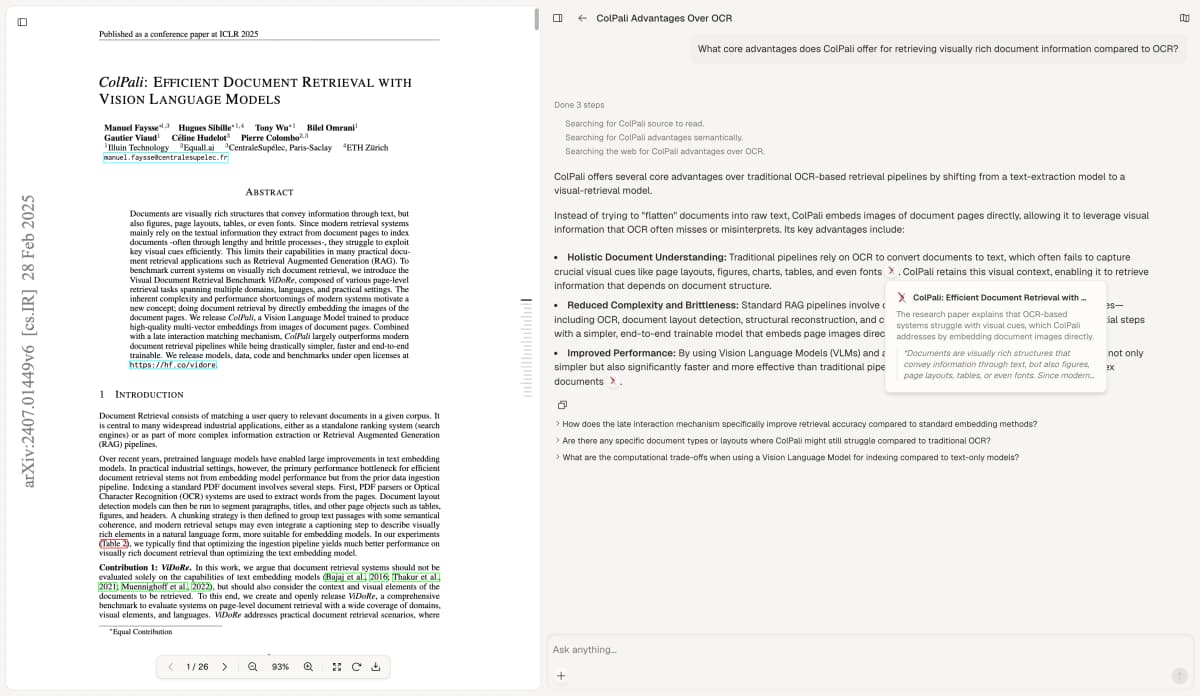
Read the passage and nearby text before retaining a claim in the results note.
The visible paper is ColPali by Manuel Faysse and colleagues, 2025, released under CC0 1.0. The screenshot retains its original pixels through lossless WebP encoding.
If a citation opens the wrong item or an unhelpful place, name the source you mean and ask again. If it cannot open, find the item directly. The AI citation checker workflow explains this check between wording and source. Keep unsupported claims out of the checked list.
Review the final section against its sources
Reconcile prose, displays, and Methods
Read each result with its actual output open. Check the group, measure, units, timepoint, and source version. Confirm that the table number in the sentence matches the display and that the display's note explains any changed count. Use the SJSU question-to-finding guidance to keep the section's purpose in view while making those checks.
Retain the decisions about missing responses and incomplete work in the team note. If a source changes after review, check the dependent wording again. A saved draft from last week may no longer match the final output.
Resolve open checks before manuscript handoff
Have the researcher or analyst check each number and each claim drawn from the data. Follow the journal's reporting checklist and format, including rules for combined sections. The claim-to-source note shows which checks remain open. The team still needs to resolve them before sharing the paper.
When you later compare past studies, return to the literature review process. Keep their findings distinct from your own outputs. Results can then give readers a clear account of what you found. The paper's wider argument can build on that account without blurring where each claim came from.
Trace your results claims to their sources
Compare supplied findings, open citations, and save a checked results note.