
A research paper outline orders the paper's sections, main points and supporting evidence before you draft. It helps you see what the reader needs to know first, where each source fits and which claims still need work.
Headings give the paper a shape. Claims and source locations give you something to write from. Keep an open check beside a point whose support is incomplete so it does not become a confident sentence by accident.
Atlas can help you compare selected sources and inspect passages behind proposed outline points. You choose the paper's argument and required format, then check the source support before saving the plan.

Connect your outline to its sources
Check the passages behind your planned claims before drafting the paper.
What the outline needs to show
The outline should show how the paper will answer its question. Purdue's outlining guide connects purpose, audience and thesis to grouping and ordering ideas. Start with those decisions before choosing Roman numerals or a heading style.
For each main section, retain three things: the point it needs to establish, the evidence you expect to use and the next unresolved check. A bare label such as Background cannot tell you whether the section will define a term, explain a debate or establish a specific gap.
An original working skeleton might include:
- Opening: the question, enough context to understand it and the paper's proposed answer or aim.
- Main sections: one step in the argument or required reporting task per section.
- Support: source names, page or section locations and reasons the passages matter.
- Limits: contrary evidence, missing support and boundaries on the claim.
- Ending: what the paper can conclude after those steps.
The City Tech outline assignment is one example of linking a question, arguments and sources. Its specific length and grading rules belong to that course. Use your own task instructions to decide how much detail to submit.
Choose the paper and outline format
First decide what kind of paper you are writing. A scientific report may require introduction, methods, results and discussion sections. An argumentative course paper may organize its body around reasons, themes or competing explanations. A review may need a structure that follows its review question and method.
Paperpile's outline guide gives examples of how main topics vary by field and asks readers to follow their institution's rules. A template can help you begin, but it cannot decide what your paper needs to establish.
Distinguish section roles from numbering
An alphanumeric outline uses Roman numerals, letters and numbers for levels. A decimal outline uses labels such as 1, 1.1 and 1.2. A sentence outline states each point as a full sentence. Scribbr's format guide explains these choices and their hierarchy.
Choose full sentences when you need a reader or coauthor to assess the argument. Short topic labels may suit an early private plan. You can keep a source-and-gap note under either form without turning the outline into a finished draft.
If an instructor asks for an APA outline, read the supplied instructions for the actual format. Do not infer a universal outline from the citation style alone. The practitioner format examples are options to adapt to the task, rather than one rule for every assignment.
Give each section a reader job
The figure excerpt below connects section roles to paragraph roles. Its abstract row includes the question, approach, findings and meaning. Its introduction moves from the broad problem to a narrower gap, then introduces the paper's approach.
The key uses blue for context, black for content and red for conclusion. Those labels explain the logic even when color is unavailable.
For the separate task of condensing the completed paper, the research paper abstract guide helps check the question, work, finding and conclusion against the final manuscript. An outline plans those claims; the abstract reports what the paper actually supports.
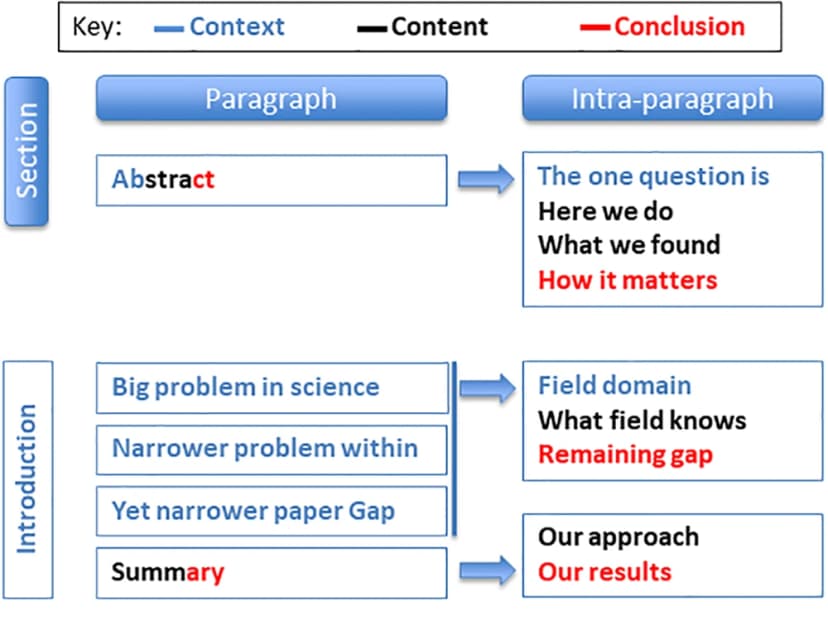
Excerpt from the corrected Figure 1 for Brett Mensh and Konrad Kording's paper. Correction © 2017 PLOS Computational Biology Staff, reproduced under CC BY 4.0. Cropped to the abstract and introduction rows and resized; wording and colors are unchanged.
Use the figure to ask what each planned paragraph contributes. It does not include every reporting requirement, and your required methods section still needs a place in the outline.
The authors' structuring-paper guidance concerns scientific manuscripts. Adapt the reader questions to your genre without forcing its section pattern onto an unrelated paper.
Turn topics into supported claims
Start by writing one sentence that describes the point of each planned section. Campus access is a topic. The supplied commuter accounts describe difficulty using evening services is a candidate claim with a named group and source scope.
The Regent writing handout links a section claim to reasons and research evidence. Its illustrative study numbers are not evidence for your paper. Bring your own reviewed sources to the claim you plan to make.
Attach a location and its meaning
Keep the source name and a page, heading, table or other locator beside the claim. Also say what the passage supports. A citation to a whole paper may be too broad to explain why it belongs under this point.
In the City Tech example, sources can sit beside individual subdivisions. Use that idea to retain the connection while you move outline points around.
If a point moves from background to a claim about effects, reopen the passage: it may not support the stronger use.
Put more than one source under a claim when they make distinct contributions. One may define the concept, another report an observation and a third offer a competing account. Our guide to synthesizing research papers explains how to compare those contributions without writing a separate summary of every source.
Keep a gap beside the point
Write what is still missing. You may need a definition, a source about another setting or a closer reading of a result. An empty cell should remain empty until the work is done.
Grammarly's planning workflow places source gathering and revision around the outline. Reading can change the planned claim. If a source supports only one group, narrowing the sentence is better than leaving the broader wording and hoping later research will fill it.
Build a source-linked outline example
This fictional teaching paper asks how the supplied records describe students' use of evening campus services. The invented files and excerpts below let you practice outline decisions. Any findings about a real campus would require actual research records.
The teaching packet contains four files. A question note and service report sit alongside two interview excerpts. Use the table to keep the section's job beside the source support and the check still needed.
| Planned section | Candidate point | Source locator | Open check |
|---|---|---|---|
| Introduction | The paper examines evening access | Question note, aim | Define access for this task |
| Service context | The report lists evening opening hours | Service report, schedule | Distinguish hours from use |
| Accounts of use | Two commuter excerpts describe timing conflicts | Excerpts C1 and C2 | Do not infer all students |
| Discussion | The records show questions for wider study | Compared source notes | Review missing groups |
Table 1: These rows plan what the paper can discuss while keeping unsupported steps visible.
Narrow a claim before placing it
Suppose the first outline says that all students struggle with evening access. The supplied interview excerpts concern two commuters, while the service report lists hours. Neither source establishes that all students share the experience.
Replace the point with a statement about what the two excerpts describe. Keep the broader population question open. The change affects both the section heading and the ending: a conclusion about every student no longer follows from this packet.
The Regent handout's claim-to-evidence relationship helps explain why the wording must fit its support. A source locator does not rescue a claim that the located passage cannot establish.
Expand one row into paragraph points
Under the accounts section, plan a paragraph about C1's timing conflict and another about the comparison with C2. Put a note under each showing where the account came from and what the writer still needs to examine.
Avoid inventing a third supporting point to make the outline look balanced. Scribbr's hierarchy guidance concerns how points relate. It does not supply missing evidence. If you cannot support the proposed structure, revise the structure or continue the research.
If this were an empirical report of your own study, the methods and results would come from the actual study record. The fictional packet above is a source-synthesis exercise. It provides no basis for inventing participants, procedures, counts or tests.
Test the order and evidence gaps
Read only the planned claims from top to bottom. Ask what each point needs from an earlier section and what it adds. Purdue's grouping and ordering steps offer a way to review those relationships before working on sentences in the draft.
Find a missing bridge
In the example, the schedule cannot establish who uses the service. If the next section draws a claim about use, it must introduce the accounts and their limits. A transition that says the hours therefore prove access would hide that missing step.
The Grammarly sequence guidance asks writers to consider what the reader needs to learn first. Use that question when moving sections. A definition may need to come before a comparison, while a limitation may belong beside the finding it qualifies.
Remove repetition without losing support
If the same excerpt appears under two points, ask whether it does a different job each time. It might supply background in one place and a specific contrast in another. The Mensh and Kording paragraph guidance gives each paragraph a message. If both paragraphs repeat the same claim, merge them or choose one location.
Keep sources organized so you can reopen them during this review. A research paper organizer supports finding the material again. It does not determine which section deserves it.
Review the ending against the rows. A discussion may explain what the records suggest and what remains unknown. It should not quietly widen the claim from two supplied accounts to an entire student population.
Check proposed points in Atlas
Add the permitted question note and reviewed sources to one project. After the sources finish processing, start a chat. Type @ to select the question note and the sources you want to use.
Choose Project only to prevent new web or literature retrieval. Earlier chat context remains available, so name the question note and source files you intend to compare.
Ask for a bounded comparison:
From these selected files, propose section points for the research question. For each point, show the source passage that supports it and the limit on its wording. Keep missing support open. Separate reported facts from the writer's proposed interpretation.
Open the citation for each point you might keep. Check the source name, passage and surrounding context. A precise PDF page or passage may be available, but reopen the source by name if the citation does not take you to a helpful location.
For the teaching packet, reject a point that turns opening hours into evidence of service use. Reject the all-students claim when its support comes only from C1 and C2. Ask the answer to separate the report's contribution from each interview excerpt rather than combining them into an untraceable statement.
Choose New, then Note, to save the corrected outline with source links and open checks. Wait for Saved before leaving it.
Keep the required heading format in your writing instructions. Atlas supports reading and notes, while you decide the final argument and verify the claims.
Move from the outline to drafting
Begin a paragraph when you can state its job and reopen the evidence it needs. If you use a writing assistant to expand an outline point, check its claims against those sources. Our comparison of AI tools for research papers separates writing assistance from source checking so you can choose the tool for the step you need.
When one outline point needs several sources, plan a synthesis paragraph around that claim. Show how the sources agree or differ, and retain each source's limits.
Treat the outline as a working plan. Drafting may reveal that one point needs two paragraphs or that the order hides a dependency. Paperpile's outlining guide allows the plan to change as you write. Record the change and check the affected source links rather than preserving the original shape for its own sake.
After drafting, write one short note about what each paragraph does. Compare this reverse outline with the plan. A paragraph that makes a new claim needs support, and a conclusion that outruns the source rows needs revision before submission.
Connect your outline to its sources
Check the passages behind your planned claims before drafting the paper.