

A synthesis paragraph links claims from more than one source around a main point. It explains how the sources relate and what that link supports. Instead of giving three separate summaries, use the sources to build one bounded claim.
Keep source credit clear when sources agree, differ, or answer distinct questions. A link between studies is something you must explain and check, not something a word such as however proves. The example below turns three made-up room-use records into one paragraph.

Keep the paragraph tied to sources
Compare source claims before drafting your paragraph.
Give the sources one shared job
Start with the point the paragraph needs to make in your paper. The Missouri S&T writing guide begins with a topic and main idea, then links source claims to the writer's reasoning.
A useful question might be: what do these sources suggest about library space for distinct study tasks? That gives the reader a reason to read the sources together. A broad topic such as libraries gives less direction.
Purdue OWL distinguishes synthesis from summary through links and conclusions. Briefly state what each source adds, then explain how the claims fit together in your own words. Keep that reasoning within the source support.
The main point can change as you read. If your notes fail to support the first claim, revise the claim rather than stretch the notes to fit it. That makes the paragraph's logic easier for a reader to check.
Build a claim and source plan
Read the relevant passage from each source before drafting. Save its location, main claim, setting, and limit. RMIT's learner guidance uses notes and common themes to help bring source ideas together.
Group the notes by the paragraph's question. Do not assume that a shared keyword means the sources measured the same thing. A survey about preferred rooms and a study of test scores have distinct jobs.
For each link, state how the claims fit: supports a shared point, reports a clashing finding, adds a new setting, or covers a distinct task. Explain the basis for that label rather than treating it as a verdict.
Keep your own inference apart from the source claims. IUP's writing guidance puts the writer's reasoning between source ideas. Do not give an author a claim the author did not make.
Decide what the paragraph will leave open. A source may not report a result you need. Keep that gap in the plan, and narrow the main point if the missing evidence matters to it.
Use this plan to choose an order. You might start with a shared pattern, then qualify it with a source that clashes. Follow the link that helps your main point rather than the order in which you found the files.
Put a source location beside each note, even if the final style does not need a page number. When you later shorten a sentence, that location lets you check whether the lost words carried a limit or changed the claim.
Worked library-space synthesis paragraph
All records, labels, and source text here are made up to teach the steps. They are not real papers, authors, findings, or citations. Labels A, B, and C stand in for the full source credit your actual assignment requires.
Source A is a first-year student survey at Campus North: students preferred quiet desks for solo reading. It reports what they prefer, not measured gains in learning.
Source B is a first-year survey at Campus South: students preferred mixed-use rooms for solo reading. It does not explain why their choices differ from A's.
Source C is an interview study of graduate project teams: members said space to talk helped them plan shared work. It covers a distinct task and group, not a test of the first-year survey claims.
| Plan record | Claim or contribution | Relationship to the main point | Limit to preserve |
|---|---|---|---|
| A, preference survey | Quiet desks preferred for solo reading | Supports keeping quiet space available | Preference does not establish a learning gain |
| B, preference survey | Mixed-use rooms preferred for solo reading | Conflicts with A's reported preference pattern | Different campus; reason for difference unknown |
| C, team interviews | Conversation space valued for shared projects | Adds another task that space must serve | Cannot settle the solo-reading preference conflict |
| Writer inference | Retain distinct space options rather than assume one universal preference | Connects the sources to a cautious planning point | Does not prove a particular room policy improves outcomes |
Table 1: The plan rejects the claim that all three sources show silent rooms improve learning. No source measured that outcome. A and B report clashing choices; C adds a distinct task rather than settling that clash.
A possible paragraph follows. It is new teaching prose based only on these made-up records, so its labels stand in for real source credit:
The supplied records give a reason to retain distinct library spaces rather than assume everyone prefers the same room. Source A reports that students prefer quiet desks during solo reading, while Source B reports that students prefer mixed-use rooms for that task at a second campus. The reason for this clash is unknown. Source C adds that graduate teams value space to talk during shared projects; it does not settle the solo-reading conflict. Together, the records suggest that room choices should account for what people prefer and the tasks they do. They do not show that either room type improves learning.
The first sentence states the writer's point. The middle credits each source and keeps both the clash in choices and the task difference clear. The last sentence limits the conclusion to what these records can support.
That structure follows the source-and-analysis logic in Missouri S&T's guide. It is one way to write the paragraph, not a fixed seven-sentence pattern. Your question and assignment may need a new order or length.
Keep differences and limits visible
Check whether a clash concerns the same claim. In the example, A and B report opposing solo-reading choices across campuses. C studies team work. Treating all three as direct opponents would misstate their tasks.
Purdue's guidance warns against forcing links and ignoring outliers. Keep B even if its result makes the first draft harder to write.
Agreement also needs limits. Sources may repeat the same claim because they share an earlier source, rather than offer fresh support. The data triangulation guide explains why matching claims still need context and source checks.
Before using a paraphrase, compare it with the source text. IUP's guide retains source credit while reworking ideas. Keep limits such as some students, one setting, or what people said they prefer.
Follow the citation style and rules for your assignment. RMIT's examples show source credit and linking words; they do not impose one format on every research paper.
Compare passages and draft in Atlas
Add two or more papers or passages you have permission to use, along with your argument notes. Wait for processing to finish. Keep each source's title easy to recognize so that the answer can be checked against the right file.
Open Ask a question and mention the sources with @. Select Project only beside + to keep new retrieval within the project. Start a fresh chat if earlier outside material would confuse this comparison; the control does not erase earlier context.
Ask: “Build a paragraph plan for this claim using the selected passages. Name each source's contribution, agreement, disagreement, different task, and limit. Separate my inference from the authors' claims. Cite the supporting passages and mark missing support.”
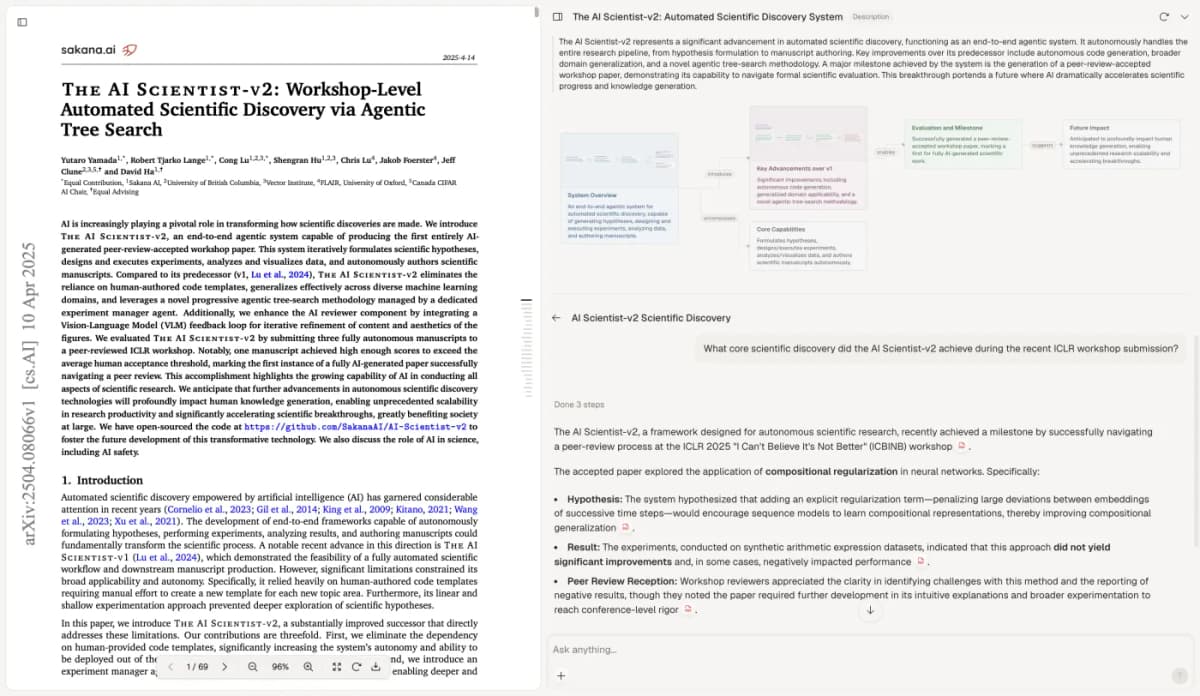
The unchanged Atlas capture shows Yamada and colleagues' AI Scientist-v2 paper, under CC BY 4.0, beside a cited answer. It does not show the fictional library records, a tested synthesis output, or proof that a drafted paragraph is accurate.
Open every citation and read the nearby text. Check who made the claim, what was studied, and which condition limits it. The source-checking workflow helps find claims whose wording goes beyond the cited text.
If the answer treats distinct tasks as a direct clash, correct the link. If it makes up agreement, retain the source that differs. When a citation points to the wrong file, name the intended source and ask again.
Use the checked plan to draft in your own words. For a larger project, the paper synthesis workflow keeps this close reading linked to the broader set of sources.
Check the proposed topic sentence too. A cited answer may support the middle of the paragraph while leaving its main claim too broad. In the example, any claim about learning gains would still need evidence that the supplied room surveys lack.
Revise the paragraph against its passages before saving. Select New, then Note, add a title and the corrected plan or paragraph, and wait for Saved. Keep unresolved questions beside the text rather than quietly filling them in.
Atlas helps with reading and notes. It does not prove cause and effect, validate a study, run a formal coding database, or guarantee that you have every relevant paper. You own the final meaning and the source credit it needs.
Review the paragraph against each passage
Read the paragraph once for its main point and once for source credit. Each sentence should state a supported source claim, explain a sound link, or name your own bounded inference. Readers should be able to tell which is which.
The Kennesaw teaching text distinguishes synthesis from merely making a source shorter. Use that distinction to check whether your paragraph builds a point from the sources together.
Finally, check what the paragraph does not prove. In the library example, room choices and accounts of team work support a cautious planning point. They do not prove an outcome effect. Keep that limit when the paragraph enters your paper.
Keep the paragraph tied to sources
Compare source claims before drafting your paragraph.