
Data triangulation compares sources about the same research question. They might come from other people, places, times, or records. Reading them together can strengthen a finding, reveal another view, or show what you still do not know.
More files do not always mean more support for a claim. If a report and newsletter quote the same person, they repeat one account. Trace the claim to where it began before counting the two files as independent evidence.
Atlas can help compare chosen records and inspect the passages behind a draft claim. You check whether the sources are independent and what it means when they agree or differ.

Compare evidence for your finding in Atlas
Trace each source, check cited passages, and save a reviewed comparison.
What data triangulation means
A library-access study might ask commuters, campus residents, and staff about the same service. Each group can describe a part the others miss. Accounts that agree may support a finding; other views can show its limits. Record silence about a claim as a gap.
The methods chapter hosted by Rutgers describes comparing findings across groups. Accounts from two campuses may show a difference that a study of one campus would miss.
Sources can also vary by time. Keep dates beside accounts from before and after evening hours began. To collect repeated accounts from the same participants, plan a diary study. Its entries provide dated self-reports, rather than independent checks of everything people did.
Triangulation does not need exactly three sources. Nielsen Norman Group's guide treats it as seeking other views and ways to check a result. Each source should offer a useful way to examine the question. A fixed count cannot tell you whether it does.
Separate sources, methods, and researchers
Triangulation covers several design choices, including the data-source, method, investigator, and theory types named in Carter and colleagues' abstract. A study can combine them, and labels vary by field, so state what you changed and how you compared the evidence.
Vary the sources
Data triangulation changes who or what supplies the data. Asking commuters and campus residents about access brings two groups' views to the study. Comparing campuses or dates also varies the sources. Johnson and colleagues' study distinguishes these source choices from the methods used to collect data.
Vary methods or analysts
Methodological triangulation changes how you gather or examine evidence. Asking people questions and watching what happens uses two methods. It can also add a new source. Describe both choices when both apply, as the NNG method guide does in its applied examples.
Investigator triangulation changes who gathers or reads the data. If several researchers analyze the same accounts, each may see something the others missed. The researcher triangulation guide covers that job. An AI reading aid does not supply another independent human analyst.
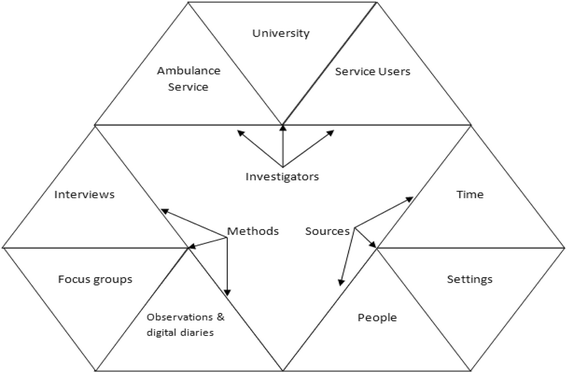
The diagram separates sources by time, settings, and people from methods and groups of researchers. Figure 3 by Johnson and colleagues, reproduced unchanged under CC BY 4.0, shows that study's choices. The fictional library example below has its own design.
Some guides use data triangulation more broadly for methods and views together. Eval Academy uses that wider frame. Naming the groups, times, and methods in your design helps readers follow the work even where labels overlap.
Plan the comparison around one claim
Set the claim's scope
Start with a claim you can check. Saying the library is accessible leaves the group, hours, site, and meaning of access unclear. A claim that commuters can use the main-campus library after late classes this term gives the sources something specific to address.
Then ask the question behind the claim: which commuters use the new hours, and what keeps others away? You need to hear from both users and people who still cannot come.
Keep the basis of each finding
Before combining findings, note for each source:
- Who or what supplied the evidence.
- Where and when it was collected.
- Which question or event it concerns.
- How it was collected and analyzed.
- What it could observe and what it could miss.
- Whether it relies on another source already in the comparison.
Keep the original findings at hand. A theme such as improved access can hide whether the claim came from two students, a staff estimate, or a count of visits.
Check each source before saying they all support the same finding. The research synthesis steps help group findings without losing their source links.
Rutherford and colleagues ask researchers to check who was sampled, the quality of data, and results that do not fit together. Their public-health method serves a different purpose from this library study. The source checks still help you see whether the records concern comparable groups and settings.
Plan how to handle differences before you read just to confirm a view. A source may support the claim, add another aspect, challenge it, or say nothing about it. Use those labels to track how evidence relates to the claim. They do not score whether a finding is valid.
Work through a data triangulation example
Read the source-by-claim table
The library, records, and findings below are fictional teaching examples. No interviews, field notes, or Atlas results were collected for this example.
A university library stays open later on some evenings. A researcher asks whether that helps students with late classes. The files include commuter interviews I1, campus-resident interviews I2, a staff account S1, door logs L1, and field notes O1. Newsletter N1 copies announcement A1.
This design varies groups and combines methods. It shows data and methodological triangulation together, like the overlapping choices in Johnson's study. The question asks about access, so the findings should address that job.
The table compares claims across the chosen sources. Keep the limits of what people said, what logs recorded, and what the observer saw beside each finding.
| Claim under review | Interview or staff evidence | Record or observation evidence | Interpretation and missing evidence |
|---|---|---|---|
| Evening hours help commuters study after class. | I1 describes use after late classes. | O1 records students present during two evening visits. | Use is described and observed. Observed visitors' commuter status is unknown. |
| Evening demand increased after the change. | S1 reports a busier building. | L1 contains evening entries only after the change. | No comparable earlier count. An increase is unestablished. |
| All students benefit from the extension. | I1 describes benefit. I2 reports transport concerns. | L1 contains no data on students who stayed away. | Experiences differ. Nonusers remain largely unobserved. |
| Extended hours caused higher library use. | S1 attributes more use to the schedule. | L1 overlaps with an exam period and records visits. | Other changes and repeat visits remain unresolved. Causality is unestablished. |
| Two announcements independently confirm the schedule. | No interview verifies every advertised date. | N1 copies A1. O1 covers only two evenings. | One underlying announcement. Full delivery needs another check. |
Table 1: The table shows which parts of each claim have support and which still need a check.
Revise the broad claim
In the first row, I1 explains why some commuters value late hours. O1 shows that students were there when the observer visited. It does not show that those students commute or are the people in I1. Keep the two findings distinct.
The third row changes the broad claim that all students benefit. Say instead that the commuters interviewed described a benefit, while campus residents raised transport concerns. That keeps both groups' views visible and leaves open what nonusers would say.
The copied notice shows what was announced. Two copies cannot independently show that the doors opened at those times. A dated field note or staff log is closer to that question.
Rutherford's source-quality checks help distinguish a repeated account from another basis for a finding.
Eval Academy's guide explains why differing views deserve attention. Here, the transport concern gives you a question to ask next: whom do the new hours still fail to serve?
Interpret agreement across evidence sources
Name what the sources support
If several commuters describe using late hours after class, their accounts support that experience among those interviewed. They do not show the share of all commuters who benefit. NNG's examples show how another method can address a different part of the question.
Logs count visits, while interviews explain why people visit. The findings are complementary because each adds a part the other lacks. State what each adds to the claim. They can inform the same view without measuring the same thing.
Before treating accounts as contradictory, check the setting of each. A commuter may say the hours helped, while a campus resident says the last bus was hard to catch. Both can be true for the people who said them. Eval Academy's guide uses differences in people's views to question a single broad conclusion.
Investigate accounts that conflict
Suppose staff say the library stayed open every evening listed, but a field note records a locked door on one of those dates. Check the entrance used, the date, and any notice of closure. Keep the conflict visible until those checks give you a basis to revise the claim.
Quirkos's method guide warns that data from distinct methods can be hard to combine and may lead to more than one reading. A policy says what should happen, while a person's account says what they experienced. Keep that distinction when you assess how they relate.
Do not decide by majority vote. Three summaries copied from one staff account still rely on that account. One dated field note may show a fact none of those summaries checked. Judge the basis of each claim before counting how often it appears.
Check independence and missing perspectives
Trace repeated findings to their origin. If a newsletter copies a notice, record that link. If a report quotes an interview you already have, it does not add another person's account. Rutherford's methods paper stresses independent evidence when assessing support for an explanation.
Sources can share a bias without copying. Staff and students you speak to might both be drawn from people who used the late hours with ease. If they agree, you still know little about those who could not get to campus.
Ask what could challenge your view. You might need to hear from students who tried to use the service but left before it opened, people with care duties, or users of another campus. Seek their views through the study's approved sampling and consent process.
Door entries count visits unless the system can reliably distinguish people. An interview count counts people interviewed. Adding those totals does not show how many students benefited.
The Rutgers source-group discussion helps frame what each source represents before you compare findings.
The public-health triangulation paper warns against dropping evidence that conflicts with a favored explanation. It also checks biased or mismatched data. Here, keep the transport concern and note that you lack an earlier set of door counts.
Stop broadening a claim when the next piece of evidence is missing. Report what the commuters interviewed said, and plan a check with nonusers. Readers can then see which group the finding concerns and whose views they still need.
Compare selected sources in Atlas
Use Atlas after choosing records you may hold in the project. Remove names and other details where the study's access rules require it. Keep each source's ID and dates visible so you can trace findings to the right record.
Open a chat in that project. In Ask a question, type @ and select the notes, staff account, logs, and field records for one claim. Wait until the sources have finished processing before choosing them.
Ask for an attributed comparison:
Compare these sources for the claim that late opening helps students with late classes use the library. For each source, state the group, place, dates, finding, and limit. Cite the passage that supports the finding. Show where sources agree, add another part, conflict, or have nothing to say about the claim. Flag files that copy the same account. Do not infer the share of all students reached or what caused a change from these records.
Open each numbered citation and read the text around it. Does the account concern the same term, campus, and group as the question? Check that the answer has not turned a planned opening time into a claim about when the doors were open.
An answer might say I1 and O1 agree that commuters came. O1 only says students were there, so check whether the answer went beyond that fact. It does not say they commute. Correct the row to describe use on the evenings observed. Keep the claim about commuters tied to I1.
Likewise, check the text before counting N1 as independent support. If it copies A1, note that link by hand even if the draft missed it. A citation may locate a passage, but you still judge what role it plays in the claim.
For a missing or unhelpful citation, find the source by name and check it directly.
Save the checked table and your reading in a project note. Add requests for earlier visit counts and nonusers' views. Wait for Saved before closing it.
Use the checked table to draft a claim within those limits and see what evidence is missing. You decide which source supports the claim and whether to gather more data.
Report the comparison and its limits
In the methods section, name the sources and why you chose them. State whether people, places, dates, or methods varied across them. Johnson's study shows these design choices. Give readers enough detail to see how you compared the evidence.
For the fictional study, a report could say that commuters interviewed described using late hours after class. Field notes showed students there but did not say if they commute. Campus residents raised transport concerns, and little is known about nonusers. In your real report, state the sample, dates, and sources beside those findings.
If a case changes your view, keep the earlier claim and why you revised it in the analysis record. Negative case analysis helps examine cases that challenge an emerging explanation. Use it alongside the source comparison.
Match proposed actions to the evidence. Asking about transport barriers follows from these accounts. To say the new hours help every student, you need evidence from the wider group. To say the hours caused higher use, the study must address other possible causes.
Return to the table when a new source arrives. Check its dates, group, and origin before adding it to the finding. It may settle a gap, show another conflict, or repeat evidence you already have.
Compare evidence for your finding in Atlas
Trace each source, check cited passages, and save a reviewed comparison.