

A perspective article develops a research viewpoint about a research topic. It can offer a new reading or challenge an assumption, then explain the effects for future work.
Start with the claim you want readers to reconsider. Then connect it to passages that back it, findings that limit it and a rival view worth testing. A list of source summaries alone leaves the case unfinished.
Atlas can help compare the chosen sources and keep a checked outline of the claim, sources and strongest challenge. You decide which reading is defensible and whether it fits the journal's meaning of a perspective.

Test the source basis of your viewpoint
Bring your research sources into Atlas and build a checked argument outline.
What a perspective article contributes
A perspective asks readers to see a research problem differently. Helpful literature supplies the basis for that change, while the author explains its effects. The viewpoint must do work beyond restating what each cited paper found.
For example, a perspective might argue that the test a field tends to use misses a key condition. It would explain the support for that concern, address reasons for keeping the benchmark and suggest what a better test should check.
AIP's Structural Dynamics guidance states a balanced focused overview combined with a forward view. That definition separates an argued viewpoint from a broad list of sources.
The article label does not determine a single format. The Journal of Language and Education permits original data in perspectives, as does the cited Structural Dynamics guidance in a defined context.
Turn a topic into an argument
A topic such as “remote laboratory teaching” does not yet state a viewpoint. Narrow it to a claim someone could question: “Tests should show both what a pair can do and what each learner knows.”
That planned claim names a distinction and an effect. It still needs evidence that the distinction matters. Name what would support it, what would weaken it and what the current tests already show.
Separate three kinds of sentence in the working outline. A finding reports what a source shows. An inference explains what you think follows. A plan states what researchers should check or change next.
Link each key finding to a source passage. For the inference, explain the reasoning between passage and claim. For the plan, name which doubt makes further work necessary. A citation cannot replace either reason.
Read at least one source that could undermine the viewpoint. A credible alternative may concern measure, differences between people or conditions absent from your chosen studies. Address its strongest form before committing to your own case.
A fictional viewpoint and its rival
In a made-up planning exercise, one teaching study reports fewer task errors during paired tasks. A second study reports that some learners relied heavily on their partners. Neither made-up report shows a general learning advantage.
The writer first suggests, “Working together to solve faults improves learning, so each learner’s assessment should be replaced.” That overstates the support twice: reduced errors are treated as learning, and a possible benefit becomes a replacement rule.
A rival explanation is that a partner completes difficult steps while the other learner learns little. The second made-up report makes that possibility helpful, although it does not prove that the reason applies everywhere.
The revised viewpoint says, “Tests should check both joint task results and what each learner knows when studying pair work.” It keeps the helpful distinction without claiming a proven effect.
The source outline now shows how the claim was formed:
- Viewpoint: tell apart joint task results from what each learner knows in tests.
- Support: the made-up paired-task report suggests task results can improve under pair work.
- Counterargument: the made-up partner-reliance report questions whether task results imply learning.
- Boundary: these supplied sources do not show learning effects across contexts.
- Next step: check whether each learner’s own grasp of how to solve faults improves alongside joint task results.
All studies in this exercise are invented. In a real outline, replace the made-up findings with checked passages and exact locations. Keep the distinction between a question worth studying and an effect already shown.
Examine the evidence in Atlas
Create a project containing your chosen papers, your planned viewpoint and the relevant journal rules. Include sources representing the rival explanation. Keep the planned thesis in a separate note so it remains distinguishable from support.
In chat, mention the papers with @ and choose Project only for new retrieval. Earlier outside evidence remains in the chat. Check that each citation comes from the sources you named. Ask: “Which passages support this viewpoint, which qualify it, and which support a rival explanation? Cite the findings and mark any step that is my inference.”
Open each numbered citation and compare the source with the answer. Check the target group, setting and outcome behind the passage. An answer about improved task results should not silently become an answer about improved learning.
Try reading the outline without the proposed thesis. What do the two source passages show on their own? In the made-up example, one shows fewer errors when learners work in pairs. The other says that some relied on their partner. The leap from those points to “each learner learned more” still needs support. Mark the leap so it cannot pass into the draft as a fact.
Then read it with the rival view in mind. A pair may finish a task because one person does most of the work. Your next step could test what each person can explain or do alone. This is a question for a new study, not a result of the two supplied papers. Keep that boundary in the final outline.
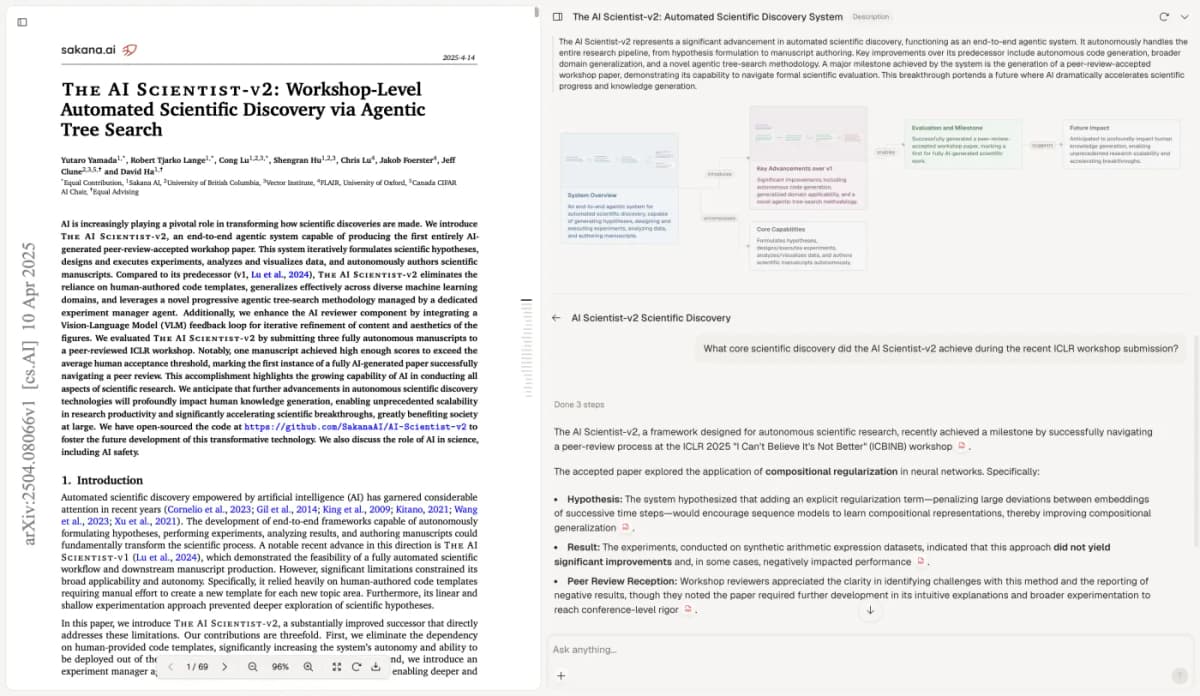
The visible source and answer illustrate how to check a source before keeping a claim. The displayed AI research paper is not linked to the made-up teaching examples. It does not back the planned learning viewpoint. Visible paper: AI Scientist-v2, Yutaro Yamada et al., CC BY 4.0. Capture copied unchanged.
When a source supports the rival explanation, keep it in the outline. Rewrite the thesis if the support narrows its scope. If the answer adds a possible cause with no citation, label it as a hypothesis to test or remove it from the source summary.
Create a note through New, then Note, and save your revised outline with source locations. Wait for Saved before closing. Include the strongest counterargument and the finding needed to separate it from your plan.
Arrange the argument for a reader
Open the draft with the problem and the exact viewpoint. Give enough background to make the disagreement clear, then move to the evidence that makes reconsideration helpful. Avoid a long history that postpones the thesis.
Develop the support and rival explanation in a logical order. Each paragraph should show a claim, explain its basis or qualify its reach. Readers need to understand why a finding changes the case, not merely which paper reported it.
End by explaining the effect on research. A helpful next step names the open question and why answering it helps choose between the rival views. “More research is needed” leaves that work to the reader.
Use a research paper outline when the main task is reporting a study's methods and results. For a response anchored to one target paper, a commentary article may be the more helpful writing task.
Verify fit before drafting the manuscript
This guide concerns planning a viewpoint from existing research sources. If your draft reports a new experiment, check the destination's instructions to decide how that source text belongs in the submission.
- Review the destination's current scope, length, references, figures and submission route. Nature's instructions show why plan and format requirements need direct review.
- If prior editorial discussion is needed, prepare a short outline of the viewpoint, support and new point before writing the full draft.
- Read claims supported only by agreement among chosen sources. Use the research synthesis workflow to expose disagreements and selection limits.
Keep those limits in the draft where they affect the planned next step. A defensible perspective gives readers a reason to reconsider an issue and a clear view of what the sources at hand still cannot decide.
Test the source basis of your viewpoint
Bring your research sources into Atlas and build a checked argument outline.