

A commentary article adds a focused research response to a paper. It can challenge an inference, extend a case or explain an effect that the original paper leaves open. The helpful new point starts with what the paper actually claims.
Before drafting, connect the target claim, response and support in an outline. Keep the original wording and limits. Tell apart a helpful disagreement from an objection the paper already addressed.
Atlas can help compare passages where the journal's drafting policy permits it. Authors keep responsibility for the case. Check those policies before using AI for the outline or draft.

Check your response against the paper
Compare the target claim and sources before saving your response outline.
What a commentary article adds
A commentary contributes a case rather than a second abstract. A critique questions an inference or method. An extension develops a point further. An application explains what the paper could mean in a new setting.
The editorial Guidelines for writing a commentary sets out these options and stresses fair critique of ideas. The response can be sympathetic while still adding something the target paper does not show.
Journal labels vary. Some journals use commentary for broader issues, while others tie it to one named article. This guide focuses on the latter task: connecting a planned response to the claims and limits of one named paper.
BJPsych Advances frames commentary around one named article's gaps, focus or disagreements. Use the journal's instructions to check the scope.
Identify the claim you are answering
Read the target paper's results and discussion with its methods and limits. The abstract may shorten a key condition. Record the exact claim, its source location, the evidence behind it and any boundary the authors already state.
Name the kind of response you intend. Are you challenging how the authors move from result to conclusion, suggesting another possible cause or proposing a new use? Each needs a distinct kind of support from sources.
Represent the authors' strongest defensible position. If they restrict the claim to one setting, keep that restriction. A critique of broad applicability misses its target when the paper makes no broad claim.
Choose one new point that matters to the journal's readers. A list of minor corrections can crowd out the reason to publish a response. Explain what reading or next choice changes if your case is accepted.
A fictional criticism and its correction
In a made-up paper, a school tests a scheduling change and reports fewer late arrivals during one term. The discussion says the approach may be helpful locally, while stating that transport conditions differ across schools.
The planned commentary first says, “The authors claim this schedule works everywhere, despite testing only one school.” Reading the full discussion removes the basis for that charge: the authors already limit the claim to their setting.
The writer can still make a helpful new point. Suppose a made-up backing paper states how transport timetables constrain attendance. The response could explain why transport conditions deserve explicit attention before applying the schedule elsewhere.
The revised outline keeps the target and extension aligned:
- Target claim: fewer late arrivals in the observed school and term, with limited applicability stated.
- Response: an extension identifying transport conditions that a new school should check before adoption.
- Support: a checked passage from the backing source explaining the helpful transport constraint.
- Boundary: no supplied support shows that transport caused the observed improvement or that the schedule will work elsewhere.
- New point: a clearer transfer question for the next setting, rather than a charge of a broad claim.
These papers are made-up. For a real response, keep the target passage and backing source location beside each point. Check that the supposed gap is absent from the full record.
If your critique concerns missing planned outcomes, the reporting-bias comparison can help organize that source check. An unexplained reporting difference still does not show why an author made it.
Inspect the target claim in Atlas
First check whether the journal permits the planned AI-assisted drafting. JMIR's current guidance strongly discourages AI tools even for commentary planning or drafting.
Where policy permits, create a project with the target paper, its extra files, helpful backing sources and your planned response. Give each source a distinct name. Keep your response separate from the paper so its authorship is clear.
Mention the chosen sources with @ and choose Project only for new retrieval. Earlier outside evidence remains in the chat. Check that each citation points to the named papers. Ask: “Locate the exact claim my response addresses. Cite its support and stated limits. Which parts of my response are already stated, and which add a point backed by a source?”
Open each numbered citation and read the surrounding passage. Confirm that a broad paraphrase has not erased a condition. If an answer reports a gap, check the full paper and extra file supplied before keeping that finding.
Test the outline by putting the target claim beside your response. Could the paper's authors accept your account of what they wrote, even if they reject your next point? In the made-up example, the paper says the change may help in one school. Your outline must keep “one school” in view. A claim that the authors promised success everywhere would fail this check.
The useful response then asks what a new school would need to know. It could compare school start times with bus routes before trying the change. The source about transport can back that question. It cannot show that transport caused the first school's result. Write those two limits beside the source passage so the extension stays fair when you turn the note into a draft.
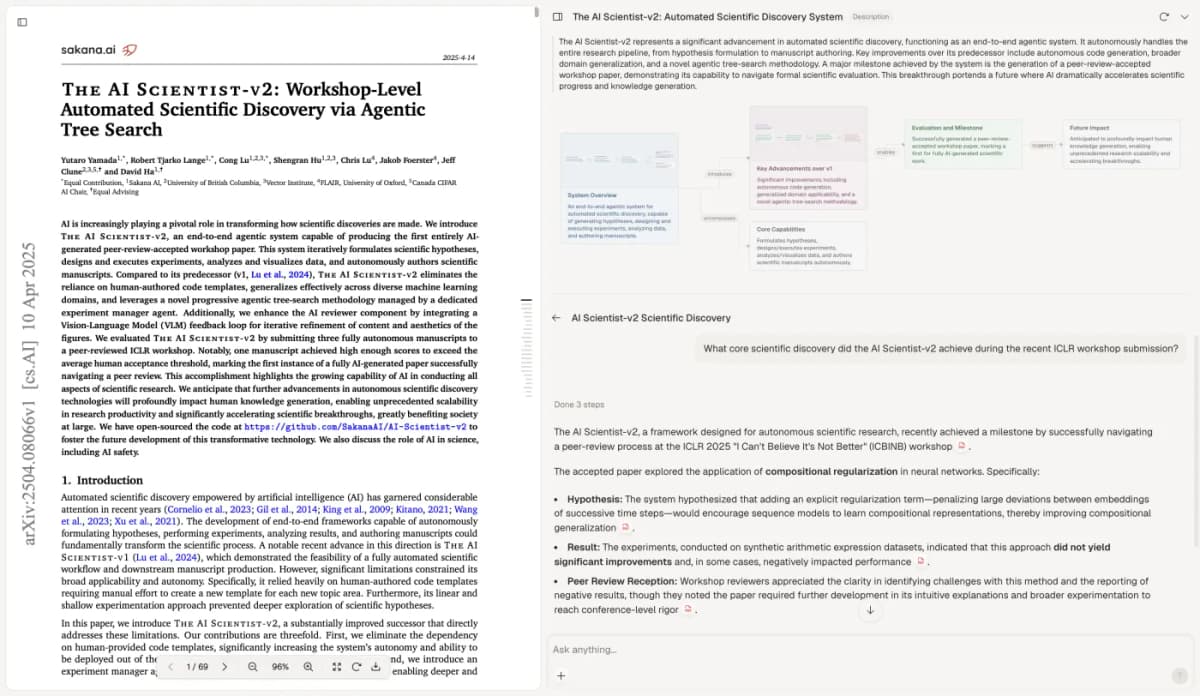
The source and response appear side by side for source checks. This existing capture illustrates the interface rather than a tested commentary workflow. Its visible AI research paper is not linked to the made-up scheduling example. Visible paper: AI Scientist-v2, Yutaro Yamada et al., CC BY 4.0. Capture copied unchanged.
Correct your outline when a cited passage undermines the first critique. Keep a remaining implication only if the source backs it. In the made-up example, the broad-claim critique disappears while the transport-context extension survives.
Select New, then Note, to save the checked outline with the target claim, response, support and remaining doubt. Wait for Saved. The software source check supplies source text for your judgment, not a publishable case by itself.
Develop the response into an argument
Give readers enough context to name the target and your new point. Then move to the point that changes its reading or use. A long summary delays the response and can consume the space needed for your evidence.
Explain the reasoning between target claim and response. If you suggest another possible cause, show why it is plausible and what evidence could distinguish it from the authors' explanation. Avoid presenting a possibility as a shown cause.
Use citations that support the real argumentative step. A related paper may show relevance without showing your conclusion. Read the backing passage and keep the conditions under which its finding applies.
End with the effect for research or reading. The made-up scheduling response could name what a new school needs to check before transfer. It should not promise an effect that neither source shows.
Verify the destination before submission
If your case spans a field without one focal paper, a perspective article may better state the task. For editorial review of your own draft, use a response to reviewers.
Check whether the journal accepts unsolicited commentary, requires an invitation or offers another response format. Current instructions also own word limits, abstract requirements, figures, reference limits and the relationship to the target paper.
JMIR distinguishes commentary from a broader viewpoint and from a short uninvited letter. Its preparation policy is one more reason to read the real instructions before choosing tools or investing in a full draft.
For the draft itself, check every quotation, paraphrase and inference against the target. Confirm that your response preserves the limits the target authors already stated. A reader should be able to see both the original position and why your new point builds on it.
Keep the source-linked outline after drafting. It provides a record for changing the response if a new report, revision or author reply comes to light. Update the claim and its effect together when that support changes.
Check your response against the paper
Compare the target claim and sources before saving your response outline.