

A research paper conclusion gives the reader the answer your work supports. It links the question, findings, and their meaning, with the limits needed to understand that answer.
Start with the findings you have checked, then trace each closing claim back to the paper. If a claim needs a new result or line of reasoning to stand, revise the body before putting it in the ending.
The note below uses a real simulation study about open textbooks to show how a model's limits shape the closing passage. We wrote this teaching example from the published study. We did no new research or calculations.

Check what your conclusion can claim
Trace closing claims to your paper's findings and stated limits.
What a research paper conclusion does
Return to the paper's question or main argument, state the supported answer, and explain why it matters. You may also name a grounded next question.
Harvard's writing guide frames these moves around what the work showed, why readers should care, and what they can now consider. Their form depends on the discipline and paper.
Keep the answer clear without recapping every section. Readers should be able to say what they learned from the work. The UNC conclusion guide recommends showing how the points fit together and avoiding a new subtopic at the end. Repeating the introduction word for word does not show how the paper changed the reader's understanding.
A discussion works through findings, competing explanations, and comparisons in detail. A conclusion closes that work. Some journals combine the two. An abstract summarizes the whole paper, while a dissertation ending can cover several chapters. The San Jose State handout uses published examples and encourages checking the form used in your field. Follow the target venue before choosing a separate heading or length.
Trace the answer to existing evidence
Use a short note to check the evidence for each claim before you draft. Record the question it answers, its support in the paper, and the limit that affects what it means. These three criteria apply even when a sentence sounds strong.
Start with what the paper showed
Use the question as it appears in the final paper, since it may differ from the first plan. Find the results that address it, including those you did not expect. For a paper that builds an argument, trace the answer through the reasoning in the text. Scribbr's guide explains how these two kinds of paper close.
Write the answer in one rough sentence and check it against the source. Does it name the same outcome, people, setting, and comparison? If it shifts from one course to all students, or from an association to a cause, locate the support for that shift. Keep the narrower answer when the paper cannot support the broader one.
Retain the limit that matters
A limit belongs in the ending when it changes how readers should use the answer. It might concern who was studied, what was measured, or a model assumption. Keep the details in the discussion and carry their effect into the closing claim. The San Jose State guidance connects limitations to what a study can and cannot say.
The discussion-section guide covers the earlier work of interpreting results and explaining limits. The conclusion can then carry the supported answer and its most consequential boundary without repeating the full analysis.
Avoid turning a limit into a ritual apology or a long list of every possible weakness. Ask which one would change a reader's takeaway. If the limitation has not yet been addressed in the paper, review its placement before finalizing the ending. The Harvard guide also cautions against adding a substantial new counterargument that has no room for assessment.
Worked question-to-finding-to-conclusion note
Grimaldi and colleagues' 2019 paper models how prior textbook access affects the chance of detecting an assumed learning benefit. A simulation creates data under stated rules. This study did not observe a new class of students. The note below traces the model work into closing claims.
| Note field | Checked part of the paper | Closing claim it supports | Claim to reject |
|---|---|---|---|
| Question | Simulation purpose asks how prior textbook access affects statistical power. | The paper examines whether a study design can detect an assumed access benefit. | It directly tested a new classroom intervention. |
| Finding | Simulation results show lower power as prior access rises, under the model. | High prior access can make an assumed benefit harder to detect in this model. | Free textbooks were observed to raise every student's grade. |
| Limit | Limitations name an assumed effect size and ideal conditions. | The finding depends on stated assumptions and does not give a verified real-world effect. | The assumed benefit was measured and proven. |
| Meaning | Discussion recommends measuring access and clarifying the effect of access. | Future work needs evidence about access and its effect. | The model settles textbook policy for every course. |
Table 1: Each source entry refers to a named section of the linked paper. We wrote the closing claims to teach how the findings constrain the ending. They are not the authors' words or a report of our own research.
Locate the finding before interpreting it
Here, statistical power means the chance of detecting the modeled effect under the study's rules. Check the simulation methods and results to see what the study measured.
A claim about grades in a real class would answer a different question from the one tested in the model.
Keep three items in your note: what the model found, what it assumed, and what the authors make of it. Synthesizing sources with their roles visible helps keep those parts clear.
When you return to the note, you should be able to tell a finding from a claim about what it means.
Preserve what remains unanswered
The paper's limitations and conclusion leave the wider learning-effect question open. That is part of its answer. You do not need to manufacture a decisive benefit or a decisive failure to give the reader closure.
Also note the disclosed OpenStax interests when reviewing the source. This belongs in your appraisal record and does not replace checking the methods.
The example illustrates a writing rule: a completed study can answer a narrower question while leaving a broader one unresolved. Carry that distinction through the final sentence.
Draft the closing passage
Here is a new possible ending based on the note. We wrote it to show how the paper's model finding and limits fit together. It is not the authors' wording, so do not present it as their text or as your own research.
Give a bounded answer
The simulations show that prior textbook access can reduce the chance of detecting an assumed learning benefit in this model. The result depends on the effect and conditions used in the simulations. It therefore cannot establish how much open textbooks improve learning in actual courses. Measuring prior access and the effect of access is needed to assess that wider question.
The passage begins with the model finding, retains the assumption, and ends with an evidence need already raised in the paper. Check these functions against the original study.
The ending offers closure through a supported answer and an explicit boundary. It makes no new promise about grades or teaching policy.
Connect significance to the answer
In your paper, ask what readers can now understand. You may have shown how something works, resolved a dispute, or explained why a question remains open. Keep the meaning tied to what the work supports. Research implications need their own reasoning when you move from a finding to what should follow.
A future-work sentence should name what needs to be learned. "More research is needed" leaves that task unclear. In the worked passage, the need is to measure access and its effect.
Advice about what to do next would need support in the body first. Editage's conclusion guide separates the closing point from detailed discussion work.
If your study did not find a significant difference, state the finding and its uncertainty. That alone does not prove no effect or equivalence.
The American Statistical Association statement explains why a p-value cutoff is not enough to decide what a result means. Ask a qualified analyst to review what your study can claim.
Check the conclusion in Atlas
Add the completed paper and clearly labeled, verified finding and limitation notes to one project. Start a fresh chat, mention the sources with @, and choose Project only beside + to scope new retrieval. Earlier outside context can remain in an existing chat, so use a new one for this focused check.
-
Ask: "Use the completed paper and these verified notes to trace each closing claim to the question, finding, and stated limit. Cite the support. Flag new evidence, invented results, causal claims, and wording that goes beyond the paper."
-
Open each citation and inspect the source and nearby text. Exact page or passage navigation is available when supported. Otherwise, find the named section yourself. Check that a results claim points to results rather than only to an introductory expectation.
-
For the worked example, reject "the study proved free textbooks improve grades." Ask for the simulation assumptions, results, and limitation passages. Correct the note to describe modeled detection, and keep the observed learning-effect question open.
-
Select New, then Note. Enter the checked claim note, source locations, revised passage, and unresolved author decisions. Wait for Saved before closing. Save the reasoning for corrections so a later edit does not restore the unsupported claim.
For each final sentence, retain the supported answer, its paper location, the limit, and the writer's review decision. This lets you organize research notes around the evidence behind the ending.
Atlas supports this textual check, while the author decides whether the interpretation and format are sound.
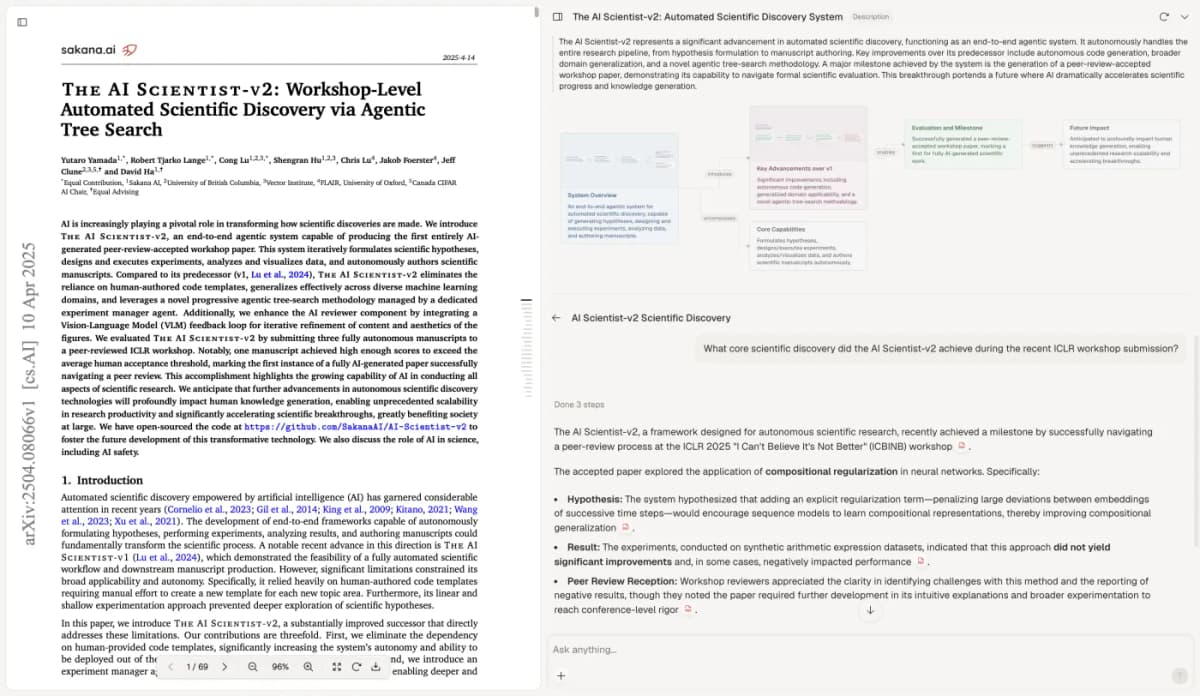
Atlas source-inspection capture showing The AI Scientist-v2 by Yutaro Yamada and colleagues (2025), under CC BY 4.0. No paper content was edited. The unrelated paper illustrates citation checking; the simulation study and example conclusion were not tested in this capture.
Review before using the final conclusion
Read the ending beside the introduction and discussion. The question and answer should concern the same work. Use the research paper introduction guide to check how the opening establishes the question the ending answers.
If the conclusion introduces a new outcome or a major comparison, return to the body and decide whether it needs support there. The UNC guidance warns against making the ending a place for unused evidence.
Use this final review with the author or supervisor:
- Every closing claim follows from a finding or argument already presented.
- The main answer is clear without a full section-by-section recap.
- Relevant scope and uncertainty remain visible.
- Model assumptions, associations, and causal claims are kept distinct.
- Any implication or next step follows from the work already discussed.
- Structure, length, and citations match the journal or assignment.
The PLOS paper-structure editorial connects interpretation to the question and stresses caveats and feedback. Ask a reader to explain the takeaway in their own words. If they hear a stronger claim than the paper supports, revise the sentence that led them there.
The ending should give readers a clear answer they can trace. Save the author's review with the note and resolve open issues before using the paper. The question, findings, and closing claim should fit together.
Check what your conclusion can claim
Trace closing claims to your paper's findings and stated limits.