
To write a discussion section, state the answer to your research question. Explain what the main findings mean, how they relate to past work, and what the study leaves open. Address unexpected findings and limitations before drawing implications or proposing the next study.
Start with an outline that links each finding to a checked source and the claim you can defend. “The findings agree with past studies” needs more detail: which finding agrees, in what setting, and where does the agreement stop? Check those points before you write the paragraph.

Check the sources behind your discussion
Compare your findings with prior papers and save a checked discussion outline.
Answer your research question
The opening should tell readers what the study found about the question it set out to answer. Name the main finding without repeating each table or test from the Results section.
For an invented study of optional writing workshops, an opening might say: “Students who attended the workshops felt more able to discuss research than students who did not attend.” This describes the survey finding. Whether the workshops caused the change is a further claim that needs support from the study design.
The ICMJE manuscript recommendations advise starting with the main findings, placing them in context, and stating their limits. They warn against claims that exceed the data. These rules address medical journals. Check your own journal's rules for the form and scope of its discussion.
Results report what you found. Discussion explains what those findings mean. A conclusion often closes that argument in a shorter form. If your journal combines Results and Discussion, state a finding before you explain it so readers can tell the data from the claim.
Plan the discussion around the main findings
Read your question and checked results together. Select the findings needed to answer the question, including ones that challenge the account you hoped to give. Order them so a reader can follow your reasoning. The order in which you ran the tests need not set the order of your prose.
For each point, note the evidence you will cite and where it supports the claim.
Choose the findings to discuss
The UCSF research-writing handout recommends an outline from the answer to its implications. Rank findings by their role in the question and keep results that do not support your hypothesis. A working outline can use these moves:
- State the answer supported by the main findings.
- Discuss each key finding with the past work it relates to.
- Examine unexpected results and other possible causes.
- Explain the limits that affect your claims.
- State what the study adds and a next question it raises.
Use these moves where the argument needs them. A finding's limit may belong in the same paragraph as its meaning, even if the paper has a later section on limitations. A thesis may need several themes to develop the same point.
Match the journal or thesis format
Charles Darwin University's discussion guide describes separate and combined sections. Check your journal's rules and a published paper in your field before choosing headings. Use those examples to learn the expected form, then build the content from your own findings.
There is no word count that suits both a short paper and a thesis chapter. Give the key findings and their limits enough space. Cut background and repeated results that do not help explain the answer. The SJSU discussion handout offers a scaffold you can adapt to that task.
Check what the literature comparison supports
Choose past studies for the claim you want to discuss. A paper on the same topic may study different people, measure a different outcome, or use a different design. Those points can change what your comparison means.
Cornell's research-writing guidance recommends reading beyond abstracts and making a chart of source findings and their role in your project. Name the relationship with care. Your finding may agree with past work, extend it to a new setting, or challenge part of its account.
Check the people and measures
For each proposed comparison, inspect the following:
- People and setting: Do the groups and settings fit your claim?
- Design: Did the study observe a link or test an intervention?
- Outcome: Do both studies measure the same thing?
- Timing: Were the outcomes measured at the same stage?
- Finding: What does the report show, and what remains unclear?
Then write the link in one sentence. “Both studies found higher self-rated confidence among workshop attendees” names a shared finding. “Workshops improve grades” adds an outcome and a causal claim. A survey about how able students feel does not by itself show that their grades improved.
Read a difference before explaining it
When findings differ, check whether the studies asked the same question. One may survey how students feel today and another assess their writing next term. Explain that gap before calling the findings a conflict. Cornell's annotated discussion examples show how to name links without making past work fit your claim too neatly.
For a larger set of papers, use the research synthesis workflow to organize the findings before you select which ones belong in this discussion.
Work through a finding-to-literature outline
Consider a fictional study of optional writing workshops at a university. Students chose whether to attend. In a survey after the workshops, attendees rated their confidence in discussing research more highly. The study had no survey from before the workshops and did not assess students' writing.
In the two invented prior papers, Study A uses a similar survey after an optional workshop, while Study B assesses writing after another teaching program. All three studies, their findings, and their source locations are invented for this example. None is published evidence.
The four rows below show a working outline for the invented study. The source locations show what to keep in a real record.
| Discussion point | Illustrative evidence location | Supported relationship | Uncertainty to retain |
|---|---|---|---|
| Main finding | Current study, Results: confidence survey | Attendees reported greater confidence | The comparison does not isolate an attendance effect |
| Related prior finding | Study A, Results: self-rating measure | Similar direction for a similar reported outcome | Check population, item wording, and timing before claiming close agreement |
| Different prior outcome | Study B, Methods and Results: writing assessment | Related teaching question using writing quality | Confidence and writing quality are different outcomes |
| Possible explanation | Current study, Methods: voluntary attendance | Self-selection is relevant to interpretation | Prior confidence or motivation was not measured |
Table 1: Study B could give a reason to assess writing in future work. It cannot show that the current students' writing improved: the current study did not measure that outcome. Keep this distinction in the note you use to draft the discussion.
Correct an overclaimed comparison
Suppose an outline says: “The findings confirm Study B and show that workshops improve writing.” The studies measured different things.
The current groups also chose whether to attend, so the design does not isolate a workshop effect.
Revise it to: “The current study concerns self-rated confidence, while Study B assesses writing. A future study could examine both.”
In a real paper, cite Study B and explain why its findings matter to your question. The Cornell source-chart method helps keep that source finding beside the claim you plan to make.
This changes the next question. How do those ratings relate to students' writing?
A future study could measure both before and after the workshops, with a design that addresses how students enter the groups. Your research team must choose that design and its tests.
Turn the checked outline into a paragraph
Give each paragraph one main point. State the finding, explain the link to past work, and develop its meaning with the limits it needs. Help readers tell which claims come from your data and which come from the cited paper.
The San José State University Writing Center handout uses annotated examples to link findings with context, limits, and future work. Inspect the job of each sentence rather than copying the whole sample.
Write the claim and its limit together
Here is a paragraph based on the invented papers above. Study A and Study B are teaching labels only:
Students who attended the optional workshops felt more able to discuss research. Study A found a similar pattern on a self-rating survey. Study B assessed writing, which the current study did not measure. Students chose whether to attend our workshops, and we did not measure their confidence beforehand. The groups may thus have differed before the workshops began. Future work could measure both self-ratings and writing over time, with a design that addresses how students enter the groups.
The opening states the result. The next sentences link it to a similar measure and distinguish the other outcome. The group-selection limit then sets the scope of the claim. The next question follows from what is missing.
Check the claim beneath the cautious verb
“May prove that workshops cause better writing” still claims a cause and an outcome the study did not test. Change the claim itself before you choose more cautious words.
The ICMJE advice on supported conclusions is useful here. In a real paragraph, replace the teaching labels with checked references that support the words beside them.
Explain uncertainty and limitations precisely
Tie each limit to the claim it affects. Does the concern involve the measure, how people joined the study, or whether the finding holds in another setting? Name the concern and explain its effect on what you can conclude.
In the workshop example, missing ratings from before the workshops leaves open whether the groups already differed. No writing test means no claim about improved writing.
A sample from one university raises a separate question about whether the pattern would hold elsewhere.
The limitations-of-the-study guide develops that claim-to-limit reasoning. Use it when a broad limitation label needs a study fact and an explained effect on the conclusion.
For an unexpected result, state what you found and examine possible reasons. Mark which reasons have support and which remain untested. The UCSF outline guidance asks writers to keep observations that challenge the hypothesis. ICMJE also asks authors to label a new hypothesis as such.
If a test does not establish a difference, ask the analyst what the estimate and its uncertainty support. Do not jump to “no effect.” The American Statistical Association's p-value statement warns that a threshold alone should not decide a scientific claim.
A p-value also does not measure the size or importance of an effect.
Make the next study address a named gap. A writing test would address the missing outcome; ratings from before the workshops would address a different problem. “More research is needed” leaves both questions unclear.
The research implications guide develops the next step: what a supported finding means for theory, practice, or future work.
Check and save passages in Atlas
Use Atlas to compare the sources you select. Start with checked findings from your study and the prior papers you need to discuss them. Check the tests with your research team before using their results in an outline.
-
Add the findings document and chosen papers to the project. Wait for the sources to finish processing.
-
Start a chat and type @ to select those sources. Name the finding you want to discuss.
-
Ask: “Compare this finding with the selected studies. Identify who was studied, the design, outcome, timing, and a supporting passage for each link. Separate results from possible reasons. Keep missing facts unresolved and do not infer a cause.”
-
Open each key citation. Read the surrounding Methods and Results text to check the outcome and design as well as the finding.
-
Correct the outline if it goes beyond a source. If it describes a confidence rating as writing skill, fix the outcome and revisit the claim.
-
Select New, then Note. Save the checked outline, source references, open questions, and your own decisions. Wait for Saved before closing.
The existing Atlas screenshot below shows a paper beside a cited answer and an open source preview. The paper is about document retrieval and is unrelated to the invented workshop study. Inspect the source text before you keep a claim.
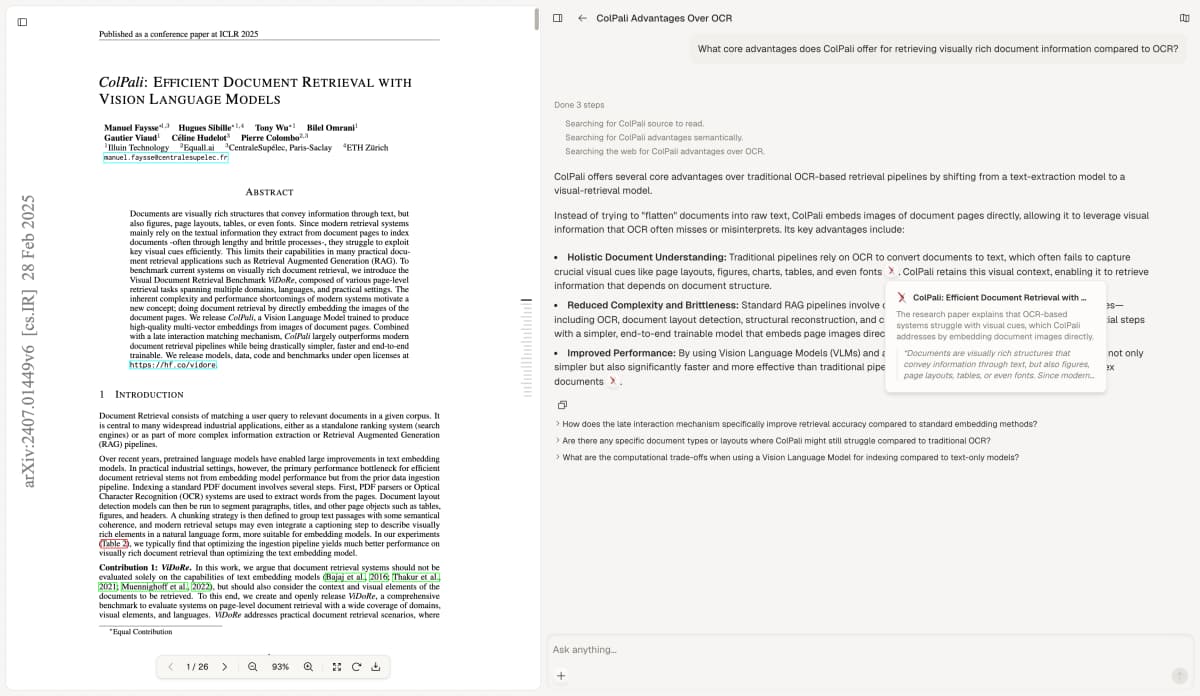
Atlas screenshot showing a source check. The visible ColPali paper by Manuel Faysse and colleagues is CC0 1.0. Lossless WebP re-encoding left the content unchanged. The paper is unrelated to the fictional workshop study.
This image shows where to read a source beside an answer. The steps above follow Atlas's public guides for source chat, citation checks, and saved notes. They have not been tested on the invented example. You still need to read the passages and write the final account yourself.
If the answer blends several studies, ask what each one adds. If a citation lacks a useful location, open the named paper and find the section. Keep an unresolved link in the note until you can check it. For help inspecting such claims, see the AI citation-checking guide.
Review the argument before submission
Read the discussion beside the research question, results, and cited papers. For each main claim, find the result that supports it and the meaning you added. Then check these points:
- Each key finding has an explanation, including ones you did not expect.
- Links to past work name the shared finding and the key differences.
- Possible causes remain distinct from causes tested by the study.
- Limits explain how they affect a claim.
- Next steps follow from findings or missing facts.
- Citations support the words and follow the journal's rules.
Check the ICMJE reference guidance for the author's duty to verify citation support. When a claim needs a new test, return to the research team. Report the completed test before you discuss its meaning. Keep the limits you found during source checks when you revise the prose.
Keep the checked outline beside the draft. Coauthors can use it to find the source behind a claim and the reason for a limit. That record helps them review what the study adds without rebuilding each comparison from memory.
Check the sources behind your discussion
Compare your findings with prior papers and save a checked discussion outline.