

Journal aims and scope tell you what a journal is trying to publish and which research it considers. The aims describe its purpose; the scope sets out its coverage. A statement may also name article types, readers or the kind of contribution expected.
Read it beside your manuscript, not in isolation. A familiar subject in the list gives you a reason to check further. It does not show that the paper meets every criterion or will be accepted.

Check your manuscript's journal fit
Compare your abstract with supplied scope pages and check the cited text.
Read the statement as separate criteria
Check subjects and article types
Find the statement on the official journal site. Save its URL and your check date with the manuscript version you used. A title or search snippet can leave out limits that matter to your study.
State what the paper does. Name its type: original research, review, case report or methods paper. Then look for that type in the scope page and author guide. If it is absent, record the question rather than assuming either permission or exclusion.
The Taylor & Francis guide treats audience and article type as separate checks. It also directs authors to the instructions after choosing a journal. Scope fit and submission cover letter are related tasks with different evidence.
Check readers and contribution
Name who could use your result. A study of local water may offer a method useful elsewhere, or it may tell us about just one place. Explain the reach of your work from the findings you have.
Optica's guide asks authors to consider broad versus specialist interest and work tied to one region. Use these questions to read the scope. Each journal sets its own rules.
Editor Patricia Snell Herzog describes scope fit as the first step for Review of Religious Research. Her account shows why a clear explanation of fit matters before review. It does not establish that all journals use the same decision process.
The source figure below comes from Mohammad S Alrashdan's biomedical journal-selection viewpoint. It places topic specialization within a wider decision that also includes funding and publication model.
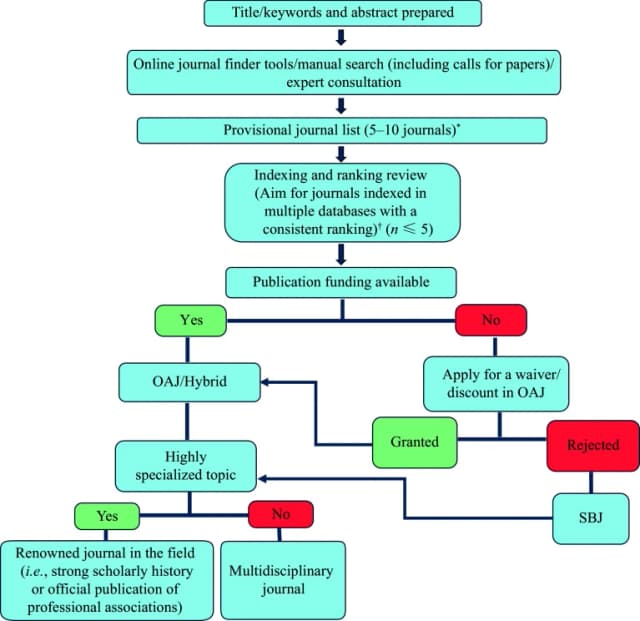
Follow the lower branch to see how the author distinguishes highly specialized topics from a multidisciplinary destination. That branch helps you think about who will read the work. The full chart is one author's advice for biomedicine. It does not tell you whether a journal will accept your paper.
Mohammad S Alrashdan, Figure 1, Where do I submit my next paper?, CC BY 4.0. Original figure converted to WebP.
Compare one manuscript with two journals
Build a passage alignment note
Consider a fictional paper on low-cost sensors that measure urban heat. Its abstract describes one city, checks against reference sensors and limits in damp weather. It does not show a major advance across the field.
Scientific Reports covers original research and Earth and environmental sciences. Nature Communications covers Earth science too. It also seeks important advances that matter to specialists. Subject fit answers only part of that test.
Use these four rows to pair the paper's claims with the scope text. Keep open questions apart from matches you can support. The journal still makes the decision.
| Check | Manuscript evidence | Journal statement | Reading judgment |
|---|---|---|---|
| Topic | Urban heat measurements | Both cover Earth science | Plausible topic match |
| Study format | Original sensor study | Scientific Reports names original research | Format match on supplied scope page |
| Audience | Methods for heat researchers | Nature Communications names specialists | Explain the method's value to those readers |
| Contribution | Local validation; humidity limit | Nature Communications names important advances | Not established by this abstract |
Table 1: A hypothetical manuscript checked against two real scope pages; no submission or acceptance outcome is claimed.
Correct the overconfident conclusion
“The subject appears in both journals” is a supported reading of the topic lists. “Both journals are equally suitable” adds a judgment the source pages cannot establish. The abstract alone also does not show that the sensor method is a major advance.
A better note says: “Both include the subject. Scientific Reports names original research. Nature Communications asks what the work adds to the field. This abstract has not yet shown that.” Check the full paper and prior work before claiming that fit.
Do not infer that Scientific Reports has no contribution or quality criteria because this one page does not state them. Read its separate editorial guidance. A missing passage means you need to check another page. The journal may state that rule elsewhere.
Tie the note to exact lines in the abstract. If a new draft changes from a methods study to a review, check the format again. Keeping the same words in the title does not make the old fit note valid.
Resolve gaps before selecting a journal
Inspect examples without treating them as promises
Read recent articles that match your format and topic. Look at how they frame the contribution and address the journal's audience. One similar paper can help you understand that conversation; it cannot promise the same decision for your manuscript.
Elsevier's journal-selection guidance pairs the current scope statement with recent issues and author guidelines. That combination is useful when a brief statement leaves the method or format unclear. Keep the source for each check visible in your note.
If recent papers seem to conflict with an explicit exclusion, do not erase the exclusion. The paper may be old or belong to a special format. Check its date and type. Ask the journal to clarify a gap you cannot resolve from its site.
Write a defensible fit statement
State the match in one or two lines: what the paper studies, which listed area it serves and what it adds for those readers. Do not claim a wider reach than the results support.
Use your research paper abstract to check whether the contribution is actually stated. A fit note can expose vague claims, but new words cannot create new evidence. Match the claim to the study you did.
Complete a separate journal quality check and review practical constraints before choosing where to submit. Fees, funder rules and credibility can change the decision even when scope fits. This note answers one part of journal selection.
Save the fit note in Atlas
Create a project and add your abstract plus the scope pages for the journals you are considering. Wait until the sources have processed. Keep each source's journal name, URL and check date so the answer can be traced to the right statement.
Open a chat and use @ to select those sources. Ask: “Compare this abstract with these scope statements. For topic, format, audience and contribution, cite the manuscript passage and journal passage. Mark criteria absent from the supplied pages as unknown. Do not predict acceptance.”
Use the source-checking steps to open each citation and read the text around it. In the example, correct an answer that turns “Earth science is included” into “the paper meets all criteria.” Keep the topic match, but change the contribution judgment to “not established by the supplied abstract.”
Choose New → Note and save the corrected comparison, its source links and open questions. Check the Saved state. Revisit it when the manuscript or scope statement changes; a saved note preserves the basis for your decision rather than certifying fit.
Check your manuscript's journal fit
Compare your abstract with supplied scope pages and check the cited text.