

Your codes describe delayed replies, repeated requests and finding help elsewhere. Axial coding asks how those categories relate. When do people repeat a request, what do they do next, and what follows?
A relationship needs more than neighboring labels in a code tree. Keep the proposed connection beside the excerpts that support it, the cases that challenge it, and the context that changes its meaning.

Check category relationships in Atlas
Compare excerpts and save your revised relationship note.
What axial coding does
Axial coding asks how categories in your data relate. It is linked with Strauss and Corbin's grounded theory approach. You ask what was going on, what people did, and what followed from their actions.
Your categories give you a place to start. If two are delayed replies and repeated requests, ask whether the delay came first. Ask what the delay meant to the person and what else might have led them to ask again.
A code tree can help you find excerpts. A claim about a link goes further: it says how a process might work in stated conditions. Keep that claim open to change when a new case shows a gap in it.
Distinguish the coding decisions
Open coding builds first ideas from parts of the data. Axial coding asks how the categories relate. In the Straussian approach, selective coding draws the account together around a core category.
Focused coding picks useful first codes to develop, especially in constructivist grounded theory. That is a different choice from asking what leads to an action and what follows it. State which job you are doing.
Chun Tie, Birks and Francis explain how grounded theory approaches differ. They also describe links among reading data, writing memos, choosing cases and making comparisons. Use terms that fit your stated approach.
These names need not make the work rigid. A proposed link may show that a category is unclear. Go back to the source evidence, revise what the category means, and then check the link again with the changed meaning.
Prepare one category for comparison
Choose a category whose links matter to your research question. Gather its meaning, the excerpts it covers, their sources and your earlier notes. Keep who spoke, what happened and when it happened with each excerpt.
Write one possible link as a sentence. For example, when work is due soon, a slow reply may lead a new staff member to ask a peer for help. That sentence states a condition, an action and a possible shift in how help is sought.
Ask questions that could change the sentence:
- Which excerpt shows what happened first, and which just names both categories?
- Does the person say what followed, or is that part of your own reading?
- Does the same response occur when replies are prompt?
- What changes between cases where the link holds and cases where it fails?
MAXQDA's guide places these questions in a Straussian account. Use them to check your data. Keep the cases and categories that do not fit the link, since they may show where the claim needs to change.
Build an axial coding example
The staff training records below are fictional. Assume you have already defined delayed replies, repeating a request, peer help and work left undone. Start with those categories so you can focus on how they relate.
The first claim is that slow replies cause new staff to stop asking their boss for help. Check that claim against each case before you carry it into your memo. Look for what the claim gets wrong as well as right.
| Case excerpt | Condition and action | Reported consequence | Relationship judgment |
|---|---|---|---|
| A reports waiting two days, then asking a peer because the task was due that afternoon. | Delayed reply under deadline pressure leads to peer contact. | A receives guidance and finishes the task. | Supports an immediate shift in help-seeking under deadline pressure. |
| B reports waiting two days and sending the supervisor another message. | Delayed reply is followed by a repeated request. | The supervisor replies after the reminder. | Challenges the claim that delay always stops supervisor contact. |
| C reports a prompt reply but asks a peer to explain unfamiliar wording. | The reply arrives, but its meaning remains unclear. | Peer explanation helps C understand the instruction. | Peer assistance may reflect comprehension needs rather than delay. |
| D reports giving up after a delay but does not describe the task outcome. | Delay precedes withdrawal in this account. | The outcome is unreported. | Retain the reported sequence and mark the consequence unknown. |
Table 1: The same categories can appear in a different order or setting, which can change the proposed link.
In case A, work is due soon and the person asks a peer for help. You do not know whether they ask their boss again later. Keep that time limit clear when you state what the account supports.
In case B, the person waits just as long but asks the boss again. What let them do that: more time, past experience, no peer to ask, or trust that the boss would reply? Keep these questions open until the data address them.
Case C shows that a person can ask a peer even when a reply comes fast. The stated reason is a need to understand it. Case D leaves a gap: the person gave up, but you do not know what happened to the task.
Read a published relational framework
Vollstedt and Rezat's chapter gives an adapted framework for personal meaning in mathematics education. It links what comes before that meaning with what follows, taking the person and the setting into account.
The figure shows how a framework can fit a specific question. Arrows link the main parts, with context around them. Read it as a model built for that study and check whether its questions fit your own data.
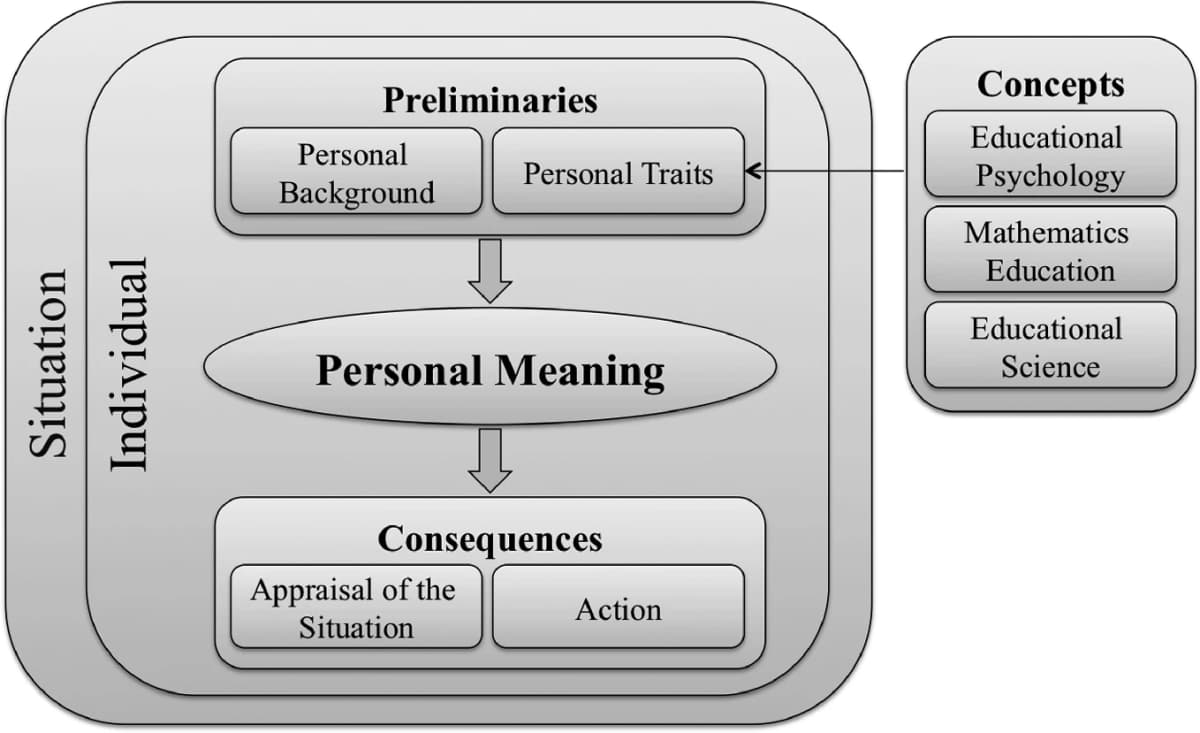
The model links a person's background and traits with meaning, appraisal and action. Figure 4.1 from Vollstedt and Rezat, CC BY 4.0, encoded as WebP with the content unchanged.
Read the relationships in text as well as in the diagram:
- Preliminaries are what comes before personal meaning, including a person's background and traits.
- Meaning links these with consequences, or what follows, including appraisal and action.
- The person and the setting surround these links. Ideas from the field also inform parts of the model.
For your own work, explain why the model fits the data. An arrow states a proposed link. It still needs support from the excerpts, even when the diagram makes the link look settled at first glance.
Revise relationships around contrary cases
The fictional cases do not support the first claim across all four people. A narrower memo might say that a slow reply can lead someone to a peer when work is due soon. Some people ask again, and others need help to understand a prompt reply.
The new claim keeps those differences in view. It separates what a person says happened from your account of why it happened. Just because one event came first does not show that it caused the next one.
Delve's worked guide uses examples and memos to build links among categories. Write why a case changes the link. Moving a label to a new folder alone does not explain what changed in your reading.
Use negative-case analysis when a case tests where your claim holds. It may lead you to narrow a condition, propose a new link, or go back to what a category means. Keep the reason in your note.
Do not fill every part of a model with a guess. If the account does not say what followed, mark that gap. It can help you decide which case to read next or which question to ask in later fieldwork.
Check a relationship note in Atlas
Add the coded excerpts you may upload, your category meanings and your memos to an Atlas project. Use clear source names and passage locations. Your category note and the interview excerpt support different parts of the claim.
Open a chat, type @ in Ask a question, and select the category note and excerpt sources. Ask for a comparison that can challenge the relationship:
Check the proposed link between delayed replies and peer help using our category meanings. Show excerpts that support or challenge it, what was going on, what people say followed, and gaps. Keep unreported outcomes marked as unknown.
Select Send and open each numbered citation. Read around the passage to check who spoke, what happened first and the setting. Check the link itself. Two category names in one passage are not enough to show how they relate.
If the answer says a slow reply caused the person to give up for good, return to case A. Keep the peer contact and the fact that work was due soon. Keep case B beside the revised claim so the other response stays in view.
Create a note through New and Note. Save the checked account of what was going on, what the person did and what followed. Include sources and open questions. Wait for Saved before you close the note.
Atlas helps compare the sources, while you own the categories and decide what the check changes in your study. Follow the study's access and consent rules for people's accounts. Review the answer before using it in a report.
Write the analytical memo
A memo should state the link you propose, what supports it and where it changes. Keep source locations with your reasoning. Another reader should be able to return to the same words and test the claim for themselves.
For the fictional example, write:
Slow replies were followed by different actions. When work was due soon, A asked a peer, while B asked the boss again. C asked a peer despite a prompt reply because its meaning was unclear. We need to check time pressure and the need to understand replies as separate conditions.
The next check should address those conditions. Look for prompt and slow replies when tasks were due at much the same time. Then read cases where a reply was hard to understand. Mark gaps if the data cannot support that check.
Before you report axial coding, show a real link and how a case led you to revise it. If you name the method in your research paper keywords, check that your methods section supports it. A background citation alone does not show you used it.
Check category relationships in Atlas
Compare excerpts and save your revised relationship note.