

Focused coding selects promising initial codes and tests how well they work across more of your data. The goal is to build an account of what the data means. A shorter code list still needs an explanation of how its codes fit the material.
Return to the passages behind each code. Ask what the code helps you explain, which events it fits, and where it breaks down. Keep a written reason for retaining, changing, splitting, or setting a code aside.
This guide uses three fictional interview excerpts to show that process. It then shows how to use Atlas to compare excerpts with your code notes, check the cited text, and save a corrected note. The example does not establish findings, frequency, or a theory.

Check the passages behind your focused codes
Compare initial codes with their supporting source excerpts.
What focused coding does
In constructivist grounded theory, focused coding builds on initial coding. You choose codes that help make sense of the data and test them across more cases. Sbaraini and colleagues' worked example shows how the team chose central codes, checked them against the data, and built their account.
Frequency can suggest where to look, but it is not the only reason to choose a code. A code may matter because it captures a key action or shows when a process changes. The Oregon State coding chapter explains how useful first-round codes guide a later pass through the data.
State which approach you use. Chun Tie, Birks, and Francis show how coding terms differ across grounded-theory approaches. Focused, axial, selective, and theoretical coding are not a universal sequence with labels you can swap freely.
Choose codes through comparison
Start with initial codes that still lead back to their source passages. If your notes contain only broad topics, return to the excerpts before choosing a focused code. An open-coding guide can help with that earlier pass; this stage asks which of those ideas deserve further work.
Compare the passages, not just labels
Read two or more excerpts beside their initial codes. What action does each person describe? What is shared, and what differs in the situation, timing, or consequence? Two labels may sound alike while capturing different processes.
The original worked study compares codes with codes and data with data. Apply that principle to your own material: test the proposed label against the passage rather than merging labels because their words overlap.
Write a provisional definition
Give the candidate code a plain definition. State what belongs, what does not, and the source locations that support it. Use the code to ask sharper questions of the data. If it covers every related topic, it may be too broad to help.
Then check whether the code still works elsewhere in the material. Keep a note of cases that need another code or a narrower definition. The expert grounded-theory FAQ links coding to comparing data, writing memos, and seeking further evidence. It is more than a one-time cleanup.
Worked focused-code comparison
Suppose your question concerns how new postgraduate students seek help with course rules. These excerpts are fictional teaching examples. They are not real interviews and cannot show how often a process occurs.
Compare the passage, its initial labels, and the possible next step before deciding which code to develop.
| Excerpt | Initial codes | Focused-code comparison |
|---|---|---|
| E1: “I check the handbook first, then ask the course office to confirm the deadline.” | Checking written rules; seeking confirmation | A candidate, “choosing a route to help,” covers the sequence. Keep “checking rules before acting” as a possible distinct process. |
| E2: “I ask my lab partner before I email the office.” | Asking a peer first; delaying formal contact | The route-to-help candidate fits the choice of contact. The excerpt does not explain why the peer comes first. |
| E3: “The office email went unanswered, so I asked my mentor.” | Waiting for a reply; changing the person asked | The candidate fits switching routes after a failed contact. Record the unanswered request as a condition. The excerpt leaves the student’s motive unresolved. |
Table 1: Fictional comparison: the candidate code is provisional; each excerpt retains its own action and limits.
“Choosing a route to help” is worth testing because the three excerpts describe different paths toward an answer. For now, define it as choosing or changing a source of help to answer a course question. This includes written guidance and people, but does not yet explain trust, ease, or satisfaction.
Do not merge “checking rules before acting” into that candidate just to reduce the list. E1 may support a distinct process around checking an official rule. Return to other passages to see whether keeping it separate helps your account.
The open-textbook analysis guide also links revising codes with making sense of the data. A tidy code list does not do that work for you.
The next comparison is concrete: find passages where students keep asking the same person, find an answer without asking anyone, or receive a reply but still change course. Those are questions to pursue in your material or further permitted data collection, not missing evidence to invent.
Test the code before expanding it
A useful code needs limits. Revisit the excerpt in context, including what came before and after it. Check whether your label captures the action or adds a claim the person did not make.
Remove an unsupported motive
An unchecked code for E2 might be “distrusting the office.” The excerpt says that the student asks a peer first; it does not say they distrust staff. A corrected code is “asking a peer before contacting the office,” with distrust left as a question that needs evidence.
This wording keeps the sequence clear without deciding its cause. If another passage states a reason, compare that account with this one before expanding the focused code. An in-vivo coding guide can help retain participant language, but a label copied from one passage still needs a fit check elsewhere.
Keep variation and contrary cases
A case that does not fit is useful evidence about the boundary of the code. It may lead you to split a broad code, narrow the definition, or find a condition you missed. Do not remove it solely because it complicates the pattern.
The grounded-theory framework shows why checking data against data continues throughout the study.
For this example, an account of deliberately avoiding all help might show a different process rather than another version of choosing a helper. Keep that distinction open until the source supports a decision.
Counts also need care. These three excerpts do not show whether a code is common in a larger group. A frequent label may be broad or reflect your interview prompts. A rare event may expose an important limit. Choose a code for its fit and what it helps explain. Write why the choice matters to your question.
Check your code comparison in Atlas
Atlas can support comparison between permitted excerpts and your initial-code notes. Keep source locations and enough surrounding text to inspect the interpretation. Follow the study's consent and data-handling rules before adding research material to a tool.
Use the following steps to create and review the comparison note:
- Add permitted excerpts and code notes. Name the sources clearly and keep researcher notes separate from participant statements. Wait for processing to finish.
- Select sources with
@. Mention the excerpts and the initial-code document. Ask Atlas to compare a small candidate set rather than decide the whole analysis at once. - Request passage support. Ask for each candidate's definition, supporting source passages, cases that do not fit, and a proposed selection reason. Treat the proposed reason as a judgment to review.
- Open the citations. Read the cited passage and nearby context. Correct a label that adds a motive, loses a qualification, or combines distinct actions without a clear reason.
- Keep alternatives visible. Record codes you set aside and what evidence would make you revisit them. Mark gaps instead of claiming that a source proves more than it says.
- Save the checked note. Use
New → Note, add the corrected comparison and rationale, and confirmSaved. Retain the source references for the next round of comparison.
Try: “Compare @Consented Excerpts with @Initial Code Notes. For each candidate, cite the passages that fit and those that challenge it. Propose a definition and selection reason, but keep participant statements separate from our interpretations.”
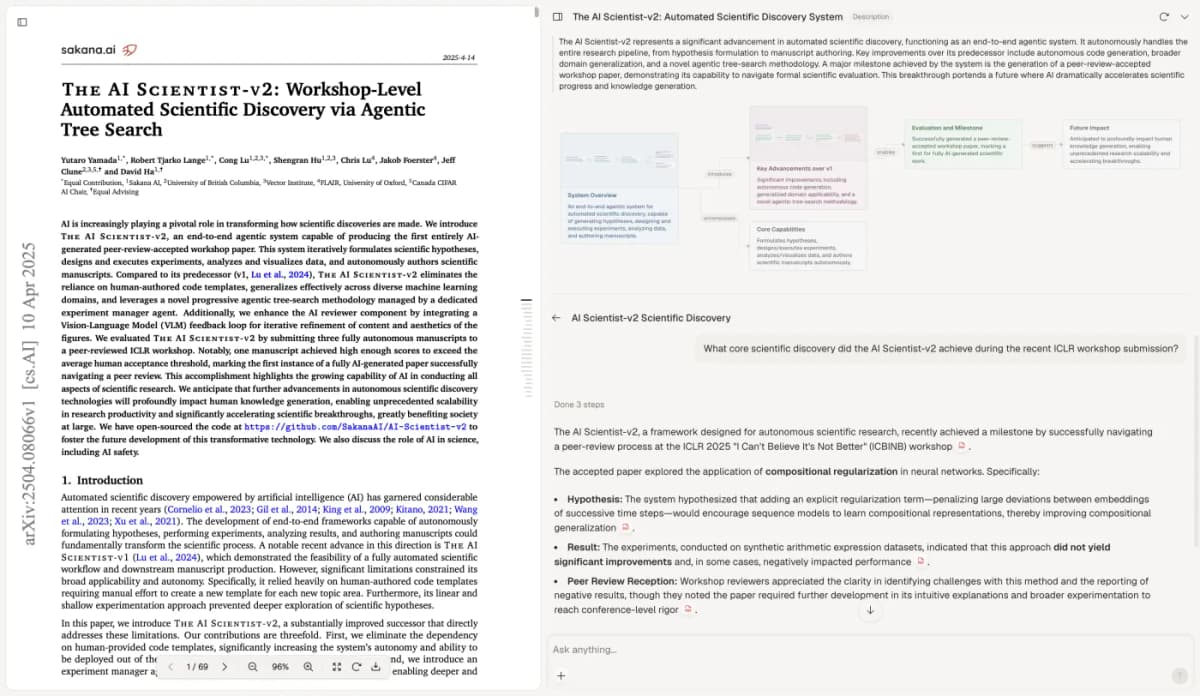
Real Atlas source-check capture. The visible AI Scientist-v2 paper by Yutaro Yamada and colleagues, licensed CC BY 4.0, appears unchanged within the screenshot. It is unrelated to the fictional excerpts and does not demonstrate coding accuracy.
The same review action applies to your coding sources: inspect the passage and correct the note. A citation marker does not make the proposed code right. Atlas cannot establish an unspoken motive, verify consent, or decide that your categories are complete.
Save the selection rationale
For each code you keep, write what it means and where its source text is. State what fits, what does not, and why you chose it. Keep other possible codes and open questions beside it. The memo helps you revisit the choice when new text changes how you see it.
Sbaraini and colleagues describe memo-writing alongside coding and comparison in their actual study. Keep that link between the data and your reasons in your own work. The code list shows what you chose; the memo explains what that choice adds.
A broader qualitative coding workflow can help organize the next pass. Keep testing focused codes as you read more material.
The expert FAQ makes clear that grounded theory involves linked methods beyond coding; three excerpt comparisons do not establish saturation or a finished theory.
Check the passages behind your focused codes
Compare initial codes with their supporting source excerpts.