
Open Coding: Label Qualitative Data Without Losing Context
Open coding gives first-pass labels to data segments. See a source-linked example, compare labels across cases, and keep coding decisions with the researcher.
- Byline

Summary
Open coding gives a short, tentative label to a part of the data. The term has a key place in Straussian grounded theory.
Keep the source passage beside each label. Compare cases that seem alike and cases that differ before naming a wider category.
A suggested label is a draft. It cannot prove full coding, coder agreement, or a finished grounded theory study.
Open coding is an early pass through qualitative data. You give a short, tentative label to a meaningful part of an interview, field note, or document. The label helps you notice and compare an idea; it is not yet a settled category.
Suppose a participant says, “I checked the booking page each night, but no slot appeared.” You might first label that passage repeated booking attempts. Another label, service access barrier, may also fit. Keep the line and its context beside both options.
In Atlas, you can compare selected sources and open citations while reviewing such options. The researcher still reads and codes the data.

Atlas

Compare coded passages in Atlas
Inspect source passages while reviewing provisional labels.
What open coding does
A segment is the span of source text you study. A code is a short name for an action, idea, or condition in that span. In open coding, you may rename, split, combine, or drop the code as you read more data.
A memo records why you chose a label and what to check next. A category is a broader idea you build later by comparing several passages. One label from one passage is too thin to serve as a category.
The unit need not always be one line. A line-by-line pass can help at the start, while a longer answer may be needed to understand one action. Preserve enough text to hear what the speaker meant.
The research-method textbook describes naming concepts in small parts of the data. An open-access methods chapter places these labels in a longer process of comparing cases and building categories.
Place coding in your method
“Open coding” has a particular place in some grounded theory traditions. In the Straussian approach, analysts break data into parts, identify early concepts, and later examine links among them. The familiar open, axial, and selective labels come from that context. They are not a required sequence for every study.
For the later task of joining categories around a tested central explanation, see the selective coding guide.
The method comparison by Rieger distinguishes classical, Straussian, and constructivist approaches. Constructivist work often calls the early pass initial coding and a later pass focused coding.
Classical grounded theory also differs in how it develops categories. Choose the terms and practices that fit your study's stated method.
Open versus axial coding
In the Straussian framing, open coding asks what is happening in a segment and names possible concepts. Axial coding asks how categories and conditions relate. Both depend on continued comparison with the data. A coding pass in another tradition may use different terms or a different path.
If you are conducting inductive thematic analysis, explain coding within that approach. If you are choosing a tool for a wider range of qualitative work, see qualitative coding software. A code label alone does not establish which method you used.
Choose a clear first-pass aim
For the first pass, choose a small set of material and a question you can keep in mind. Ask what a person did, felt, or tried to accomplish. If your study is about access to a service, booking repeatedly may tell you more than a broad label like service.
Use that question as a guide while staying open to surprising ideas. If a passage does not fit your first list, note it. That may become a new code, a memo, or a reason to revise the question.
Label a passage provisionally
Read a short source span and the text around it. Mark the exact line, page, or time range so you can return later. Write a label that stays close to what the segment shows. If the label implies a motive the person did not state, write a second, more cautious option.
Make one record at a time
For each passage, keep the case ID, source locator, a short excerpt or faithful summary, your tentative label, and a reason. Add an alternative label and a next check. This separates what the source says from the meaning you are testing.
You can use a participant's own phrase as an in vivo code when it captures something distinctive. You can also name an action in your own words. Neither form is automatically better. Compare how the label works on other incidents, then write a memo on its scope.
The in vivo coding guide shows how to keep an exact phrase tied to its speaker, source passage, and case context. If your question is about what people do and how an action changes, process coding gives those actions gerund labels while keeping time-order claims tied to source text.
Keep the surrounding account
A sentence about “having no time” could refer to a crowded work schedule, a hard booking window, or low priority for the service. The words alone do not settle the code. Read the question that prompted the answer and the speaker's next lines before labeling it.
Do not turn each line into a detached token. A short excerpt can carry several ideas, and one idea can stretch across a longer answer. The chosen segment size should let another reader find and check your decision.
Example passage-to-label record
The three cases, excerpts, and line numbers below are wholly hypothetical. They are invented for teaching. No participant said these words in a real study. The question is how students tried to use a campus support desk.
| Case and source | Fictional segment with context | Provisional label | Alternative and rationale | Next check |
|---|---|---|---|---|
| A, lines 42–48 | “I checked the booking page each night, but no slot appeared.” The speaker later called the desk. | Repeated booking attempts | Online access barrier may fit if the booking system, rather than timing, drove the problem. | Read A's next answer and compare other booking accounts. |
| B, lines 71–78 | “I had no time after my shift.” B says the desk was open but travel from work took an hour. | Travel constrained by work | Limited hours is possible, but B mentions distance more clearly than desk hours. | Check B's account of alternative routes. |
| C, lines 96–103 | “I had no time to book.” C says support was not a priority during exams. | Deferring support during exams | The phrase “no time” echoes B, yet the stated reason differs. Keep the two incidents apart for now. | Check whether C later describes a failed attempt. |
Table 1: The same phrase appears in B and C, but it does different work. B describes travel after a shift. C describes a choice during exams. Merging both under lack of time would lose that difference. A may belong with either case only after you learn why the booking attempts failed.
From label to memo
A useful memo might say: “No time may refer to travel, desk hours, or priority. Check the next transcript for which condition the speaker names. Keep B and C separate until then.” This is a research question, not a final category.
The table keeps an alternative label in view. You can later reject it with a reason. A record with only the final label hides the choice.
The research-method textbook stresses returning to the source as concepts are compared.
Compare labels across cases
After a few passages, compare incidents that seem alike. Ask whether the same action, condition, or meaning is present. Then compare an incident that seems different. The constant comparative method extends this check across new incidents, earlier examples, and provisional categories. Do not merge labels because two people use the same word, or split them only because they use different words.
Check a counterexample
Suppose a fourth fictional case found an open slot but declined it. That challenges booking barriers if the code implies the system blocked everyone. The reason may concern timing or trust. A negative-case analysis helps test the claim against such cases.
If the contrast changes your code, update the memo with the old label, the new label, the passage, and the reason. If evidence is thin, keep both labels provisional.
A framework matrix can help compare cases later. Its case-by-theme chart serves a different job from this first labeling pass.
Decide when a category is warranted
Look for a pattern across several incidents and ask what makes them similar. Check cases that do not fit. A category should help explain a set of observations and still point back to the source data.
The open-access grounded-theory chapter treats comparison and later integration as work beyond first labels.
Do not claim that a short table proves saturation or finishes a theory. Those judgments require your study's sampling, memos, comparisons, and method. A thematic analysis guide may use a different path from codes to themes.
Next step: inspect candidate labels in Atlas
Add transcripts or notes that you are allowed to use to one Atlas project. Type @ in chat and select the small source set you want to compare. The public Atlas guides support mentions, structured source comparison, citation opening, and saved notes. They do not establish a dedicated coding database or complete retrieval of every relevant segment.
In these selected transcripts, compare the passages about booking the support desk. For each case, give a short source-linked summary and two possible first-pass labels. Keep any reason or uncertainty the speaker states. Do not merge cases. Mark anything that needs a source check.
Open each citation and read the nearby text. If Atlas blends cases, ask it to separate them. If a label suggests a motive the source does not state, change the label or leave a question. The researcher decides which passages to code and whether the comparison fits the chosen method.
Save the corrected labels, locators, alternatives, and questions in a note. Keep a formal codebook and the full coding record in the system your study uses. Atlas can help inspect selected source claims; it does not calculate coder agreement or validate codes.
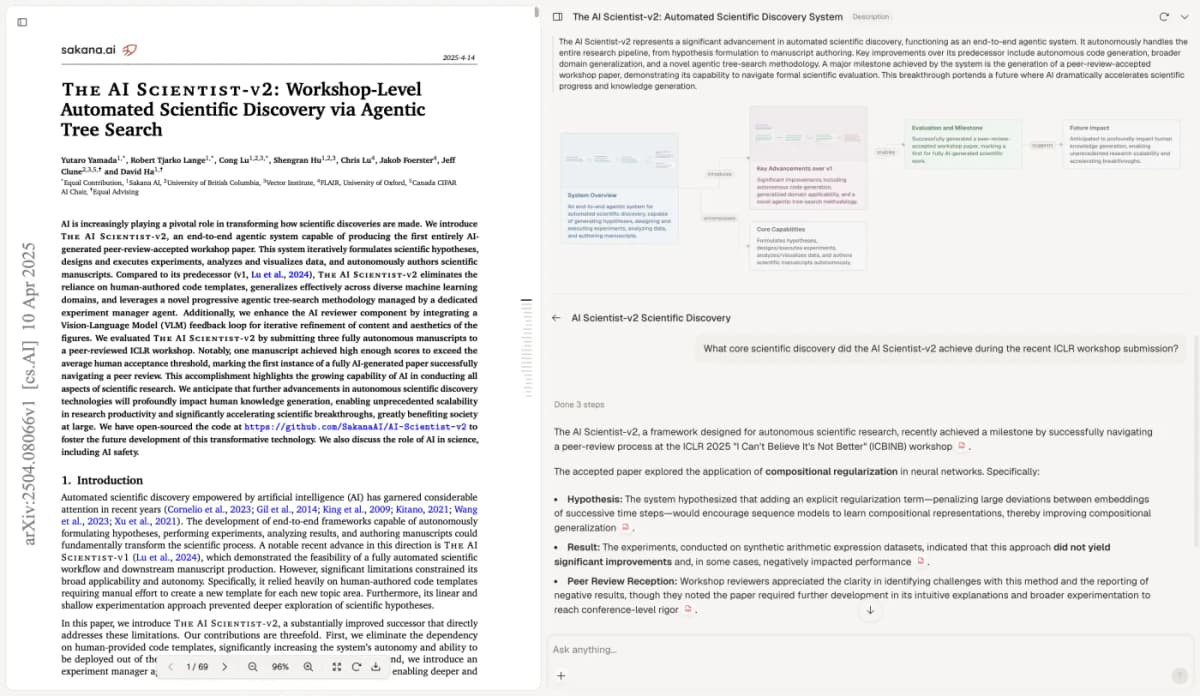
The screenshot shows a research paper beside a cited Atlas answer. The paper is unrelated to the fictional interviews and is not a coding database. The view illustrates the source check needed before you accept a suggested label.
Keep the analysis researcher-led
An AI answer about selected passages is a prompt to inspect the data. It is not a line-by-line pass through every transcript. Re-read the corpus in the depth your method calls for, including parts a search or summary may have missed.
Write down changes to your labels and why you made them. Keep a case's surrounding account, a possible alternative, and the source locator with each decision. Seek permission for any data you put into a tool and follow the study's data rules.
Open coding gives you a way to ask better questions of the material. The next step is continued comparison, memo writing, and category work under your chosen method.
The methods chapter shows why a first set of labels should remain open to revision.
Atlas
Compare coded passages in Atlas
Inspect source passages while reviewing provisional labels.
Frequently Asked Questions
It is an exploratory reading of qualitative material that gives short, provisional conceptual labels to meaningful segments. The researcher compares incidents and revises labels as the analysis develops.