
Process Coding: Name Actions Without Inventing a Sequence
Process coding labels actions in qualitative data with gerunds. Learn to trace source passages, compare changes across cases, and avoid inferred timelines.
- Byline

Summary
Process coding names actions in qualitative data, often with gerunds such as “seeking help” or “changing plans.”
Keep each action code beside its source passage and distinguish what a person did from what they only considered.
A cross-case table can show possible transitions, but the researcher must verify order and interpret the process.
Process coding is a way to name actions in qualitative data. The label is often a gerund, a verb ending in -ing: asking for help, waiting for a reply, or changing a plan. Read the source for an action before choosing the label.
Suppose a fictional interview note says, “I sent the form on Monday, then called when nobody replied.” A first pass might mark sending a form and following up by phone. The order is in that sentence. If a second note says only “I thought about calling,” calling would overstate what happened.
Atlas can help compare selected text and cite the lines behind a proposed label. You still choose the codes and decide whether the source supports a sequence. The example below is invented for teaching.

Atlas

Check action evidence in Atlas
Compare selected excerpts, open citations, and save a checked action memo.
What process coding labels
A process code points to something a person does or describes doing. A gerund helps keep the analyst's eye on action. The Oregon State University qualitative-method guide describes gerunds as the common form for these labels.
A topic code such as appointment says what the passage concerns. A process code such as seeking an appointment says what the person is doing. Neither is inherently better. Choose the one that helps answer your research question.
Actions may be visible events, reported actions, or broader social moves such as negotiating a rule. State which kind you have. An interview can report that a person “asked twice”; it does not let you observe either call directly. A field note may capture the call but miss the person's reason.
The published coding study uses process codes for actions and decisions in a different setting. It shows why order can matter; it does not make every qualitative question a process question. A code remains a researcher's reading of a source span.
When action codes fit your question
Process coding is useful when your question asks what people do, how they respond, or how a practice changes. Interview accounts of seeking help, field notes of a handoff, or diary entries across weeks can supply such material.
Ask whether you have enough text about action. A survey answer that says “the service is slow” offers a judgment. You might code judging service speed, but you cannot infer that the respondent called a manager or stopped using the service.
The BMJ method article notes that gerund labels can help researchers attend to process over time. A single retrospective sentence may still leave timing or cause unclear. Your method should match the study question and the source material.
Use open coding if the first job is broader, provisional labeling of what is in a passage. Use in vivo coding if the participant's exact phrasing matters to the analytic question.
Process coding may use the participant's words, but its job is to name the action. Those approaches can coexist when a researcher can explain why each was used.
Code an action in its source context
Read the whole exchange or field-note entry before labeling one line. Mark the actor, what happened, the source locator, and any words that limit the claim. “I was planning to appeal” is an intention. “I appealed yesterday” is a reported action. “They appealed” is someone else's account of an action.
Try a short gerund label that a later reader can check: planning an appeal, filing an appeal, or reporting another person's appeal. The labels differ because the source evidence differs. Do not compress them into appealing merely because the words look alike.
Keep one alternate label when the text allows two readings. Perhaps “asking for a supervisor” reflects escalating a complaint or seeking an answer. Read the response and the speaker's goal before deciding. Record what evidence would settle the choice.
For a formal study, preserve the segment and memo in the system that holds your coding record.
The SAGE publisher page for Saldaña's manual identifies the broader coding resource. The specific gerund convention is documented in the Oregon State teaching guide.
Work through an action-code example
The following fictional interview excerpts concern a public clinic's appointment form. I-01, I-02, and I-03 are made-up source labels. No real participant said these words. In a study, retain the exact transcript location and enough surrounding context to check the label.
| Fictional source text | First action code | Alternative or limit | What the source says about order |
|---|---|---|---|
I-01: “I sent the form Monday. On Thursday, I called to ask if it arrived.” | sending a form; following up by phone | The call could be a status check; the speaker gives no complaint. | This speaker reports sending before calling. |
I-02: “I wanted to phone, but I waited for an email.” | waiting for a reply | Planning to call names an intention. The speaker reports no call. | Waiting is reported; no call is reported. |
I-03: “I called first because the online form kept failing.” | calling for help; trying the form | Check whether “kept failing” refers to several attempts or one session. | This speaker says the call came after a form attempt, but gives no dates. |
Table 1: The table does not prove a common path from form to phone. I-01 and I-03 both mention a form and call, yet their reasons differ. I-02 never says they called at all. A neat three-step flow would erase that difference.
Write a memo before making a wider claim: “Two cases report a call after a form event; one case reports waiting and a plan to call. Check the full accounts for dates and whether the call was for status, help, or escalation.” The fictional text leaves this question open. A real clinic finding would require real study data.
A negative-case analysis can test a proposed path against cases that do not fit. A comparative analysis guide helps choose common dimensions before comparing cases.
Check the evidence for a sequence
A code for an action is not yet a code for a transition. “I called” and “I waited” can appear in one account without telling you which came first. Time words such as then, before, and a date may help. They still need a speaker and context.
Separate three levels in the memo: reported order (“Monday, then Thursday”), inferred order (the analyst thinks one event led to another), and causal claim (one event made the next happen).
Each step needs more support than the last. A stated order alone does not show cause.
The published coding study examines sequences in students' work in its own data. That is an example of why time can matter. It is not evidence that the fictional clinic accounts share the same path.
If a transcript is cut off, mark the missing interval. If a speaker changes the story later, keep both lines and ask which account the research design treats as evidence. Let the source set the limit of the code.
Compare cases and revise labels
Compare each new action with earlier cases. Does following up still fit when a person calls for urgent help rather than an update? You may split the label into checking status and seeking help. Keep the old code and the reason for the change in a memo.
Look for a case that challenges your first pattern. In the invented set, I-02 shows that waiting can follow a plan without a call. If more cases have this shape, a claim that “patients always escalate by phone” fails. The revision may be a narrower claim about some cases or no cross-case sequence at all.
A useful comparison record includes source, excerpt, action label, alternative, timing evidence, and a decision. It should let a second reader see why two lines share a code or why you split them.
The Oregon State guide places coding alongside memo writing and pattern checks. A code starts the analysis; later checks test what it means.
This is not formal process tracing, which tests causal mechanisms against evidence under a specific research design. Do not call an action-code list a causal chain.
Check selected excerpts with Atlas
Add transcripts or field notes you are allowed to use to an Atlas project. Select a small set with @ in chat.
Ask for cited text that shows a named action and a possible contrast: “Across these selected interviews, find reported form submissions and follow-up calls. Cite each line, keep cases separate, and flag an intention to call as an intention.”
Open every citation and read around it. Check who acted, when, and whether a phrase states an action or only a plan. If Atlas joins events from two cases, ask for each case separately. Correct the labels in your own coding record. Save a checked comparison and open questions in an Atlas note if that helps you return to the sources.
Atlas supports cited comparison of selected text, as its public source-synthesis guide explains. It does not code the full corpus, calculate coder agreement, detect every event, or certify a time order. The researcher chooses segments, codes, and method.
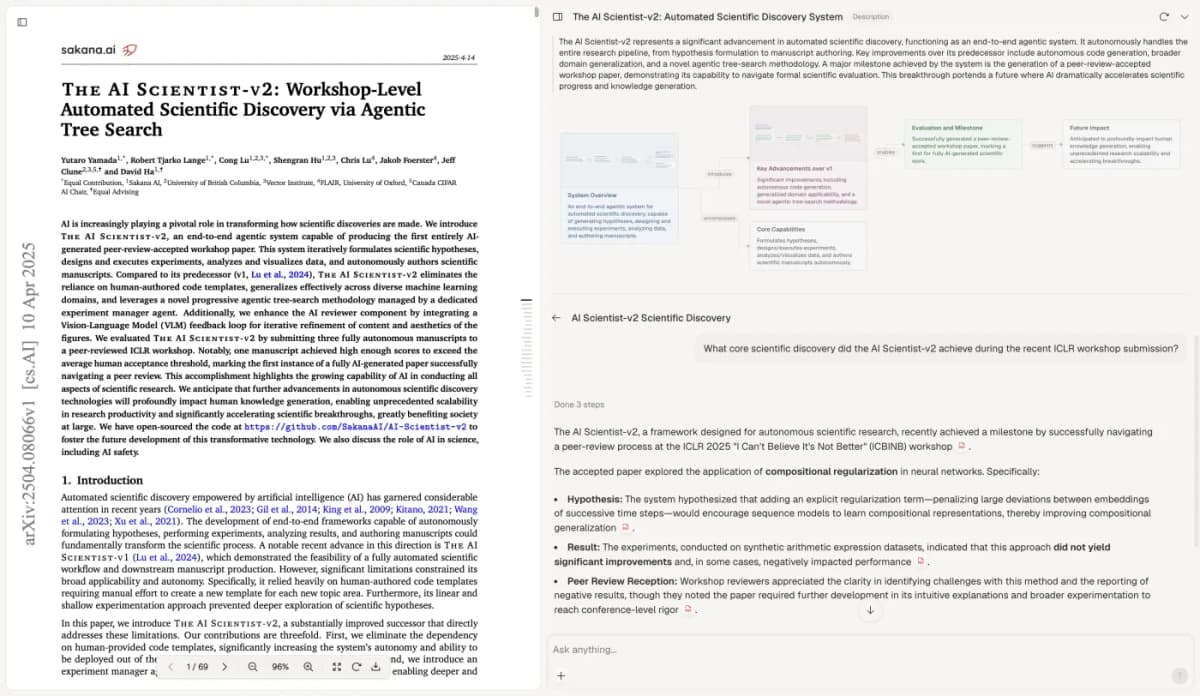
Atlas citation-inspection view. The visible scientific paper is unrelated to the fictional clinic excerpts and does not supply evidence for them.
Keep the researcher's decisions visible
Before reporting a process, ask whether each code names an action in its cited text. Check the actor, timing, and source context. Mark any proposed transition as reported, inferred, or unsupported. Preserve counterexamples and reasons for code revisions.
If the data support only a list of actions, report that. A claim about a shared path needs more than a repeated verb. The next step is a researcher-led comparison across the full study corpus, with limits stated and claims tied to source text.
For tool choices across wider qualitative work, the AI research assistants comparison covers a separate decision. Use Atlas here to inspect selected evidence and keep checked notes. Maintain the formal coding record in the system your study uses.
Atlas
Check action evidence in Atlas
Compare selected excerpts, open citations, and save a checked action memo.
Frequently Asked Questions
It is a coding approach that names actions in data, commonly with gerunds, so a researcher can examine what people do and how actions may change.