

Your paper reports interviews about how first-year students seek help with their studies. A keyword such as "student success" sounds like a fit. But did the paper study success, or just what students said about seeking help?
Choose research paper keywords by checking what each term describes in the finished paper. Keep the passage and the journal's rules beside your choice. Pay close attention when a term would make the study seem broader than it is.

Check manuscript keywords in Atlas
Compare candidate terms with your paper and journal instructions.
What research paper keywords describe
Research paper keywords are terms you supply to describe the paper's main subjects and ideas. The journal collects them as metadata, or details about the paper, often with the title and abstract when you submit.
They may name a topic, group, method or setting that matters to the study. The term should help a reader see what the paper covers. Check that it does not promise a design or result your work cannot support.
Author keywords differ from subject headings assigned by a database. Oermann and Murphy's guide explains that readers may search author terms supplied by the publisher. Those terms do not decide the assigned headings.
These terms serve a different job from a literature search. In a search, you may combine many words to find other papers. Your author keyword list describes this paper and must fit the journal's rules for that list.
Read the target journal's keyword rules
Read the rules for the journal and type of paper you plan to submit. Note the number of terms, phrase length, separator, case and any required vocabulary. Check the submission field as well as the template.
There is no count that fits all journals. JMIR's keyword rules ask for several terms separated by semicolons. They describe a larger typical list than some guides suggest. This is guidance for JMIR.
Do not assume every journal bans words used in the title. Some guides favor terms that add coverage, while a journal may ask for a specific term. Check what each choice adds and follow the rule that applies.
For the fictional example below, assume the journal asks for four to six keywords and allows phrases. It does not require a controlled vocabulary. Use these teaching rules for the example and check your own journal's rules separately.
Extract candidates from the completed paper
Read the purpose, methods, results and conclusion, then cross-check the research paper abstract. Build a small pool of terms for the main topic and what makes the study distinct. Keep each beside the passage that shows it fits.
Start with what you studied. In the fictional paper, that is academic help-seeking among first-year university students. "Education" names the wider field but says little about what the paper asks or who took part.
Check the method and setting next. The paper may support "qualitative interviews" if that is the design it reports. Choose a setting term when it helps describe the study's question, methods or findings.
Check terms for outcomes with care. A student saying help was useful does not show an effect on grades or staying at school. A term that names those outcomes could give the wrong idea about what the study measured.
Treat the literature review as background. A trial you cite may explain why you did the research, while your own study uses interviews. A word can appear many times and still be a poor keyword for your design.
Use a research paper outline to find sections in a long draft. Make the final choices from the finished passages. The methods or claims may have changed since you first wrote the outline.
Build a checked keyword selection table
The fictional paper reports 18 interviews with first-year university students about seeking academic support. It covers peer advice and formal services and uses thematic analysis. It does not test an intervention or measure grades.
The table checks terms against those facts. For a real paper, give exact section references or cited passages. Keep the reasons for rejected terms, so a choice that lacks support does not slip back into the next draft.
Fictional candidate keywords checked against manuscript content and journal constraints
| Candidate | Supporting manuscript passage | Selection decision | Rationale or unresolved check |
|---|---|---|---|
| Academic help-seeking | Purpose examines how students seek academic support | Retain | Specific central topic. Check terminology used by the target discipline. |
| First-year university students | Methods identifies all interview participants as first-year students | Retain | Describes the studied population without generalizing to every student group. |
| Qualitative interviews | Methods reports 18 interviews | Retain | Describes the data-collection method. Match the manuscript's final design wording. |
| Student success | Introduction discusses achievement, but results report accounts of seeking help | Refine or omit | Replace with a supported concept if available. Grades and retention were not measured. |
| Randomized controlled trial | Background cites an intervention trial by other authors | Reject | The candidate describes a cited study. This manuscript did not randomize participants. |
Table 1: The last term is wrong for this design even if it appears often in the introduction. It describes a cited trial. A keyword describes the paper you submit, so check which study the phrase names before you keep it.
The fourth row needs more thought. If the paper studies what success means to students, the term might fit. This example only reports accounts of seeking help. The broader outcome claim does not have support in those facts.
You still need a fourth term under the fictional journal's rule. Return to what the study did. You could consider "thematic analysis" if the final methods section reports that approach and the journal accepts terms for methods.
Check controlled vocabulary and synonyms
A journal may ask for a named thesaurus or controlled vocabulary, a defined set of terms. Check which one it requires. MeSH serves biomedical subject indexing. It is not a default vocabulary for papers in every field.
The NLM's author-keyword guidance says to check journal rules and use the MeSH Browser to find a suitable specific heading. Read its scope note, which explains what the term covers, before you choose it.
MeSH separates the preferred heading from entry terms, as NLM explains for authors. An entry term can help you find a record, but nearby words do not all mean the same thing. Check what the concept covers and where it sits among broader and narrower terms.
Review machine suggestions as candidates. NLM describes MeSH on Demand terms as machine generated and different from human indexing. Each still needs to describe your paper and meet the journal's rules before you use it.
If the journal does not require a vocabulary, read terms in relevant recent papers and ask a subject librarian when needed. Another paper can show how the field uses a word. You still need to check its fit with your own study.
Choose synonyms that keep the same meaning. "First-year students" is narrower than "university students." If a new term changes the group or outcome, treat it as a new claim and check its support in the paper.
Write out an unfamiliar acronym unless the journal or field asks you to do otherwise. Check that the full form describes the study. A short form used in nearby literature still needs that check before it joins your list.
Coordinate keywords with title and abstract
Keywords are part of how you describe the paper. Pottier and colleagues' 2024 guide gives advice across the title, abstract and keyword regions. Read those parts together when checking what the paper promises.
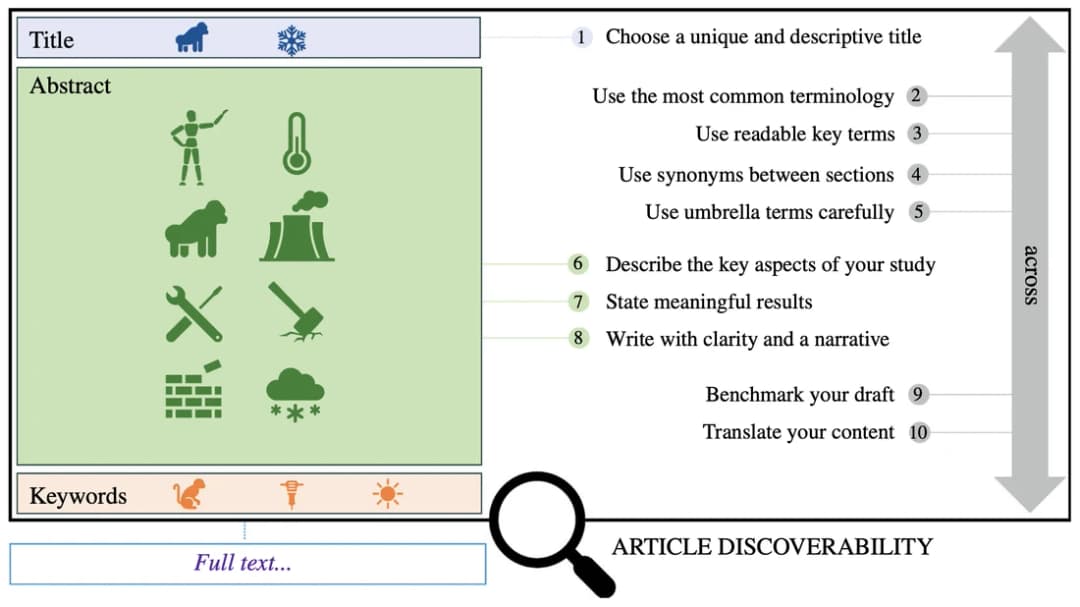
Pottier and colleagues, 2024, Figure 1, CC BY 4.0. Exact figure hosted by coauthor Philip Downing, encoded as WebP.
The figure shows where the title, abstract and keywords sit. It advises use of common and readable terms, synonyms across sections, and clear accounts of what the study did. Check those points against the actual paper.
Use the figure to review the parts together, while following the journal's rules. Its advice does not guarantee search rank or more citations. The journal survey behind the article concerns ecology and evolutionary biology, so keep that scope in view.
If you use a structured abstract, its methods and results headings can help you find those checks. The keywords should agree with the paper's claims, whether the abstract has headings or runs as one block.
Verify candidate keywords in Atlas
Create an Atlas project with the finished manuscript, current title and abstract, journal rules and term sources. Add only sources you may upload. Check privacy and access rules when the paper contains confidential information.
Choose Ask a question and use @ to mention those sources. Ask for a bounded check, then Send. Require a passage from the paper and a check against the journal's rules for each proposed term.
A useful request is: "Check these author keywords against my paper and journal rules. Show the passage that supports each, whether it describes my own study, whether to keep, refine or reject it, and term checks still open."
Open the numbered citations. If "randomized controlled trial" cites the review, check whether the passage describes someone else's study. Read the text around the citation. The term's presence in the paper alone does not make it a fit.
Correct the term using the methods section. Ask for a new table that keeps cited background apart from your own design. Check a term for the sample against the rules for who took part, too. It may be too broad.
Check claims about journal rules against the source you supplied. A reply should not impose five keywords when your journal asks for a different range. Keep a vocabulary match open until you have checked the term's meaning.
Use New and Note to save the checked list and its reasons, then wait for Saved. Keep rejected terms when the reasons help explain a choice you may revisit after peer review. This saves the basis of the decision too.
Atlas helps compare the passages and rules you supply. You choose the final terms and check the submission. A reviewed list does not guarantee assigned subject headings, acceptance or that a reader will find the paper.
Finalize the submission keyword list
Review the list after the last major change to the paper. If you remove an analysis or narrow the sample, a term may no longer fit. Compare the final title, abstract, paper and metadata fields together before you submit.
Ask coauthors to review the reasons for each term. First settle whether it describes the study. Then discuss how broad or familiar it should be, and check the journal's count, punctuation and preferred vocabulary.
Keep the final list with its sources and the date you read the rules. If you change journals, check the new rules again. You should be able to defend each term as an accurate, permitted description of this paper.
Check manuscript keywords in Atlas
Compare candidate terms with your paper and journal instructions.