
A cover letter for journal submission tells the editor what your paper adds and why it fits the journal. Start with the target journal's current author rules. They set the need for a letter, what goes in it, and where other details belong.
The hard part is making a short, supported case for what the work adds and fit. This guide works through a fictional study, maps each claim to its source, and repairs wording that goes beyond the source support. Add your paper and journal guidance to Atlas to draft that evidence outline, then check the cited passages yourself.

Check the evidence behind your letter
Compare the manuscript, journal scope, and cover-letter rules.
What the journal letter should do
Give the editor a clear account of the paper's title, article type, question, main finding and contribution, and fit to the journal. Explain the case in your own words rather than pasting the abstract.
Taylor & Francis's guide makes that distinction and asks authors to check journal-specific rules first.
A letter is not a place to claim more than the paper found. A small, bounded study can make a useful contribution without being described as the first, definitive, or practice-changing result. The authored scientific-writing review advises keeping claims supported by the paper.
Keep the target's review criteria in view. For example, PLOS ONE's criteria assess technical rigor rather than perceived impact. A broad “high-impact breakthrough” pitch does not replace the case that the work meets the journal's actual criteria.
Gather the evidence before drafting
Use three source sets: the latest paper, the journal's scope or criteria page, and its current letter rules. Save the access date with web guidance. If the paper changes, check the letter against that version again. A research-paper analysis workflow helps find the claim and its limits before shortening it.
Locate the contribution in the paper
Find the question, method, result, and limit you need for a concise account. Note a page, section, or table for each. State what your work adds to the relevant literature, without treating your own search as proof that nobody has done anything similar.
Use your literature-review source support to support any narrower novelty claim.
State what the work adds as a clear answer: which setting, data, or comparison does the paper add? AJE's writing guide recommends showing fit to the actual scope rather than offering a generic claim of interest.
Check the target's letter rules
Do not transfer required statements from one publisher's template into another journal's letter. PLOS ONE asks for a one-page separate file and a summary of the contribution and specified editorial details. It puts requests for help with fees elsewhere.
Current Elsevier support says funding, author declarations, and suggested or opposed reviewers should not go in the letter.
Springer Nature support asks authors to confirm that they approve the paper and it is not under review elsewhere.
These are examples of differing rules, not a combined broad checklist. Read the chosen journal's own rules and current submission fields.
Worked contribution and fit outline
Imagine a fictional paper called “Queue Changes After an Advising Desk Redesign.” It describes one campus before and after a new desk layout. There is no control campus. A fictional journal's scope includes empirical studies of student services, and its letter rules ask for a summary of what the work adds and why readers would care.
The outline below maps each proposed sentence to a clear paper or journal source and its limit.
| Letter purpose | Fictional source evidence | Supported outline | Claim to remove |
|---|---|---|---|
| Identify the paper | Title page lists title and research-article type | Request consideration of the named research article | A different title or unverified article category |
| Explain the result | Results report shorter median waits after the layout change | Describe shorter waits in this campus during the study | The redesign caused shorter waits everywhere |
| Explain what the work adds | Discussion describes the layout and queue record in detail | Offer a documented service example for comparison | This is the first study of student-service queues |
| Explain journal fit | Scope includes empirical student-service studies | Connect the setting and source support to that scope | The editor will accept the paper because it fits |
| Confirm required facts | Author approval has not yet been checked | Keep a pending check outside the final prose | All authors approve, inferred from their names |
Table 1: Fictional evidence outline for teaching the claim-checking process. It is not a submitted paper or a real journal's scope.
Turn the outline into a paragraph
A supported draft might read: “Our single-campus study describes queue times before and after an advising desk layout change. It adds a documented service example, including the layout and queue-recording method. The topic aligns with your journal's stated interest in empirical student-service research.”
That scope is made up for this example. Use the real journal's scope and your own source support when you draft.
That paragraph does not need a broad novelty claim. It also avoids saying the layout caused the change. If your actual design supports a cause claim, explain it at the level supported by the paper and its analysis; do not borrow the example's limits blindly.
Keep the letter separate from the abstract
The abstract summarizes the study for readers. The letter explains why this paper suits this journal. Use the same findings, but select the details that support that narrower case.
Taylor & Francis recommends a concise explanation in your own words.
If a result changes during revision, update both texts. A polished letter with an old result can still mislead the editor. A source-linked paper summary can help you keep the current finding and its limit together.
Repair claims and verify declarations
For the fictional study, replace “Our redesign proves how to eliminate campus waiting” with “We report shorter median waits after a layout change at one advising desk.” The repair preserves the seen result and setting. It drops a claim of cause and a promise about all campuses that the study does not support.
Remove “the first study” unless you have a defensible literature basis for that exact claim. You can often explain what the work adds more clearly by naming the data, method, setting, or question added. AJE's guide supports naming the specific contribution and fit.
Confirm statements with the authors
The paper does not prove that each author has agreed to submit it. Nor does it prove there are no conflicts or that related work is not under review elsewhere. Ask the responsible authors and record the answer. Silence in a paper is not a no-conflict declaration.
Then place each statement where the target asks for it. A general template does not prove that the statement is true or that it belongs in the letter.
The current Elsevier guidance illustrates why location matters; the Springer Nature guidance illustrates a different requirement.
Check the letter outline in Atlas
Add the latest paper, current scope page, and letter rules to one project. Include only material you have permission to upload. Label the source versions so you can tell which instruction and paper passage supports a row.
- Select those sources with
@mentions in a bounded question. - Ask for a contribution and fit outline, with source passages for the question, finding, limit, journal scope, and letter requirements.
- Open each citation and read its context. Check the result's direction, setting, and limits against the paper.
- Remove unproven cause, novelty, or broad-impact claims. Keep facts the authors have not checked out of the final wording.
- Correct requirement locations against the target's current rules. Do not let a generic publisher template override a journal-specific instruction.
- Choose New → Note, save the reviewed outline and open questions, and confirm Saved.
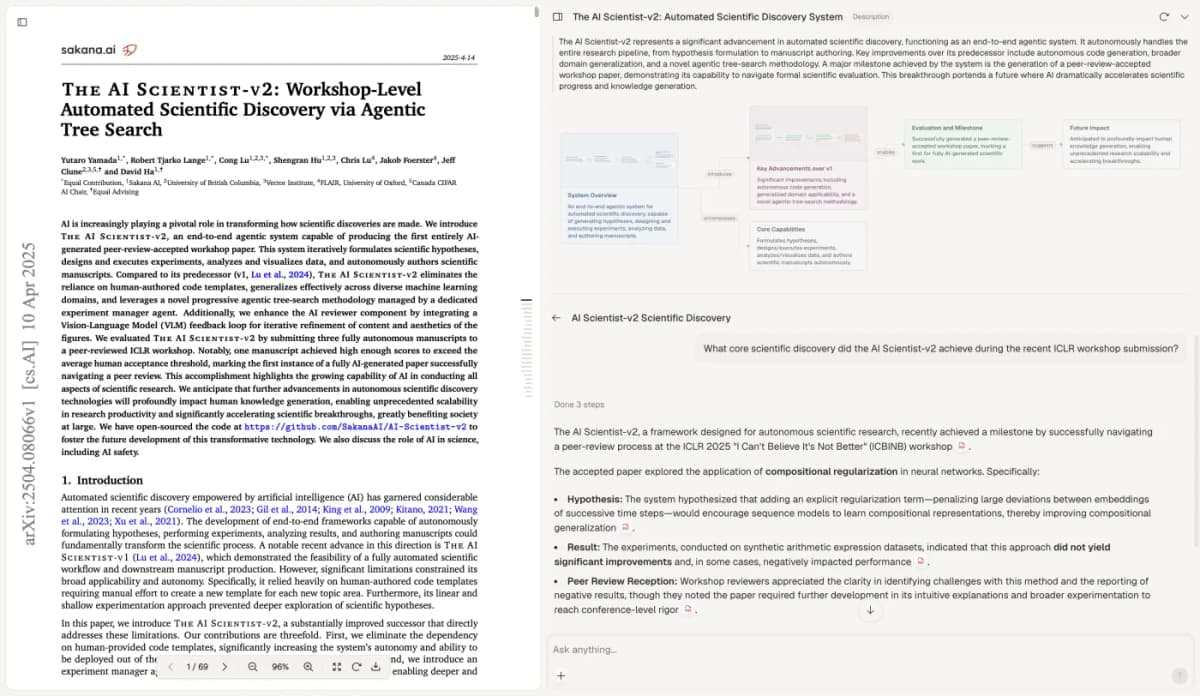
The unchanged Atlas citation-checking view displays Yamada et al.'s AI Scientist-v2 paper, licensed under CC BY 4.0. It demonstrates passage inspection, not the fictional paper or a completed journal letter.
Try: “Using this paper, scope page, and letter guidance, map claims about what the work adds and why it fits the journal to passages. Mark unproven novelty or cause wording and find statements that need an author to check them.” Inspect the draft before turning any row into letter prose.
A citation marker does not prove that the source supports the whole sentence. If it only states the journal topic, it cannot establish acceptance. Save the narrower wording and the source location that actually supports it.
Review the final submission package
Check the journal name, editor or appropriate salutation, paper title, article type, file format, and length. Recheck each claim about what the work adds and why it fits against the saved outline. Confirm all required statements with the authors and remove pending placeholders before submission.
If you are resubmitting a revision, follow the editor's rules and keep the detailed point-by-point response to reviewers in the requested response document.
For a first submission, focus on what the paper adds and why it fits. The final letter should be short, accurate, and tailored to the current target; it cannot promise a review or acceptance.
Check the evidence behind your letter
Compare the manuscript, journal scope, and cover-letter rules.