
Research Implications: How to Write Them With Evidence
Learn what research implications mean, how they differ from recommendations, and how to write clear theoretical and practical claims from a study finding.
- Byline

Summary
Research implications are the possible effects of a study's findings on theory, practice, or the next study, within the study's limits.
Trace each implication from a specific finding through an interpretation, relevant prior work, and a boundary condition.
A recommendation proposes an action. An implication explains why an action or new question may be warranted.
Research implications tell readers what a finding may mean beyond the result itself. A finding reports what happened. An interpretation explains a plausible meaning. An implication asks what that meaning could change for a concept, a practice, or the next question a field studies.
The bridge matters. If three interviewees describe a schedule barrier, the finding can justify examining access hours in that setting. It cannot show that changing hours would solve every access problem. Source checks and clear limits make the implication useful.
Atlas can help compare selected project sources and open the citations behind a proposed comparison. The researcher still decides what the evidence warrants.

Atlas

Check the source behind your implication
Compare selected papers, open citations, and keep a checked note.
What research implications mean
An implication is what a finding may mean for a wider question. It can shape a theory, a choice at work, or the next study. It goes beyond the result, yet it must still follow from it.
The UW–Madison Writing Center's discussion guide asks writers to link main results to past work. They then can ask what those results mean for theory and practice. The guide also asks for proof behind each claim and warns against claims that go too far.
For example, “Three people could not visit the service during posted hours” is a finding. “The hours may be one barrier for them” is a reading of that finding. “The service could test later pickup times” is a practical implication. The last claim points to a test. It does not report an effect already shown.
A recommendation asks someone to act: “The campus should add a pickup window next term.” Elsevier Author Services draws this line between what may follow and what to do. The campus would still need to weigh cost, risk, and more proof before acting.
Separate theory, practice, and next studies
The study method and the evidence it yields set the reach of each claim. A theme from a few interviews may suggest a question to test; a strong trial may support a more direct action claim.
What a finding may mean for theory
A theory gives a way to explain what happens. Suppose people who can use a service still do not visit it.
The study might raise a new question: Does “access” include both hours that fit and a sense of privacy? That could help refine a model. It does not prove the old model wrong.
What a finding may mean for practice
A service team might test a later pickup window, a more private route, or clearer steps. A small interview study can point to a problem worth checking. It cannot show that any one fix will work, how much it will help, or what it will cost.
What the next study could test
The next study can ask what is still unclear. It might look at another group, compare two sites, or test a change. “More research is needed” says little. “Compare visits before and after a new pickup slot” names a real gap.
These types can overlap. A new view of access may lead to a pilot. The pilot may then change that view. Keep each claim clear so readers know what this study found and what a new study must test. Loughborough University's guide also asks writers to explain meaning and limits rather than repeat the results.
Build a claim from the finding
Start with one result
Start with one key result. State it in plain terms. Then ask what may explain it. Could another cause fit? Does it agree with past work? A literature review process can help you find and sort that past work before you make the claim.
A short check sequence can keep the inference visible:
- Finding: What exactly was observed, by which method, among whom, and where?
- Interpretation: What might explain it? Which parts are directly supported, and which are inferred?
- Prior evidence: Which relevant source agrees, conflicts, or studied a different population or outcome?
- Countercase: What observation makes the first explanation less complete?
- Implication and boundary: What could follow for theory, practice, or a next study, and where does that statement stop?
This is a writing aid, not a score. Read the full source before you use it. A paper may study a different group or outcome.
A short quote may hide a condition that changes its meaning. Use a paper analysis workflow to keep those checks tied to the source.
Check the case that does not fit
The UCSF discussion guide moves from the answer and its proof to wider meaning, limits, and next steps. Each step should be easy to follow.
If a case does not fit, change the claim rather than hide the case. The UW–Madison guide asks writers to deal with such gaps. A narrow claim that holds up is more useful than a broad one built from only neat examples.
Work through a fictional example
This example is fictional. The study, interview IDs, excerpts, and source locators below are invented for teaching. They are not research results or an Atlas-generated analysis.
Imagine a small study at one campus. It asks how students who commute use a food pantry. Three say its pickup hours clash with work or travel. A fourth can go at those hours but feels too exposed at the entrance.
The team has no trial of new hours. It has no data from other campuses. Those gaps matter when the team writes its qualitative analysis.
A first draft reads: “The pantry's hours cause low use, so every campus should extend them.” The study cannot support that cause or that rule for every campus. The ledger keeps the useful insight and the case that does not fit.
| Step | Fictional evidence or question | Bounded writing decision |
|---|---|---|
| Finding | P1, 03:20; P2, 06:10; and P3, 09:05 describe time conflicts. P4, 04:42 says the hours work but the entrance feels exposed. | Report both the repeated schedule account and the privacy countercase. Do not infer prevalence from four interviews. |
| Interpretation | The first three accounts make schedule fit a plausible barrier. P4 shows it is not the only possible barrier. | Write “schedule fit may matter for some commuters here,” not “hours cause low use.” |
| Prior evidence | The team has yet to check whether relevant campus-access studies discuss schedules, privacy, or different populations. | Locate and inspect those sources before claiming agreement, novelty, or a theoretical gap. |
| Implication | The pattern may justify testing another pickup window; P4 may justify examining privacy separately. | Frame these as local possibilities to evaluate, not a proven solution or policy mandate. |
| Next test | A service team could pilot pickup options and record uptake and participant experience. | Name feasibility, consent, and equity checks before recommending a lasting change. |
Table 1: The ledger blocks two shortcuts. A person's account alone does not prove why they act. And a local finding does not justify a broad policy. A brief limits sentence at the end cannot fix a claim that leaps past the proof.
For theory, the team might ask: Does a model of access need to include time fit and privacy? The interviews make that worth a look. They do not prove a new model.
For practice, the campus could test a new pickup slot and also ask about privacy. A firm plan would need a choice by the service team. They would need to check local need, cost, student wishes, and risk.
Write the paragraph in your paper
Put the wider meaning after the finding and your reading of it. In many papers this goes in the discussion. Some put a short form in the close. Check your journal's rules or your school's guide. There is no one slot for every paper.
The paragraph needs the finding, your view of its meaning, the past work, and a limit. It can then say what the result may mean for theory, practice, or a next study. Do not repeat each number in a table. Loughborough's guide draws this line between what you found and what it means.
Here is a model paragraph for the fictional pantry study, with prior literature intentionally left as a check rather than invented:
Three students who commute said pantry hours clashed with work or travel. One could visit at those hours but felt exposed at the entrance. Hours may be one barrier at this campus, alongside privacy. Before we link this pattern to past work, we need to check how other studies define access. A local test of new pickup slots could show whether the change helps. These talks alone cannot show its effect or justify a campus-wide rule.
The first draft says hours cause low use everywhere. The new version names a local finding and a test. It leaves room for past work to change the claim. If another study points to a different cause, cite it and explain the gap. A quick search cannot prove that your result is new.
If you need to argue for a campus policy, a position paper can set out the proposal, reasons, and counterargument for that audience. This one study's implication remains narrower than a policy verdict.
For nearby tasks, research paper analysis helps you read a source closely. The literature review process helps you set sources in order. The implication is the claim you make after those checks.
Check prior evidence in Atlas
Atlas can help compare the sources. Put only material you may use in one project. Name the papers or notes in a chat. Ask: “What does each source say about hours, privacy, and access? Show its study group, method, finding, and limit. Cite each claim.” The public Atlas source-comparison guide describes this step. The UW–Madison discussion guide asks writers to compare new findings with past work.
Open each cite and read the source around it. If two papers use “access” in different ways, note that gap. Do not blend their claims. If Atlas skips a paper, read it yourself and fix the note. This source check helps meet the Loughborough discussion guide's call to interpret findings against past work.
Save a note with the source location, the claim you may make, the case that does not fit, and what would change your mind. That record helps keep a proposed action apart from a finding's meaning, as Elsevier's writing guide advises.
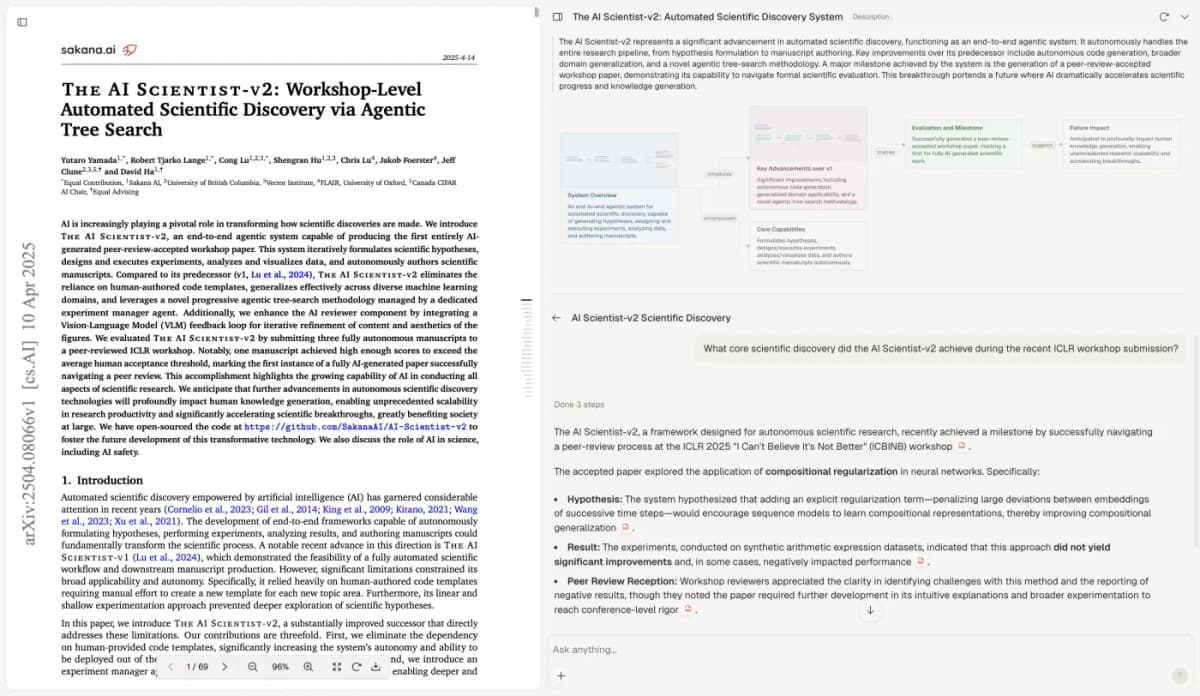
This first-party Atlas image shows an answer beside an open paper. The paper is about AI science, not the pantry case. It shows where to check a cited passage. It does not show Atlas proving the claim.
Those steps can help keep a chain of proof. They do not show cause, prove a theory, find every key source, or make a policy choice. The researcher must read the papers and own the final claim. For a broader view of that duty, see AI-assisted qualitative analysis.
Keep the implication within scope
A useful claim should fit the study. Ask what its design can show. A small set of talks can shed light on a place or a possible cause. It cannot tell you how common a view is in a whole group. A link between two things does not by itself show cause.
A fair test of a change may support a stronger claim. Even then, state who took part, where it took place, and what was measured. The UW–Madison guide asks writers to give proof for each claim.
Keep the measured outcome in view. More visits do not by themselves show that students felt safe, got enough food, or found the service easy to use.
Look for other ways to read the result. Did the people you chose shape the pattern? Could the question's words have done so? Does one case point to a second path? Say what you checked and what is still open. Loughborough's discussion guide asks writers to deal with results they did not expect.
Match the words to the proof. “May be worth a test” and “at this site” can fit early work. But soft words cannot hide a leap. If you cannot point to the finding and past work behind a claim, leave it as a question. Elsevier's writing guide also warns against claims that outrun a study's scope.
The person who writes the study may not be the one who can act. A team that runs a service needs to check costs, risks, and better outcome data before it makes a change. Your source-linked claim gives that team a clear question to test.
Atlas
Check the source behind your implication
Compare selected papers, open citations, and keep a checked note.
Frequently Asked Questions
They are reasoned statements about what a study's findings may mean for theory, practice, policy, or future inquiry, with the study's scope and limits made clear.