
Position Paper: Build a Claim, Evidence, and Counterargument
A position paper defends a debatable claim with checked evidence. See a worked argument map, counterargument, outline, and audience-specific format tips.
- Byline

Summary
A position paper states a clear, arguable view on an issue, supports it with evidence, and answers a serious objection.
Build the paper from a claim, reasons, source passages, and a fair counterargument before drafting full paragraphs.
Assignment rules vary. A Model UN paper, an academic essay, and an organizational statement need different formats and source conventions.
A position paper argues for one defensible view of an issue. It tells readers what should be believed or done, why the evidence supports that choice, and how the writer answers a serious objection.
Imagine a fictional campus debate over later library hours. “Libraries matter” is a topic. “Pilot two late evenings during exam weeks, then review use and staffing costs” is a position readers could challenge. An argument map can link that claim to the relevant source passages and to a fair case against it.
Atlas can help compare selected papers or reports on both sides and show citations for checking. The writer still decides which evidence is sound, how to represent the opposing view, and what claim follows.

Atlas

Check both sides of your argument in Atlas
Compare selected sources, inspect citations, and save your argument map.
What a position paper does
A position paper states a debatable claim and defends it for a named audience. An academic paper may answer a course prompt; an organization may ask a policymaker to act; a Model UN delegate may represent an assigned country's view. The form changes, but a position needs reasons that can be examined. If the task asks for advice on a legal issue, use a legal research memo to frame the question, check authority, apply it to facts, and give a qualified answer.
The Agnes Scott College writing center describes a stand that goes beyond a personal reaction. Specific facts, quotations, and arguments support it. A neutral tour of both sides leaves the reader without a position to assess.
Four parts keep the draft clear:
- Claim: What the writer wants the reader to accept or do.
- Reason: Why that claim could be sound.
- Evidence: The source detail that bears on a reason.
- Response: What a strong opposing view gets right and why the claim still holds, perhaps in a narrower form.
A source does not argue by itself. The writer must explain how a passage supports a reason and how that reason supports the claim. The Purdue OWL argument guide stresses that the link between a cited fact and a conclusion still needs reasoning.
Choose a claim worth defending
Start with the issue, audience, and assignment. Ask what decision the paper should help readers make. Then write a working thesis: a sentence that takes a side and sets a manageable scope. This is an evidence plan as well as a writing choice, because it tells you what facts you must find.
The older Rutgers-hosted position-paper handout suggests a real dispute, distinct positions, and a topic narrow enough to handle. OpenStax adds that a working thesis may change as the writer gathers evidence and hears objections.
Turn a topic into a thesis
For the fictional library issue, “Should the library stay open later?” is a question. “The library should stay open later because students need space” takes a side, but its scope and evidence are still loose.
A stronger working thesis might be: The campus should pilot two later library evenings during exam weeks, provided it can staff the hours safely and check whether students use them. The claim names an action, a time frame, and conditions under which the plan should be reviewed. It also tells the writer to seek evidence about demand, staffing, and access.
Name the audience and burden
A student assignment may ask for a thesis and cited scholarship. A campus committee may need a costed proposal. A policymaker may need a specific action. Write down what the audience already knows, what it doubts, and the standard of evidence it expects.
The Rutgers-hosted handout asks who the readers are and which evidence will matter to them. This does not mean telling each audience only what it wants to hear. It means making the claim specific enough for that audience to judge.
Map reasons to source evidence
Before drafting paragraphs, make a small map. Put the claim at the top. Under it, list two or three reasons, the source passage for each, and the step that connects the passage to the claim. Add the strongest objection and its best source. Keep a blank where support is still missing.
The map is a working tool, not a substitute for reading. A study may measure a different group from the one in your claim. A policy report may give a recommendation rather than evidence that the recommendation works. Open each source and check its setting, date, measure, and limits.
Separate fact from inference
Suppose a campus report says some students use the library after dinner. That fact alone does not show that two extra evenings are affordable or safe. The writer needs to explain why it matters, what else is required, and which part of the proposed policy remains unproven.
OpenStax's writing guide asks writers to gather information for their reasons and the opposing view.
A research-paper synthesis workflow can help when several papers disagree. This page turns that reading into a defended claim.
Keep a source trail
For each map entry, save the source title, page or passage, the source's actual claim, and the point you plan to make. Mark whether the passage supports the point, qualifies it, or challenges it. If a source does not answer the question, leave the gap open.
The Purdue OWL guide warns that reasons do not support conclusions simply because they appear in the same paper. A traceable passage lets the writer test the link before putting it in prose.
Work a position paper example
The campus, committee, and source pack below are fictional teaching material. No student survey, staff memo, or budget note was conducted or retrieved for this guide. The IDs illustrate how a writer could record exact locations in real, permitted sources.
The first claim, keep the library open later every night, is too broad for the sample pack. It ignores staff cost and a transit concern. The map instead tests a smaller pilot.
| Argument part | Fictional source note | What the writer can say |
|---|---|---|
| Reason for a pilot | Student council note F1 says several members lack a quiet study place in exam weeks. | This suggests a need worth checking; it does not measure campus-wide demand. |
| Reason to choose exam weeks | Library desk log F2 notes its busiest late hours during exam weeks. | This supports trying a limited period, pending a real check of the log and its dates. |
| Strong objection | Staffing note F3 says late cover would require paid shifts and a safe close. | A nightly extension is not yet justified. Cost and staff safety need a plan. |
| Revised position | F1 and F2 point toward a time-limited trial; F3 limits its scope. | Propose two trial evenings with staffing and a review point, then decide on any extension. |
Table 1: This fictional map shows how the staffing objection changes the scope of the claim. It does not prove that any real campus should adopt the plan. A real writer would replace F1–F3 with checked source passages and add the institution's actual decision rules.
Turn the map into an outline
One possible paper outline is:
- Introduction: State the exam-week access problem and the limited pilot thesis.
- Reason one: Explain the need for study space, using a checked source and naming whom it covers.
- Reason two: Explain why exam weeks are the proposed period, with the desk-log limits visible.
- Counterargument: Present the staffing and safe-close case in its strongest form.
- Response: Show how a limited pilot, staff plan, and review date address part of that objection; leave any unresolved cost open.
- Conclusion: Ask the named committee to consider the trial and state what evidence should decide whether it continues.
This order is a teaching example. The Rutgers-hosted handout gives an outline that starts with the other side.
OpenStax treats drafting and revision as a cycle. Use the order that best serves the assignment and readers.
Answer the strongest counterargument
Find the objection a fair reader would take seriously, not the easiest one to dismiss. In the fictional example, staff cost and a safe close are stronger objections than “some people do not like libraries.” The reply must deal with those concerns on their terms.
The Harvard College Writing Center recommends thinking about where readers may reasonably disagree.
The Purdue OWL guide asks writers to represent that view fairly and explain their response. If the objection survives, revise the thesis.
Concede what the source supports
A fair paragraph might say: The staffing note raises a real cost and safety limit. It weakens a nightly-hours proposal. A two-evening exam-week pilot would need agreed staff cover, safe closing, and a review before any wider change.
That paragraph does not pretend the objection vanished. It shows why a narrower claim may remain worth considering and what must be checked first. If no feasible staffing plan exists, the proposal should change again.
Recheck the conclusion
Compare the final thesis with every paragraph. Has the writer changed from “a trial may be justified” to “late hours will solve access” without new evidence? Has a source about one group become a claim about all students? Has the strongest opposing evidence been quoted with enough context?
Harvard's counterargument guide allows that an objection may reveal the need to narrow or rethink a thesis. A good response earns its force from the evidence and reasoning, not from confident wording.
Check your source trail in Atlas
Atlas can help review selected research papers, reports, and notes before you write. Add material you are permitted to use to one project. In chat, mention the chosen sources with @ so the comparison has a clear scope.
Ask: “For my draft claim, list passages that support it, passages that challenge it, and key limits. Keep each source separate. Cite each passage. Do not write the position for me.” Then open each cited passage. Read around it and check that the answer did not turn a narrow result into a broad claim.
Inspect the answer beside a source
If a claim lacks a citation, search the source yourself or leave the map entry open. If a cited report describes a different setting, note that limit. The AI source-checking guide gives a fuller check for plausible answers and weak support.
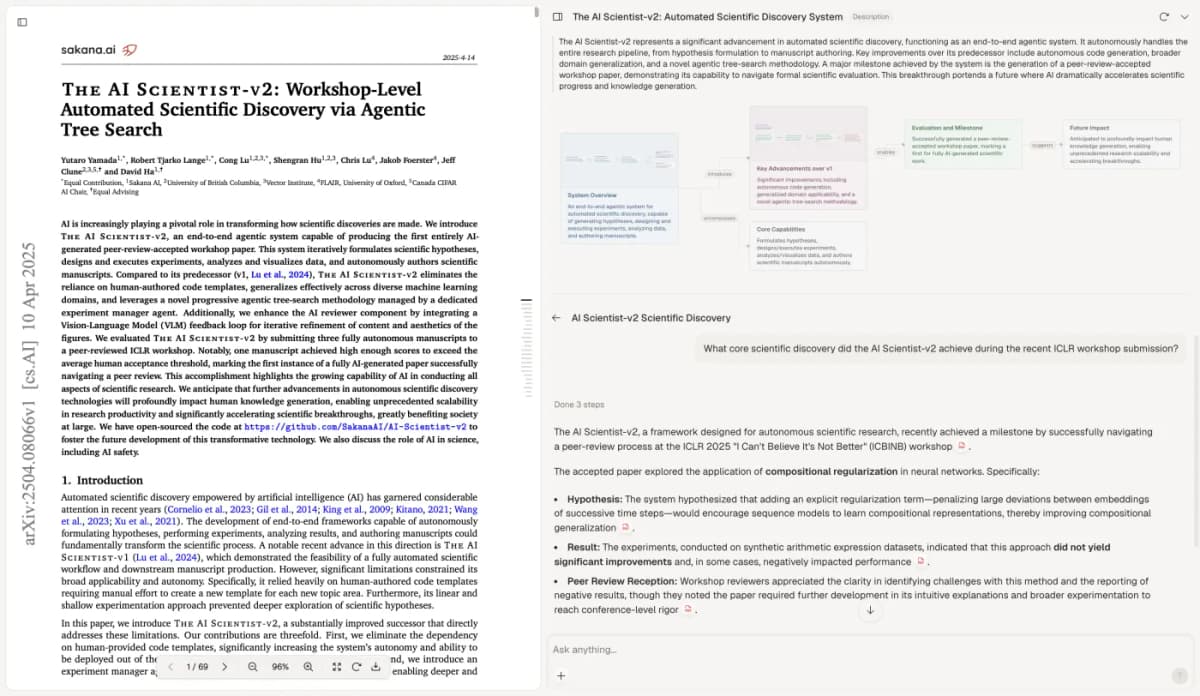
The image below shows an Atlas answer beside an open source. The visible paper is unrelated to the fictional library-hours example. It shows where a writer can inspect text while checking a draft argument map.
Save your argument map
After checking the passages, save a note with the thesis, reasons, source locations, objection, and gaps. The note can guide a draft. Atlas does not choose a side or judge whether the source set is complete. The research-paper analysis guide can help you read one source closely.
Match the assignment and audience
There is no universal page count or citation format for a position paper. Read the actual prompt, journal, organization, or conference rules before setting the outline. The shared core is a clear stance and support; the required voice, format, and end action vary.
An academic position paper often needs a thesis, cited evidence, and an answer to opposition. An advocacy paper may ask a policymaker to act.
The UNICEF Youth Advocacy Guide Workbook treats a short position paper as preparation for a stakeholder meeting or conference. State the action you want this audience to take, and use its required format.
A Model UN paper speaks for the assigned state and follows that conference's instructions. The NMUN position-paper page has its own rules for length, source references, original writing, and AI disclosure.
Check those rules at submission time. They do not set the form of an ordinary course essay.
Before submitting, test one last sentence: Does the conclusion say only what the checked reasons and answered objection warrant? If the answer is unclear, narrow the claim or do more source work. That revision is part of writing a sound position.
If the assignment asks what a study's findings mean for future work, the research implications guide addresses that evidence-to-next-step task. A position paper instead defends a chosen stance for its audience, so its call to act must match the reasons and counterargument it has tested.
Atlas
Check both sides of your argument in Atlas
Compare selected sources, inspect citations, and save your argument map.
Frequently Asked Questions
It is a paper that takes a defensible stand on a debatable issue, gives reasons and evidence for that stand, and addresses a serious opposing view for its intended audience.