
Limitations of the study explain what your evidence can support and where a claim needs to change. Link a fact about the study to the claim it affects. A small sample or tight deadline needs an explanation of why it matters.
Start with the claim you want to make, then trace it through the results and methods. Keep the source passage, your reason, and the revised claim together. The worked example shows how to turn that record into prose.

Check limitation claims in Atlas
Find study passages and keep your checked reasoning beside them.
What counts as a study limitation
A study limitation affects how you read or use a finding. It may concern who was studied, what was measured, or which groups could be compared. Explain why it matters for the question and claim at hand.
For example, a survey of workshop attendees can describe their views. It needs more support to describe every student on campus. The same choice of sample has different effects on those two claims. In an ecological study design, check whether group measures have been stretched into claims about individuals.
Separate chosen scope from its consequences
Writers call chosen study boundaries delimitations: its campus, period, group, or topic. A limitation explains what follows from that choice. Studying one campus may suit the aim while leaving use elsewhere untested.
A workshop study need not answer every question about library services. Focus on gaps that affect its aims or claims. If a claim has grown beyond the research objective, narrowing it may be part of the fix.
Find constraints in the study evidence
Read the question, methods, results, and conclusion together to find the evidence for the broadest claim. Lasting change, for instance, needs more support than a measure taken just after an event.
Keep the page, section, or table behind each possible limit. When you have access, check the report against the protocol and study records. They may answer questions the paper leaves open.
Read across methods and results
Check who could enter the study and who took part in the final analysis. Read what each score or answer measures. Check when it was collected and which changes the timing could reveal. A ceiling effect is another measurement limit to check: scores already at the top of a scale leave little or no room to record further gains. A small score change can therefore hide change the measure could not capture.
Explain those links before naming a flaw: missing answers may affect whose views the result reflects, while a short study may leave long-term change untested. The label should follow that explanation.
STROBE's guidance for observational studies asks authors to address bias and its likely size and direction. Ground that judgment in evidence, stating what you cannot establish.
Keep reporting gaps as open questions
An absent account of how missing answers were handled calls for a check of the study records. STROBE's reporting guidance addresses missing-data methods. Until you resolve the gap, say the report leaves this unclear.
Connect limitations to specific claims
Consider a fictional study of a library workshop. Students volunteered after an invite to attendees. A web survey asked about their confidence at the session's end. Some did not answer, and the study had no later follow-up.
These facts are invented for teaching. The page numbers belong only to this imagined report. Use them to see how to trace a study limit back to its evidence before choosing the final wording.
Build the claim-to-limitation table
Use one row for each study fact that affects a claim. Keep the revised claim beside its evidence so a reviewer can check both at once.
| Report evidence | Claim being checked | Limit and open question | Revised claim |
|---|---|---|---|
| Methods, p. 2: volunteers drawn from attendees at one campus | All students found the workshop useful | Students who stayed away were not asked | Attendees who answered described their views |
| Survey, p. 3: confidence rated after the session | The workshop improved research skill | The study did not test skill directly | The report describes confidence ratings after the session |
| Methods, p. 3: no baseline or comparison group | The workshop caused higher confidence | The design lacks those comparisons | The report cannot show a confidence gain caused by the workshop |
| Results, p. 4: some answers missing, with no group comparison | Positive views reflect all attendees | Views of those who did not answer are unknown | The views describe those who answered |
Table 1: Each row narrows a different claim. The rows do not estimate the size of any bias or prove the whole fictional study useless.
Keep the second and third rows separate: whether confidence measures skill differs from whether the workshop caused a change. A skill test would address one issue without supplying the missing baseline or comparison.
Prioritize by the conclusion at stake
For a study of attendees' views, the first and fourth rows matter most. For a claim about improved skill, the measure and missing comparisons are central. Set priorities through the claim you need to assess.
No later follow-up means lasting change remains untested. That gap needs less space if the aim concerns only views at the session's end. Keep it visible if someone uses the finding to predict later behavior.
For use at another campus, check how its students and workshop differ. The external validity guide develops that question. Adding sites alone would not settle whether their results apply to your setting.
Write the limitations paragraph
Turn a checked row into prose by stating the study fact, explaining its effect, and bounding the claim. Add what could close the gap when it helps the reader, tying future work to the issue you have described.
Wordvice's writing guide suggests naming a limit, explaining its impact, and proposing future work. Use that sequence as a writing aid while following your publication's rules for length.
Replace a label with a mechanism
A weak sentence would be: “This study was limited by sampling bias and self-report.” It leaves the reader to guess who was sampled, what was reported, and which claim needs to change.
A more useful paragraph would read:
Students volunteered from one campus's workshop attendees, so the results do not show how other students viewed the session. The survey recorded confidence after the workshop, but did not test research skill. With no baseline or comparison group, the report cannot show that the workshop caused a confidence gain. The findings describe the views of those who answered. Broader effects and lasting change remain untested.
This original teaching paragraph rests on the fictional facts above. It retains a useful finding and removes the unsupported claim about improved skill. It does not accuse students of false answers or assert that a bias occurred.
Add a specific future question
For the skills claim, a later study could test students on a defined research task. It would also need suitable comparisons to assess change caused by the workshop. Plan those methods before collecting more survey answers.
For the sample concern, ask which students are absent and how to learn about their views. More of the same attendees would leave that gap open. Settle the reasoning before polishing the sentence.
The Manchester Academic Phrasebank offers ways to describe study limits and future work. Choose words that fit the evidence. A polished phrase cannot supply a missing study fact.
Keep uncertainty and mitigation distinct
Separate a possible problem from evidence that it occurred, then ask what effect it may have had. The report may support one of these judgments while leaving the other open.
This matters for missing survey answers. AAPOR's Standard Definitions explains that a response rate alone cannot establish nonresponse error or its size. Check how the groups differ in ways relevant to the study.
Do not invent a bias direction
In the fictional study, “missing answers inflated satisfaction” is unsupported. Students who disliked the workshop might have skipped the survey. Those who liked it might also have skipped it. The report cannot settle which happened.
Write that the missing views and bias direction are unknown, using relevant group comparisons if available. AAPOR explains why the rate alone is insufficient.
Describe what mitigation actually addresses
Suppose students could answer without giving their names. That may help them feel free to criticize the workshop. It would not reveal the missing views, turn a confidence score into a skill test, or create a comparison group.
Keep each method's claimed benefit tied to the issue it addresses. Say the limit was overcome only when evidence supports that claim. A future study may close a gap later. It does not change what this study found.
Check source passages in Atlas
Atlas can help find passages in a supplied report and keep them beside your reasoning. Add material you are permitted to use, then confirm it has finished processing. Keep the report and relevant supplements ready to check.
Open a chat, type @, and select the report. Mention a supplement if it holds the details you need. Choose Project only to prevent new web or literature searches. Earlier outside evidence in the chat remains available.
Ask about a named conclusion
A bounded prompt for the fictional example would be:
In this report, find passages about the sample, confidence measure, comparison groups, and missing survey answers. Which support the claim that the workshop improved research skills? Separate report facts from possible effects and open questions. Cite each passage. Do not assume an unreported step was omitted or estimate bias without evidence.
Open each citation and read the text around it. Check that it belongs to the right report and supports the fact. If a precise passage is unavailable, find the section yourself before keeping the entry.
The screenshot shows a citation preview beside a ColPali paper and an Atlas answer. Compare the claim with the source text. The pictured paper is unrelated to the fictional workshop and does not show an assessment of study limits.
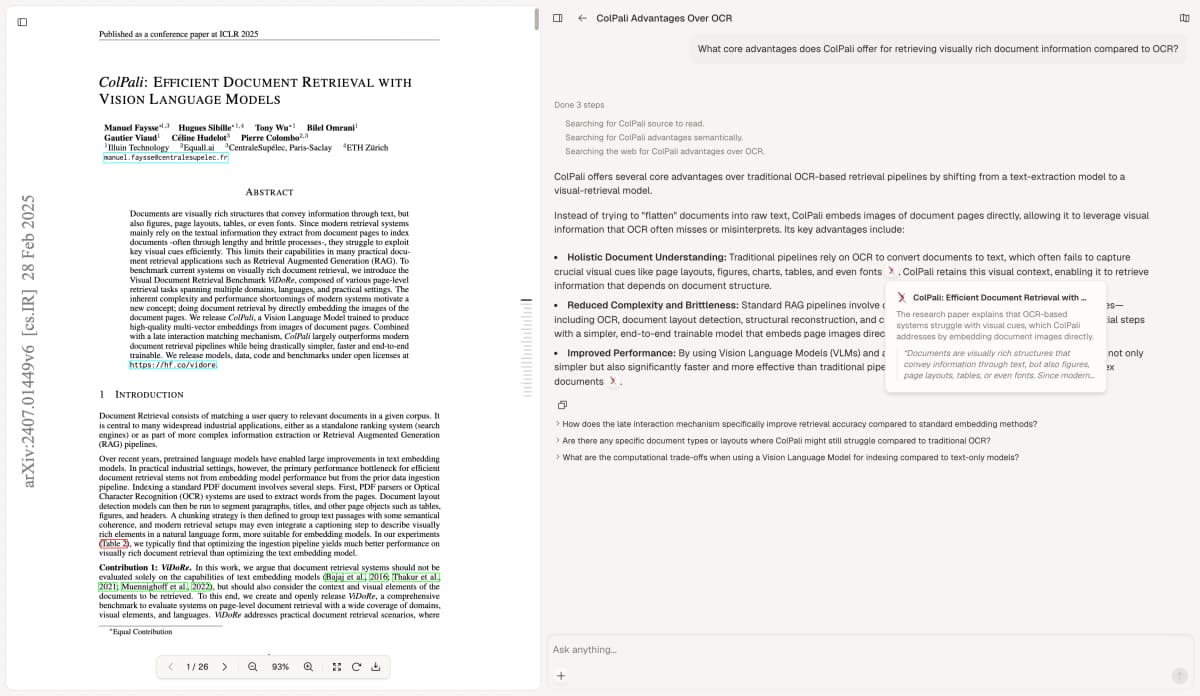
Opening the citation lets you read the source context before accepting wording in the answer.
The displayed paper is ColPali, by Faysse and colleagues, under CC0 1.0. The capture retains the original pixels.
Correct implications before saving
If an answer says missing survey answers inflated positive views, ask for the supporting passage. When the source only reports missing answers, keep the direction unknown. Save the corrected entry in the table.
Create a note through New, then Note, and save the study reference, checked passages, your judgment, and the paragraph. Wait for Saved before leaving the note.
Mark open questions for the study team. Check the design and analysis with them when needed. Atlas helps organize text, while the researchers assess the methods and make the required disclosures.
For a review of several studies, keep each study's limits distinct before combining findings. The paper synthesis workflow explains that next step. A gap in one report need not apply to the whole field.
Review the section before submission
Read the limitations against the abstract and conclusion to check that both retain the same bounds on a broad claim. ICMJE asks for consistency between abstract and text.
Check that each material limit has a study basis and an explained effect. Separate report facts from judgments based on other records. Resolve technical questions with the study team or methods support.
Keep the contribution within its evidence
The fictional report can still inform discussion of attendees' views. Its stated facts cannot show campus-wide approval, improved skill, or lasting causal effects. Keep what the evidence supports and make its bounds clear. Our discussion-section guide shows how to connect those bounds to the meaning of a finding and its comparison with prior work.
Follow the required format
Research articles commonly address study limits in the Discussion. ICMJE's guidance asks authors to discuss limits and avoid unsupported claims. Your journal or thesis handbook sets the required format.
Use the space needed to explain the key limits, unknowns, and their effects. A fixed count of limitations cannot replace that judgment. Check that a reviewer can trace each claim and see why it matters.
Check limitation claims in Atlas
Find study passages and keep your checked reasoning beside them.