

The purpose of the study says what you will study and how far the inquiry extends. It links the problem you have found to the question you plan to answer. A useful statement names the subject, the people or sources you will study, and what you plan to learn from them.
Suppose your draft promises to prove a service works. Yet your plan only asks users what seeking help was like. The sentence then promises more than the study can show. Fix that mismatch before polishing the wording, and check the purpose against the rest of your plan.

Check what your purpose promises
Compare your problem, purpose, question, and method sources.
What the purpose statement does
A research purpose describes the inquiry and leaves its result open. Wisconsin's writing guidance distinguishes a purpose statement, which sets out scope and direction, from a thesis, which states an argument or conclusion. A proposal should leave room for findings that disagree with your expectations.
The problem explains what needs investigation and why it matters. The purpose states what this study will do. The research question asks what it must answer.
Your research objectives break that inquiry into specific aims. These parts should refer to the same subject and scope, even though they perform different jobs.
Your program may ask for one core sentence or a short purpose section with context. Capella's dissertation guidance connects a focused question to the wider problem it may help address. Follow your own rubric for placement and length; a generic script is not a substitute.
Choose words your design can support
Begin with what you will study. Name the action, the subject, and the people, sources, or setting involved. Include the planned approach when your rubric requires it. Details such as how you will invite people belong in the methods section unless the reader needs them to grasp the purpose.
Choose an inquiry verb
Words such as describe, explore, compare, and estimate point to different tasks. Choose the word that fits your question and sources. A label such as qualitative or quantitative is a starting point. You still need to explain how the study will answer the question and why its claims fit what you can learn.
An interview plan might explore how students describe seeking advice. A survey might estimate how many respondents report difficulty obtaining it.
A comparison could examine differences between groups, but a claim that one service caused a change needs a defensible causal design. Choose that design with appropriate methods advice before promising the effect.
State the scope consistently
Name the same group and setting in the problem, purpose, and question. If you plan to study one campus, avoid a purpose about all university students. If the sources concern staff accounts, do not silently change the question to student experiences.
The dissertation alignment review by Ali and colleagues examines how independently drafted sections become inconsistent. Its proposed exercises address the links between sections.
Consistent nouns help expose a mismatch, but matching words alone does not settle whether the design is sound.
Worked example of an alignment repair
Consider a fictional proposal about first-year students seeking academic advice at one commuter campus. The researcher plans interviews about students' attempts to get help. No interviews have occurred, and no campus records or literature search have yet established the claimed local gap.
The first draft says: “The purpose of the study is to prove that online advising improves first-year retention.” That jumps from students' accounts to a causal claim about an outcome the plan will not measure.
Use the following check to compare each proposal part with the evidence the study actually plans to obtain. The corrections are illustrative, not findings from a real campus.
| Proposal part | Draft mismatch | Proposed repair and evidence need |
|---|---|---|
| Problem | Online advising is assumed ineffective. | Identify what remains unknown about seeking advice; verify the gap with relevant literature and local evidence. |
| Purpose | Prove an effect on retention. | Explore how first-year students describe seeking academic advice at this campus. |
| Question | Does online advising improve retention? | How do first-year students describe getting advice and the obstacles they encounter? |
| Approach | Interviews are expected to measure an effect. | Use accounts to examine experiences; review sampling, interview design, and analysis with the supervisor. |
| Contribution | Promise higher retention. | Offer an account that may inform service planning; do not promise an improvement or a causal estimate. |
Table 1: The same subject and scope run through the corrected plan; the local evidence gap still needs checking.
Revise the core sentence
A closer purpose is: “The purpose of this qualitative study is to explore how first-year students at a commuter campus describe seeking academic advice and the obstacles they encounter.” It names the inquiry and setting while leaving the findings open. The exact study design still needs to be specified and justified.
That sentence is only useful if the problem is real and the sources can answer the question. This editing guide also asks writers to check that these parts fit. Use its advice to review your own plan rather than copying a script without checking it.
Change the purpose when evidence changes
Suppose the researcher can access only staff interviews. The student-experience purpose no longer fits. Revise it to study staff accounts of providing advice, or obtain the access needed for the original question. Do not keep a student claim and treat staff accounts as an interchangeable source.
If the real goal is a retention effect, this repair changes the study's goal. The researcher should instead discuss a suitable design and outcome data with the supervisor. A smoother sentence cannot resolve a disagreement about what the project needs to learn.
The alignment review asks whether the planned method can answer the question. Repeat the same terms where they refer to the same thing, but also check how you will learn about that thing.
Check the statement against your sources
Keep the draft problem, purpose, question, and chosen methods guidance together. Use only sources you are allowed to upload. Check your research permissions before adding personal data. The following Atlas steps help you compare the texts before you take the plan for review.
-
Open the project containing your proposal drafts and methods sources. Wait for the sources to finish processing so they are available in the chat.
-
In Ask a question, type @ and select the relevant draft and method sources. Select the actual documents whose claims you need to compare.
-
Ask: “Compare my problem, purpose, and research question. For each, identify the subject, population, setting, inquiry verb, and planned evidence. Cite supporting passages. Flag changes in scope and mark missing support.”
-
Open each citation that matters. Check which source it opens and read the text around the cited passage. Separate what it says from what the answer proposes.
-
Correct the wording yourself. Keep open questions about access, the gap, and the method visible. Do not accept guesses that fill in what the sources leave out.
-
Select New → Note, save the corrected alignment check and source references, and wait for Saved before closing it.
Check a stronger claim
In the fictional example, reject an answer that says interviews will show how much online advising increases retention. The draft concerns accounts of seeking advice. It supplies neither retention data nor a causal comparison.
Ask for the passage that supports the stronger wording. If none does, remove the claim and keep the open design question in the note.
The capture below shows the relevant reading arrangement: a source document beside a cited answer. Its visible paper concerns AI research, not the fictional advising project. Compare each answer with its source context before using it to revise your own purpose statement.
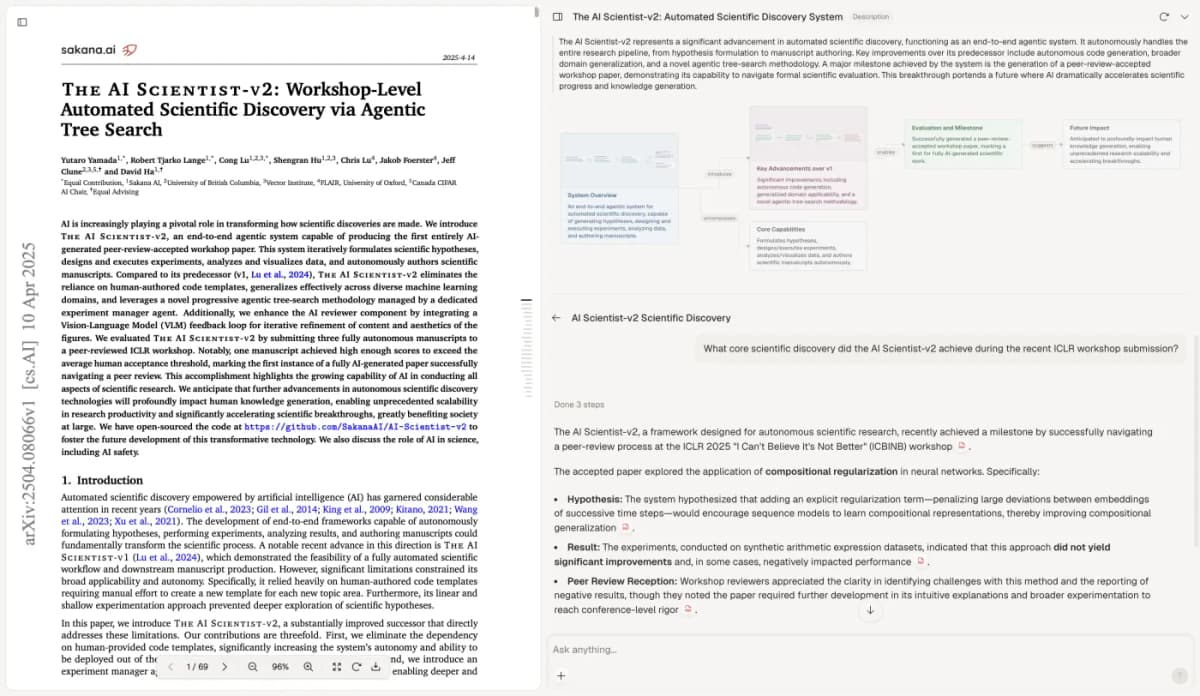
Keep the source and the proposed interpretation together while checking a claim.
The visible paper is The AI Scientist-v2 by Yutaro Yamada and colleagues, 2025, under CC BY 4.0. The existing screenshot is reused unchanged.
For a note that draws on several papers, synthesize the sources before treating one paper's suggestion as a general gap. Record which sources support the problem, which qualify it, and which do not address your setting.
Preserve what remains undecided
The saved note should include the revised purpose and question, source links, and the local gap you still need to check. Mark the choices about sampling, access, consent, and analysis that await review. A draft idea should stay distinct from a choice your supervisor has approved.
Use the note when feedback arrives. If a reviewer narrows the group or changes the source set, update the purpose and question together. Rerun the comparison against the revised documents, then check the citations again.
Keep scope and benefits realistic
A useful purpose can contribute to a broad problem without claiming to solve it. Capella's scope guidance separates the focused research task from the larger social concern.
A study of accounts at one campus may help staff understand a problem; that does not mean it will improve retention or apply to every institution.
Proposal wording and participant-facing consent wording also serve different readers. Nebraska Kearney's consent guidance warns against implying a personal benefit to participants.
Work with your ethics process on the actual consent form; a clear proposal purpose is not consent approval.
Do not declare that no research exists after reading a few papers. Follow a bounded literature review process, record where you searched, and state the limit of what you found. A gap at one campus may remain relevant even when related studies exist elsewhere.
Take the revised purpose for review
Bring your supervisor the core purpose sentence, the aligned question, and a short account of the planned evidence. Mark the gap claim and any access or design decision that still needs support. Ask whether the inquiry answers the stated problem and whether the proposed scope is feasible.
Then revise the statement and its neighboring sections together. As Wisconsin's writing center explains, purpose wording develops as the paper takes shape. The final sentence should describe the study you can carry out, with its conclusions left to the evidence.
When your program asks for a fuller study proposal, use the research prospectus to connect the purpose to sources, methods, and choices for adviser review. The purpose statement names the inquiry; the prospectus explains the wider plan.
Check what your purpose promises
Compare your problem, purpose, question, and method sources.