

A research prospectus is a plan for a study you intend to carry out. An adviser or committee reads it to review the plan.
It explains the question, why it matters, which sources you will use, and how you plan to work with them. Make the choices that still need review clear.
Start with the rules for your program or assignment. Then link each required part to your sources and notes. A clear plan can still depend on things you have not checked, such as access to data. Keep those open questions visible instead of writing as though they are settled facts.

Build a source-linked plan for review
Compare your question and sources with the prospectus requirements.
What a research prospectus does
A prospectus gives reviewers enough detail to discuss the work you plan to do. It is not the finished study.
Columbia English's guidelines ask writers to explain the argument, why it matters, and which sources will support it. That account is provisional, meaning it can change. In that setting, an argument may take the form of a focused question, a hypothesis, or a tentative thesis.
The plan can change as you learn more. UGA History's guide treats it as a tentative roadmap based on early reading and sources. A change may still need approval. Keep your adviser involved and follow the review steps that apply to your project.
A research proposal and a prospectus may serve similar jobs. Programs can use those names for different forms or milestones, so do not rely on a universal distinction. Read the actual prompt. Ask what reviewers need to decide from this document and which work must be done before that review.
Start with the rules for your project
Gather the current rules, format, and review schedule. Save the version or date so you know which rules your draft follows.
Yale's Poorvu writing guide notes that length and format vary greatly across departments. Use a general outline to think through the plan, then check it against your own rules.
Match content to the discipline
Compare what two programs ask for. UCLA English names the central problem, debates in the field, chapter summaries, and a source list. Yale's MPH catalog names aims, background, planned methods, and the skills to be developed. Neither list is the default for every field.
Confirm scope and length locally
Do not copy a word count from another department's guide. UCLA asks students to discuss length with their committee.
Fordham English gives its own page limits and review process. You may need a short course plan or a much fuller dissertation plan. Ask about unclear rules before making the draft longer.
As a working outline, many plans need a question, its importance, relevant scholarship, evidence or data, approach, scope, timeline, and references. The Poorvu guide offers common components, including preliminary work and potential problems. Use only the parts needed for your assignment, and give each one a clear job.
When your prospectus needs a chapter plan, the dissertation outline guide helps map each chapter to its question and evidence needs. Mark future work as planned so the outline does not imply completed findings.
Worked requirement-to-evidence map
The following example is fictional. It models planning work for a document-based study of a town library's public notices. No library, archive, source finding, access approval, or completed study is represented.
The rows show what a writer needs to establish; they do not supply evidence that those facts are true.
Suppose the initial question is, “How did evening opening notices change visitors' use of the library?” The available material is only a proposed set of notices. Those texts could show what was communicated, but cannot by themselves establish changes in visitor behavior.
A more bounded question for adviser discussion is, “How did the notices describe evening access during the selected year?”
| Required part | Fictional planning note | Current status | Next review question |
|---|---|---|---|
| Research question | Describe how notices framed evening access. | Proposed scope | Is this question useful and narrow enough for the assignment? |
| Significance | Explain how the question relates to relevant scholarship. | Evidence needed | Which reviewed sources support the importance claim? |
| Body of evidence | Use dated public notices from one year. | Access unconfirmed | Does the archive contain a usable set, and can it be accessed? |
| Planned approach | Compare wording about hours, entry, and exceptions. | Method under review | Does this approach answer the question, and how will comparisons be made? |
| Scope and limits | Study written notices, not visitor experiences. | Boundary stated | What further claims would require other kinds of evidence? |
| Work plan | Read, confirm access, refine the plan, then analyze. | Dependencies open | Which steps depend on access or adviser decisions? |
Table 1: This map helps you write. It is not a program's required form. It keeps the task, current support, and next choice in view.
Jennifer Strtak's prospectus checklist asks writers to work through the question, sources, method, chapter plan, and timeline. It also asks them to check their own department's rules. The table lets a reader check those links. It does not claim the plan is valid.
Check claims against the listed sources
Listing five papers under “significance” does not show what they establish. Read the relevant passages and note how each one bears on the question.
One may define the issue, another may study a related setting, and a third may challenge your starting assumption. Keep that difference in the map before writing a sentence about a research gap.
A possible archive is not confirmed access
Record “access unconfirmed” until someone checks what is held and what can be used. UGA's history requirements include an archival plan and anticipated challenges.
Even in a small project, practical access can change the scope. A public webpage naming a collection does not prove that every item you need is available.
Turn open decisions into review questions
Keep a list of open decisions beside the outline. For each item, name the evidence needed, who can help decide, and which later step depends on it. A vague note to “do more research” does not show the next action. A clear list also stops a draft plan from looking more settled than it is.
For the fictional example, three questions would guide the next discussion:
- Can the proposed archive supply dated texts for the chosen year? If not, which narrower set could answer a useful question?
- Which sources show why the wording of public notices matters? Which claims about novelty remain unsupported?
- What comparison steps fit the question? Which decisions need the adviser's methods review before analysis starts?
Take these questions to people and sources. They are not prompts for automatic approval.
Strtak's checklist also asks about bias, methods challenges, the timeline, and grants. Choose the questions that fit your project. A study of what texts say and a study of cause and effect do not need the same plan.
If your project links shared inquiry to action, the participatory action research guide helps you identify who shapes the question, interprets the evidence, and chooses the next step. Keep those responsibilities visible in the proposed plan.
Keep preliminary work distinct from proposed work. If you have reviewed three sources, say which three and what they support. If you plan to search a larger corpus, describe that plan as intended work. Do not turn a proposed search or pilot into a completed finding just to make the draft feel more complete.
Compare requirements and sources in Atlas
Atlas can compare your supplied rules, early sources, and research notes to help draft the map. It cannot approve the prospectus, prove the work is feasible, or choose the method for you. The result is a working note for you and your adviser to inspect.
Name the materials and their roles
Add only material you have permission to use and wait for processing to finish. Keep the program instructions distinct from the papers and your planning notes. Start a fresh chat if earlier context includes unrelated evidence. Choose Project only beside + to avoid new web or literature searches. Earlier chat context remains available.
In Ask a question, type @ and select the instructions, sources, and notes. Ask for a bounded comparison such as:
Map the named prospectus requirements to my planning notes and preliminary sources. For each part, show what the requirement asks, which cited passage supports my current claim, what is planned, and what remains undecided. Keep access, novelty, and method fit unresolved unless the selected material establishes them. Do not invent completed research or approval.
The approach used in research synthesis helps keep each source's role clear. Program rules tell you what to include. A paper can support a background claim. Your notes state the work you plan to do. Each source has a different job.
Check the citations and correct the map
Open the numbered citations and read the text. First check the actual rule. Then inspect the passage offered as support for your draft claim, including its limits.
An answer might say “no prior work exists” because one paper describes a gap in a different setting. Remove that claim. Record what the paper says and what further reading is needed.
Apply the same check to access. If your note says “possible archive,” a proposed row must not say “archive access secured.” Correct the wording and retain a question for the data or archive owner. The source-checking workflow explains why the cited passage matters more than the presence of a marker.
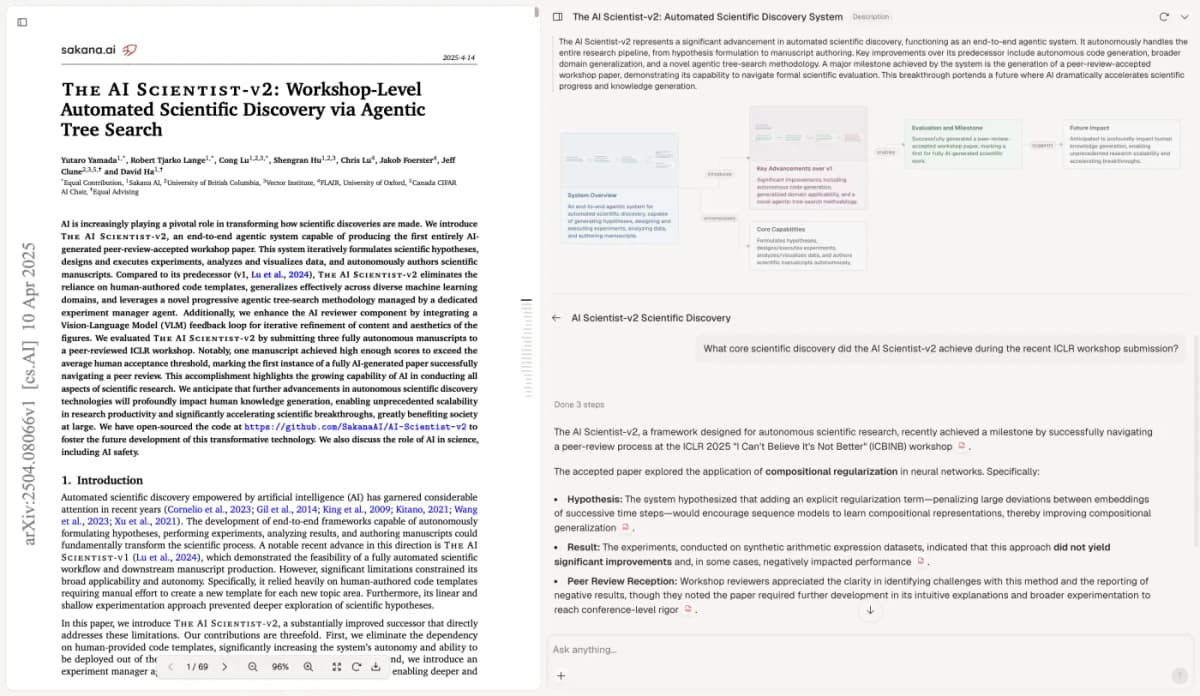
This archived Atlas view shows a different paper. It shows how to check cited text. It is not approval of the fictional plan or a test of the tool's writing accuracy.
Paper shown: The AI Scientist-v2, Yamada et al., under CC BY 4.0. The displayed paper content is unchanged.
Save a corrected review note
To keep the checked map and open decisions, select New, then Note. Include the rules version, source links, planned steps, and review questions. Wait for Saved. The broader paper-analysis workflow can help you read further sources as you work through those questions.
Use the saved note to draft your own prose. Keep any required bibliography in the requested format. Where a source supports only part of a sentence, narrow the claim or find additional support. An outline with citations still needs a human check for omissions and a truthful account of what has been done.
Prepare the draft for human review
Read the draft alongside the program rules and evidence map. Check that the question, sources, and approach fit together. Mark planned work clearly, check references, and keep open access or methods choices visible.
Columbia's guidelines ask about the question, why it matters, and the sources to be used. Use your own program's criteria for the actual review.
Bring specific questions to your adviser rather than asking only whether the draft is “good.” Record the feedback and why you changed the plan. The aim is a plan people can discuss and improve. It should show the work you intend to do, the support you have, and the choices that still need human judgment.
Build a source-linked plan for review
Compare your question and sources with the prospectus requirements.