

Participatory action research (PAR) links inquiry, action, and reflection with people affected by an issue acting as co-researchers.
They help choose the questions, methods, interpretation, and action. To assess participation, check who can influence those choices as well as who appears in the participant list.
When reading a PAR project's records, trace views and decisions across the cycle. Keep individual accounts, group choices, actions, and later reflections distinct. A comparison table can show how a decision developed. It cannot, by itself, prove equal power, shared agreement, or an action's effect.

Keep participant views linked to decisions
Compare consented accounts with the group's decisions and reflections.
What makes the inquiry participatory
PAR treats the knowledge of people who live with an issue as part of the inquiry. Jo Howard's method guide describes their role as co-researchers.
They help choose the focus, methods, meaning of the evidence, and action. A researcher may guide the work, but the group needs room to change its direction.
Asking people for feedback on a fixed plan gives them a different role. To check a project's claim of shared inquiry, ask who set the question, who made sense of the evidence, and who chose the next step. Could group members reject the proposed action? Could their view change it? A list of workshops does not answer those questions on its own.
The approach can draw on different methods. Bob Mash's methods overview explains how a group learns through action and reflection. PAR is not tied to one type of interview or to text-based data alone. Choose methods that fit the group's question and shared work. Seek the skills needed to use those methods well.
Track a cycle of shared inquiry
Follow the question through the records instead of imposing a neat sequence after the event. What concern did people raise? What evidence did they seek? How did they interpret it? Which action did they choose, and what did they learn from it?
Howard's design guidance calls for a flexible process that lets the group steer the work.
Keep views beside the evidence
Record who offers each view and which account supports it. The same event may mean different things to different people. Compare those views without ranking them by how neatly they fit the researcher's first idea.
When records disagree, a source-by-claim comparison can help you keep the differences and the limits of what each source can show.
Distinguish decisions from effects
A group may choose a trial because it looks promising. That is a decision about action, not proof that the action works.
CLARISSA's process account describes groups developing evidence, planning actions, and reflecting on what followed. Its account shows a recorded process in particular settings. It does not make every group choice a causal finding.
Make reflection part of the record
Ask what the group would keep, change, or explore next. Also note how the person guiding the group influences its work. In Emke and colleagues' 2024 study, researchers read selected reflection forms from three youth PAR projects.
They looked at how sessions were planned, how the group worked together, and who took the lead. Those lessons come from specific settings; check their fit with your own project.
Worked participant-perspective and decision table
The following example is fictional. It concerns a community workshop that wants to make tool-sharing easier. The accounts, meeting notes, trial, and reflections are invented. No real people, consent forms, field notes, or results are represented.
The table shows what a reader might need to trace across records in a real project.
Imagine that members initially frame the problem as poor access to shared tools. Some want longer opening hours; others say the checkout instructions are hard to follow. The group chooses a small trial of clearer instructions before making a wider schedule change.
Its records must preserve why that choice was made and which needs it leaves unresolved.
| Cycle record | Participant perspective | Collective decision or action | Evidence limit or next question |
|---|---|---|---|
| Initial accounts | Member A says the closing time prevents visits after work. | Group keeps opening hours on its list of concerns. | One account does not show how many people share this barrier. |
| Group discussion | Member B says unclear checkout steps are a more immediate problem. | Meeting note records a choice to trial clearer instructions first. | The note must show how the choice was reached; it does not establish unanimous agreement. |
| Trial reflection | Member C says the new instructions helped with checkout. | Group considers keeping the revised instructions. | A positive account does not prove that the change caused better access for everyone. |
| Dissent and next cycle | Member A says the closing-time barrier remains. | Group proposes a new inquiry into after-work access and feasible hours. | A future inquiry is not a completed action; other absent members' needs remain unknown. |
Table 1: The table follows a choice while keeping the other concern in view. The group might keep the new instructions while the hours problem remains. A note that says “the group solved access” would go beyond the invented records.
The next cycle changes because the other view still matters. A group choice need not mean that all concerns have been met.
Correct a false consensus claim
A weak note might say, “All members agreed that clearer instructions improved access.” The table supports a narrower account: “The meeting note records a choice to trial clearer instructions. One later account describes a benefit. Another member says the closing-time barrier remains. The records do not show all members' views or the overall effect.”
That change keeps both the choice and its limits. It does not prove the process was fair. To judge shared inquiry in a real project, the group would need to inspect how the choice was made, who could speak, and whose views are absent. The reader should not invent those details to fill the table.
Keep the next question open
For the invented group, a next question might be, “What prevents members from using tools after work, and which changes could address it?” Members would still need to shape that question and choose how to study it. A researcher or AI answer should not speak for them before that discussion happens.
Check power and evidence limits
Read the claim of shared inquiry against the choices people made. The person guiding the group may write most of the notes or control funding. State how that role could shape the record.
Emke's study limitations note the risk of people analyzing their own forms and the youth settings in which they worked. A rich record can still show only one view.
Consider what makes shared work possible. Snijder and Apgar's realist-review summary highlights a safe space for working together and the role of those guiding the group.
The summary describes proposed ways the process can work. It does not promise that a workshop will shift power or achieve its aim. Check what those conditions mean in the actual project.
When community and research partners share the inquiry, check their agreed roles alongside the cycle records. The community-based participatory research guide helps trace partner input, interpretation decisions and data-use rights across plans and reports.
Use records only within the permissions agreed for them. Consent to join a group is not automatically permission for every later use of an account.
Keep personal details out of a comparison when they are not needed or permitted. These choices belong to the project and its co-researchers. Software cannot grant consent or repair a process that excludes them.
An account of what changed is not proof that one action caused it. People, settings, and other actions can change between cycles. Mash's overview frames action and reflection as repeated learning. Keep the evidence needed to understand what was learned and the limits of any impact claim.
Compare cycle records in Atlas
Add only accounts and notes whose use is permitted by the agreed consent. Include the group's decision records and later reflections. Wait for processing to finish. Name each source with its cycle and role so a member's account cannot be confused with the leader's summary.
Use a multi-source comparison to retain who supplied each view and when.
Start a chat. In Ask a question, type @ and select the named records. Choose Project only beside + to prevent new web or literature searches. Earlier chat context may still contain outside material, so use a fresh chat if that context would blur the task. Ask for a table of what the records support rather than a verdict about the project's quality.
Compare the named accounts, group decision notes, and reflections by inquiry cycle. Show each person's view, its source passage, the recorded choice or action, and differences still open. Keep one person's view separate from what the group agreed. Do not infer consent, shared agreement, equal power, or causal impact from missing records.
Open the citation markers and read the source passages with their context. Check that a group choice is supported by the decision record, not just one person's preference.
A claim-to-source check helps you catch that mismatch. If the wrong record is cited, mention the intended source and ask again. Keep a missing decision as an open check.
Check the proposed reading before sharing it. Replace “everyone benefited” with the actual account and its limits. Restore dissent if a summary leaves it out. For a disputed reading, examine the source text closely and return the issue to the people involved.
Atlas helps you work with supplied text. It does not run fieldwork, maintain a formal coding database, or prove that power was shared.
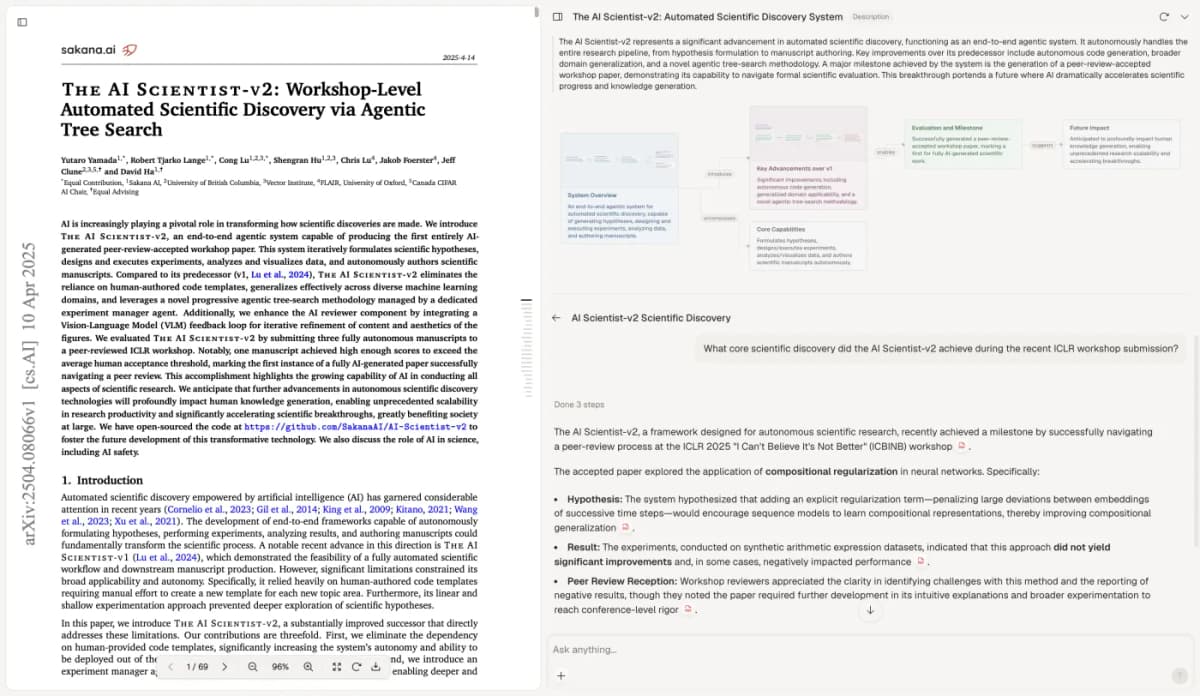
This real Atlas archive screenshot shows an AI Scientist-v2 paper and citation review. It shows how to inspect source support. It does not depict fieldwork with the invented group or prove that its inquiry was participatory.
Paper shown: The AI Scientist-v2, Yamada et al., under CC BY 4.0. The displayed paper content is unchanged.
To save the work, select New, then Note. Add the corrected table of views and decisions, source links, differences, and next-cycle questions. Wait for Saved.
Keep the note's review status clear. A saved reading is a working record for human discussion. The group still owns the inquiry and decides what happens next.
Return the interpretation to the group
Share the proposed reading through the process agreed with the co-researchers. Ask what has been missed, misstated, or given too much weight.
Record changes and dissent rather than treating feedback as a stamp of approval. Howard's guidance places the group's work on meaning and choices within the inquiry itself.
Keep the action history recoverable. Note what the group chose, what followed, which records support that account, and which question now needs attention. CLARISSA's process description explains why detailed documentation matters for understanding repeated inquiry and action. Your record should serve the project's own purpose and permissions.
The output is a checked account of views and choices, with a next question that the group can revise. People may still dispute parts of it, and some records may be missing. Keep that status clear so the next cycle can learn from what happened instead of from a polished claim that all agreed.
Keep participant views linked to decisions
Compare consented accounts with the group's decisions and reflections.