

A dissertation outline is a plan for what each chapter will do, the evidence it will use, and the choices still open. Begin with your research question and your program's rules. Then give each chapter a clear job in answering that question.
The worked map below shows how to keep sources, planned outputs, and committee questions together. It does not assume that every dissertation needs the same number of chapters.

Map your dissertation chapters to sources
Compare chapter requirements and research notes with cited support.
What belongs in a dissertation outline
A useful working outline includes chapter titles, the purpose of each chapter, its main points, and the evidence those points need. Add gaps and questions for your supervisor. The Scribbr outline guide also distinguishes this planning work from a short chapter overview written for readers in the introduction.
A table of contents lists the headings and pages in the finished document. For example, the University of Illinois Chicago's Thesis Manual requires page numbers for contents entries and lists references, appendices and the vita. Follow your own institution's rules for what belongs there.
A working note can include doubts, missing sources, and planned revisions that do not belong in that final list.
Keep front matter and end matter visible, too. The Purdue OWL template guide explains why the university template helps with items before the main text, such as the abstract and lists. Your chapter argument and your submission format are linked tasks, but one does not settle the other.
Start with your department and research question
Collect the current program handbook, graduate-school template, and any written committee feedback. Record which source sets each rule and when you checked it.
If two instructions appear to conflict, ask the relevant office or supervisor to resolve the issue. Do not choose whichever template is easiest to copy.
Check the required structure
The Valdosta guide's opening page suggests five chapters: introduction, literature review, methods, findings, and interpretation. It also says to consult the chair and committee about elements and order. This older guide refers to an older APA edition, so use it as a scoped example rather than a current style rule for your own program.
By contrast, the Regent sample outline places the literature review within the first chapter and uses four main chapters. The difference gives you a concrete committee question: “Should my literature review be a separate chapter or part of the introduction?” It does not mean either count is correct everywhere.
Other formats need other checks. Deakin's structure guidance describes conventional theses, theses built around papers, and practice-based work. Papers still need linking sections that make the work coherent. Check local rules before treating a set of published papers as a complete thesis.
State the question each chapter serves
Write your central research question at the top of the outline. Under each proposed chapter, finish the sentence: “This chapter helps answer the question by…” If you cannot finish it clearly, the chapter may need a narrower job, a new position, or more evidence.
Separate the reason for the study from the work you did. Background sources in a dissertation introduction can show a debate or a problem. They cannot stand in for your own study findings. The Valdosta introduction guidance links the problem and questions to the later chapters; your outline should make that link easy to check.
Use local feedback as evidence about requirements. Use research papers as evidence about the field. When those sources serve different jobs, compare the documents without merging their authority.
Build a chapter-by-chapter evidence map
Here is a hypothetical planning example, not a completed study or a universal chapter template. Suppose the question is: “How do postgraduate students describe using written supervisor feedback to revise their drafts?” Assume only that the student is discussing a possible interview study.
No interviews, findings, or approved method are claimed here.
Give chapters jobs and evidence needs
| Planned chapter | Job in the argument | Evidence or output needed | Committee question |
|---|---|---|---|
| Introduction | State the feedback problem and bounded question | Checked background sources; local aims | Is the question narrow enough? |
| Literature review | Compare what the field says about feedback use | Retained studies grouped by claims and methods | Which debate should frame the study? |
| Methods | Explain and justify the proposed approach | Method sources; approved protocol when available | Does this approach answer the question? |
| Findings | Report what the completed study shows | Actual study outputs; currently pending | How should findings be organized? |
| Discussion | Connect findings to the question and prior work | Checked findings plus relevant literature | Which conclusions will the evidence support? |
Table 1: The map is an author-created aid. Its chapter jobs draw on the Valdosta suggested framework, with order left open to local review.
The entries about the imagined study are planning choices, not sourced research findings.
Attach support to the planned claim
For each literature point, keep the source title, the checked passage, and why it belongs there. A note saying “Paper A goes in chapter 2” is too vague to guide drafting. A better note states what the paper supports and what it cannot support.
For instance, a source on written feedback might help define a term or frame a debate. It need not support a claim about every postgraduate student's experience. Preserve its study setting and limits.
A source-checking workflow helps you verify that a proposed sentence fits the cited passage before placing it in the outline.
For your own work, name the output you expect to discuss: a checked theme, a table, an archive passage, or another relevant result.
If it does not yet exist, write “pending” and state what must happen first. Do not turn an expected result into a completed finding to make the outline look full.
Test the order before drafting more prose
Read the chapter jobs in sequence. Does the reader meet the question before the evidence meant to answer it? Are key terms introduced before they carry an argument? Is a limitation hidden until after a claim that depends on it?
Use a reverse outline for existing text
If you already have chapter drafts, outline what they actually say. UW–Madison's long-project revision guide recommends mapping the main idea and role of each paragraph to check logic, gaps, and order. Compare that map with your intended chapter plan.
A paragraph that has no clear job is worth reviewing. So is a claim repeated in several chapters with no new purpose. Keep useful repetition that guides a reader, but ask whether two sections do the same work.
The Kennesaw reverse-outline guide offers practical checks for paragraph relevance and order.
Check context, content, and conclusion
This corrected diagram maps context, content, and conclusion across paper sections and paragraphs. It shows how each role supports the argument, from the question to the work done and what the findings mean.
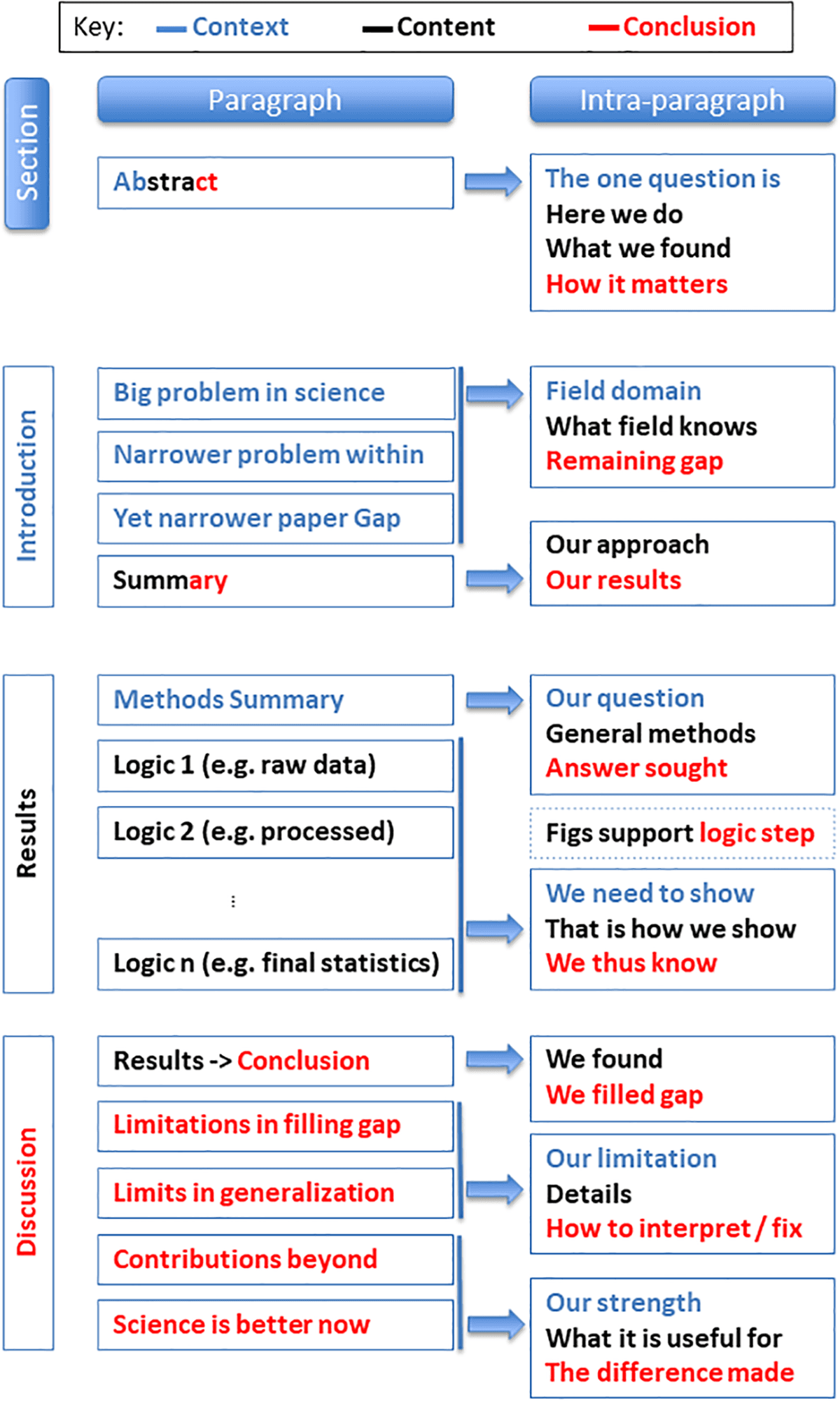
Corrected Figure 1 from PLOS Computational Biology Staff (2017), based on Mensh and Kording, reproduced unchanged under CC BY 4.0.
The diagram uses blue for context, black for content, and red for conclusion. It shows how a paper moves from a gap, through work and results, to meaning and limits. The abstract contains all three roles.
This is a scientific-paper model, not a dissertation chapter template.
Use it as a reading check for a relevant chapter or paper-based section. What does the reader need to know first? What evidence is presented? What can the reader conclude? The original writing guidance develops these roles at several scales.
The correction supplies the key missing from the original figure.
Keep missing evidence and approvals visible
A tidy outline can conceal unfinished research. Keep source evidence, your own results, and planned work distinct. Ask whether each claim has support and whether that support is strong enough for the claim. UW–Madison's revision questions make those checks part of whole-project revision.
Maintain a short decision list: chapter order, scope of the review, method justification, findings still pending, and where to discuss limits. Give each question a next action and the person who can resolve it. This is a working practice, not a claim that every program requires the same checklist.
Do not confuse formatting acceptance with content approval. The UIC Thesis Manual describes the academic program's content-review role and a more limited graduate format review. Follow your own institution's process rather than importing UIC's procedure.
Check your institution's rules for AI use, source sharing, authorship, and disclosure before using a tool in the writing process. Atlas cannot approve your chapters or create the original findings your dissertation needs.
For a thesis by publication, Deakin's guidance also shows why authorship and permissions need attention; local rules control your submission.
Save a checked chapter map in Atlas
Use Atlas for a source-based working note that you can revise with your supervisor. Keep the research question, local requirements, retained papers, and verified study notes in view. The map helps organize your reading; you remain responsible for its claims and decisions.
- Add sources you may share to one project. Include the current requirements and your question, then wait for processing to finish.
- Mention the selected sources with
@in chat. Choose Project only to prevent new web or literature retrieval. Earlier chat context remains available, so name the requirements and sources you intend to compare. Ask for chapter jobs, source support, gaps, and committee questions. Keep local rules separate from research claims. - Open each citation and inspect the surrounding passage. Correct the map where a source does not support the proposed use. Apply the same checks when you synthesize research papers.
- Create a new Note, save the checked map, and confirm the Saved state. Mark pending results and unresolved chapter choices before sharing the note for review.
Try this prompt: “Use these requirements, my research question, and selected sources to propose a working chapter map. For each chapter, state its job, the cited support available, the evidence still needed, and a question for my supervisor. Do not invent results or references. Mark conflicts between requirements and leave approval to my committee.”
Map your dissertation chapters to sources
Compare chapter requirements and research notes with cited support.