
An extended abstract gives reviewers enough of your study's question, approach, evidence, and contribution to judge the work. It is more than a short abstract with extra background. The right format depends on the conference, track, and stage of submission.
Start with the venue's current instructions and the study material you can verify. Then build a section plan in which each main claim has a source. The worked example below shows how to preserve a useful finding while removing an unsupported claim about its effect.

Check an abstract outline in Atlas
Compare your study evidence with the venue's instructions.
What an extended abstract does
A short abstract gives a quick summary. An extended abstract usually gives more room to show how the study was done, what it found, and why the finding matters. It may serve as the document reviewers assess or as a shorter record in the proceedings. If you also need to explain the study to readers outside your field, the lay abstract guide covers that plain-language task. Follow the venue's extended-abstract rules for the research-review document.
Those roles can require different content. AMA's proceedings guidance offers an extended abstract as an alternative to a full paper for accepted work. MESD'26 uses the extended abstract itself as the complete document for review. Check which job your document must do.
In his advice based on the 1991 SIGPLAN committee, William Pugh treats the extended abstract as a compact research argument. Reviewers need to understand the advance and the support for it. His historical page limits are not a rule for your current venue.
The practical test is whether a reader can follow your central claim and see why the evidence supports it. Extra words that only repeat the background do not meet that need. A complete paper may include more detail, but the shorter document still needs a coherent argument.
Read the venue rules first
Choose the criteria before drafting. Note the current call, track, template, and review stage, then check word or page limits and what counts toward them. If two rules conflict, ask the organizer which to follow rather than choose the easier one.
For example, AMA's extended-abstract rules ask for four sections with no more than 200 words each. They do not ask for a reference list and do not allow graphics.
These limits apply to AMA's format. Other venues set their own rules for sources and figures.
The MESD'26 word-count rules set a 1,500-word limit and explain which parts count. The same page asks for a reference list and allows figures that help the reader. Read the details rather than assume every part of the file counts the same way.
An archived University of Colombo guide illustrates another format, with references and a longer document. It belongs to the 2017 event and shows how formats vary. Consult the current instructions for your conference before choosing a format.
Also check the review model, author details, file type, and whether the venue accepts work at its current stage. MESD'26 asks authors to label early findings and expected results clearly. If your venue allows work in progress, a planned analysis still must not be written as a finished result.
Choose sections around the core claim
Write down the main question and the strongest claim your study supports. Then sketch the sections a reader needs to judge it. You can start with the question, method, findings, and what they add, using the venue's required headings.
For context, name the problem and the relevant gap without writing a miniature literature review. Pick the prior work that explains why your question matters.
If you need help comparing that work, synthesizing research papers is a separate step that should come before final wording.
For the method, keep the details that change how the reader judges the result. State where the study took place, who or what you studied, what you did, and how you analyzed it. Do not replace a precise method with a broad label just to save space.
For findings, state the results of the completed work. Explain what the data covers and any limit that changes the claim. The MESD research-stage guidance shows how one venue asks authors to separate early findings from results they expect.
For the contribution, explain what the finding adds and to whom. Pugh's advice on significance asks authors to show how their work advances what came before.
A claim such as “this will transform practice” needs more support than one local finding.
Map a fictional study to sections
Suppose you have a small study of library signs. The notes below and their source labels are made-up teaching text. They are not published findings, real data, or an Atlas test.
The outline shows how to link each planned claim to a source.
Fictional teaching example: an extended-abstract section plan linked to study notes and limits.
| Planned section | Fictional study-note source | Supported claim | Limit to preserve |
|---|---|---|---|
| Question | Planning note, paragraph 2 | The study asked how visitors understood signs at two library entrances. | These two entrances set the question's scope. |
| Method | Session log, paragraphs 1–3 | Volunteers explained how they read the existing signs during guided sessions. | The procedure involved guided sessions. Unaided visits were not tested. |
| Findings | Analysis note, paragraph 4 | Some volunteers gave different meanings to the same sign wording. | The note does not establish how common those meanings are across all visitors. |
| Contribution | Design note, paragraph 2 | The team identified wording to examine in a later sign revision. | No revised signs were tested, so effectiveness remains unknown. |
Table 1: The map shows that a claim such as “the revised signs made it easier to find the way” would need a test of those signs. Since the made-up record has no such test, the design note supports a next step rather than a proven effect.
A checked version could say: “In guided sessions at two library entrances, some volunteers read the same wording in different ways. This points to wording to review in a later revision; the study did not test revised signs.” The finding and its limit stay together.
You would still need real study details in an actual abstract, including the basis for “some” and how you analyzed the data. Never copy this made-up sentence into another study as if it described that study's findings. The map helps you plan; it does not supply a research result.
Use the venue's headings for the final text. The AMA section structure covers the question, method, findings, and what they add, but its rules also tell you what to leave out. This teaching table helps an author plan; it does not belong in every final file.
Shorten without losing the evidence
Cut repeated background before cutting the facts that support the result. Each paragraph should help a reader grasp the question, judge the method, check a finding, or see what it adds. If a paragraph does none of those jobs, ask why it belongs.
The USENIX LISA 2005 guide suggests planning the whole paper before making it shorter, then cutting less-needed detail.
This advice comes from an old event. Its length limits and rules on who can submit do not govern a current call.
Keep the meaning of each measure or finding clear. In the made-up study, cutting “guided” would make the sessions sound like ordinary visits. Cutting “not tested” would blur the line between a suggested revision and proof that it works.
Trim long setup phrases and repeated claims while keeping the scope and limits. “This study aims to contribute toward an understanding of” can often become a direct statement of the question. Keep a limit when it stops the reader from making a stronger claim than the data supports.
Check the source list as its own task. Where the venue asks for one, include sources that support the claims rather than a long list meant to show how much you read. Where the final form leaves out a full list, keep your own source record and follow the venue's rules.
Compare instructions and evidence in Atlas
Atlas can help compare a supplied study report with the venue instructions. Add only material you have permission to use, and name each source clearly.
Keep the current instructions distinct from older event templates so a comparison does not blend their rules.
In a project chat, type @ and select the study report and conference instructions. Ask: “Plan an extended-abstract outline using these two sources. For each section, cite the venue rule and the study text supporting its proposed claim. Flag missing evidence, planned work, and format conflicts. Do not invent results or calculate statistics.”
Use Project only to stop new web or literature searches. Earlier outside context can remain in an existing chat, so use a fresh project chat if the old one contains unrelated venue guidance. The named sources define what you want compared.
Open each citation and read the text around it. Check both sides: does the rule belong to this submission stage, and does the study support the proposed claim? A citation does not make the answer correct. The citation tracking guide explains this source-check step in more detail.
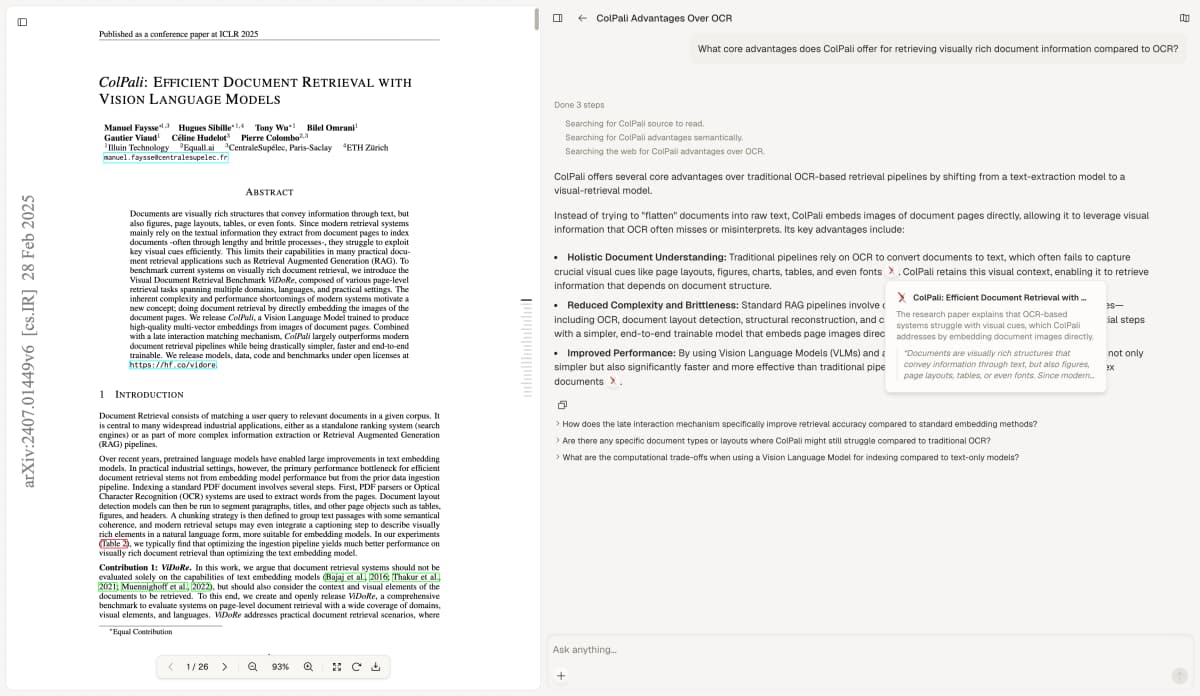
Atlas screenshot showing a source check. The visible ColPali paper by Manuel Faysse and colleagues is CC0 1.0. Lossless WebP re-encoding left the content unchanged. This is not the fictional signage study or an extended-abstract writing test.
Check the outline before saving it. In the made-up study, replace the claim that signs helped visitors find the way with what was found and the untested next step. The AI PDF reader guide covers other ways to check answers beside documents.
Choose New, then Note, save the checked outline and open questions, and wait for Saved before closing.
Check the file before submission
Read the draft as a reviewer who has not seen your full study. Can they identify the question, what you did, what you found, and why it matters? Ask a colleague to flag any point where the argument depends on detail that is absent.
Check the final word count using the venue's own counting rules, then inspect the exported file. Headings, figures, references, and author details should follow the current template.
Do not squeeze text with smaller type to evade a page limit; make the argument shorter.
Recheck every finding against the study record and every reference against its source. If a result is preliminary, retain that label. The MESD'26 guidance on findings shows why the stage of work belongs in the text rather than only in a private planning note.
Authors own the final claims, file preparation, and submission. A well-organized outline makes that review easier but cannot certify the method or guarantee acceptance. Keep the reviewed source version and outline together so later edits can be checked against the same evidence.
Check an abstract outline in Atlas
Compare your study evidence with the venue's instructions.