

A lay abstract explains research to people who do not share your specialist knowledge. It gives them enough context to understand the question, what you did, what you found, and what those findings can mean.
Plain words still need careful claims. If people who chose a short library notice recalled its deadline more often, you cannot jump to "short notices make people attend events." Reader choice may affect the comparison, and recall is a different outcome from attendance.
The worked rewrite below keeps both limits visible.

Draft your lay abstract in Atlas
Compare manuscript passages, check claims, and save your reviewed draft.
What a lay abstract needs to do
A lay abstract is a short explanation that can stand on its own for the intended reader. You may also see the names lay summary or plain-language summary. NIHR's guidance stresses that readers should understand it without extra information. Explain an essential term where it appears rather than making the reader search for a definition.
The audience changes the explanation. A structured scientific abstract can assume field knowledge; a public summary usually needs more context and fewer unexplained terms. Researcher.Life's comparison describes that difference. Both versions must still agree about what the study did and found.
The study stage also matters. A completed study has findings you can check. A grant proposal has a question and plan, with possible future value. The NCI training guide includes results when research is complete.
Do not turn a planned benefit into a result to make a proposal sound stronger.
Set the audience and writing brief
Name a reader you can write for
"The general public" leaves many choices open. A library user who wants to join a workshop may need to know how to sign up. A council member reviewing a service may care about who it reaches. Write down who will read your text, what they know, and what you want them to learn.
The Southampton help sheet suggests readers such as a family member, a policy group, or a student. Choose someone suited to where your text will appear. People with the same level of schooling can still know very different things about your topic.
Check the writing rules before you draft.
Look for the word limit, needed headings, allowed references, and rules for figures or shortened names. Researcher.Life's writing tips put this check first. Use the journal or funder's current limit, even if a guide suggests a different range.
Plan the message and its use
Choose the main point the reader should take away, then ask which context makes it clear. In the library example, the point concerns recall of a deadline in a small study. The reader needs to know who took part and how they saw the notices before they can judge the finding.
The source page below shows the CDC's audience review checks. It asks writers to identify the audience, learn about them, define the purpose and message, choose how the text will reach them, and allow time to test it. The final item makes reader feedback part of the plan.
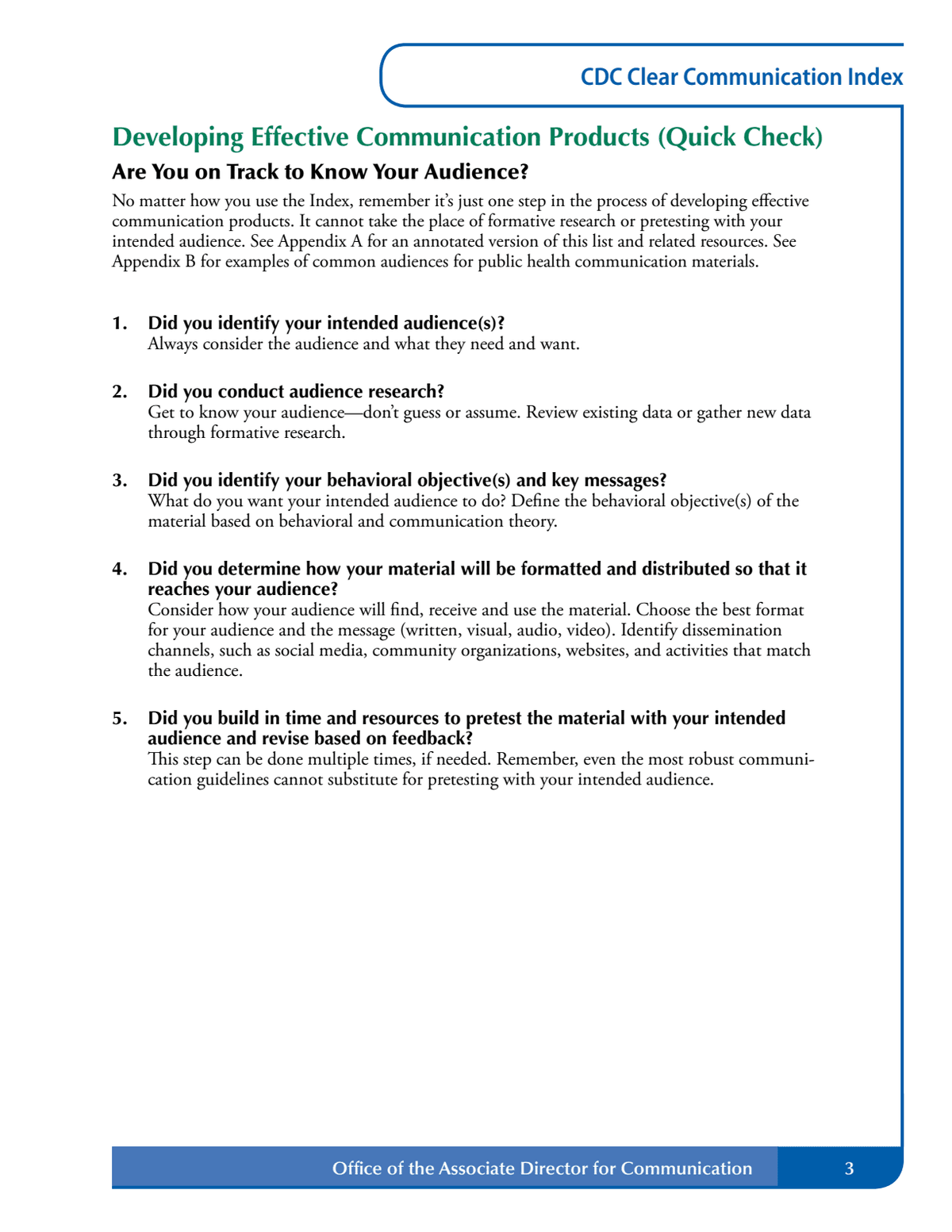
This page comes from the CDC Clear Communication Index User Guide, August 2019, PDF page 5, printed page 3. The complete page is reproduced without content changes. CDC Stacks identifies the guide as Public Domain.
These checks concern public communication broadly. They do not require every lay abstract to tell the reader to change a behavior. Your purpose may be to help someone understand a finding. For this task, make that purpose explicit and use feedback to test whether the explanation achieves it.
Choose claims the manuscript can support
Read the study's methods, results, and discussion before rewriting the abstract. For each planned claim, note the supporting passage and any condition it depends on. If you need a first pass through the paper, the research paper summary workflow shows how to retain evidence while condensing it.
Extract the purpose, who or what was studied, the approach, the main finding, and the main limit. This is a working claim map.
It gives you a way to check the evidence after you change the wording. The NCI guide's key elements connect the research question, background, methods, completed results, and possible value.
Keep each number attached to what it counts. Thirty correct answers means little without the number of readers tested. If the source reports 30 of 40, preserve that denominator or a faithful equivalent. Also retain the time of measurement: a test right after reading does not show what someone remembers a month later.
Separate the finding from its possible use. "More readers recalled the deadline" describes an observed comparison. "The notice could guide further testing" describes a next step. "The notice improves attendance" claims a different outcome. The CDC's state-of-the-science guidance asks writers to make important known and unknown points clear.
Keep limitations that change the meaning even when space is tight. In the example, reader choice matters because the two groups may differ in ways the notice did not cause. A single library limits where the finding can be applied. Removing both facts would produce a smoother sentence and a weaker account of the evidence.
Rewrite the ideas in plain language
Explain the task before the term
Start with what someone wanted to learn. A phrase such as "a single-site evaluation of information retention" makes the reader decode the task.
Try "we studied how readers remembered a library notice." Then explain where the work took place and what you measured.
NIHR recommends explaining technical terms when you need them. Some have no short word with the same meaning.
Explain "recall" as what a person remembers, for example. Keep the term only if it helps the reader follow the rest of the text.
Tell readers who did what. The Southampton guide recommends active voice and plain accounts of needed terms.
"We asked readers to name the deadline" shows the task directly. "Deadline identification was assessed" hides who asked and how.
Preserve meaning as you simplify
Changing words can change claims. "Associated with" may become "went together with."
To say "caused," you would need more evidence. Keep phrases such as "in this group" when they set a real limit on what the study can show.
Build the account around the reader's questions. The NCI training advises against just translating each sentence of a technical abstract.
Explain why the question matters, then say how you studied it. Keep method details that affect what the result means.
Elsevier's author guidance recommends context, a clear order, and saying why the work matters. Link that value to what you found. The library could test the notices in a stronger study next. We do not yet know whether they help the service work better.
A lay abstract before and after
Read the fictional source account
The study and all numbers here are made up for teaching. They tell us nothing about real library users. Use the source passage below to check the rewrite and claim map, just as you would check your own study's paper.
At one community library, 80 adult volunteers selected either a concise event flyer or the full event flyer. Forty participants selected each version. Immediately after reading, participants answered a question about the event registration deadline. Thirty readers of the concise flyer and 22 readers of the full flyer stated the deadline correctly. Participants were not randomly assigned to flyer versions. The study did not measure later recall or event attendance. The observed group difference therefore does not establish that flyer length caused the recall difference.
Here is a technical-style draft that stays within that source account:
A single-site evaluation compared immediate deadline recall among 80 adult volunteers who self-selected concise or full event flyers. Correct recall occurred in 30 of 40 concise-flyer readers and 22 of 40 full-flyer readers. Non-random allocation limits causal interpretation of the observed group difference. Neither delayed recall nor event attendance was assessed. These findings support further evaluation of notice design rather than a claim of improved participation.
The passage has the right facts but makes the reader decode several terms. We can explain those ideas directly. The Southampton question prompts help us check for missing context: who, what, where, when, why, and how.
Compare the revised lay abstract
How readers remembered two library notices
Library notices need to help people find details about events. We studied how 80 adult volunteers at one community library remembered a sign-up deadline. Each reader chose a short or full event flyer, with 40 people choosing each version. We then asked them to name the deadline right after reading. Thirty people who chose the short flyer answered correctly, compared with 22 who chose the full flyer. Because readers chose their flyer, differences between the groups could help explain the result. We cannot tell whether the shorter text caused better recall. We also did not test later memory or attendance. The findings give the library a reason to test notice designs further before changing how it promotes events.
This version explains what "self-selected" and "immediate recall" mean through the actions people took. It preserves both group sizes, both counts, and the key design limit. It also states which outcomes were not tested before proposing a next step.
The claim map below links the rewrite to the fictional manuscript passage. It applies the CDC's distinction between known and unknown points to an original writing exercise; the CDC did not conduct or endorse this study.
| Claim in the lay abstract | Support in the fictional source | Meaning check |
|---|---|---|
| We studied memory for a sign-up deadline | The question measured event registration deadline recall | Keep recall distinct from understanding every detail |
| 80 adult volunteers at one library took part | One site and 80 adult volunteers | Avoid a claim about all library users |
| Readers chose a flyer, 40 per version | Participant choice and both group counts | Preserve the lack of random assignment |
| 30 short-flyer readers and 22 full-flyer readers answered correctly | Correct answers among 40 readers in each group | Keep the denominator and immediate timing |
| Cause, later memory, and attendance remain unresolved | Explicit design limit and unmeasured outcomes | Do not claim better attendance or lasting recall |
Table 1: Each row ties a public-facing sentence to source detail that must survive the rewrite.
Check meaning with a real reader
Catch a clearer but false sentence
Consider the line "Shorter library notices improve memory and get more people to attend." It is easy to read, but adds two claims the source cannot support. Readers chose their notices, so we do not know what caused the gap. The study also did not count attendance.
You can say "In this group, more readers who chose the short notice remembered the deadline right after reading."
Then explain the choice and attendance limits, as the full lay draft does. The NCI writing tips favor clarity over detail. Keep the facts that show what a result can mean.
To explain the value, say who might use the finding and what still needs to be tested. The research implications guide helps link a result to a sound next step. Here, the library has reason to test the notices further. It does not yet have proof of a better service.
Ask the reader to explain the study
Ask someone from the intended audience to read the draft without the scientific abstract beside it. Then ask them to explain the study's question, what the team did, what it found, and what it could not show. NIHR recommends public feedback, while Elsevier suggests a non-academic reader review.
Use their explanation to locate the problem. If they think readers were assigned to flyers, revise the choice sentence. If they think the library recorded attendance, bring that missing outcome into the explanation of the result.
Ask which word or step led them to that interpretation.
A readability tool can flag long sentences and difficult words. It cannot tell whether someone understands why reader choice limits a claim about cause. The CDC user guide explains that reading formulas count features such as syllables and sentence length while missing audience and purpose.
Recheck the source after each substantial edit.
A reader may reasonably ask for a simpler statement, yet a suggested wording can overstate the evidence. Resolve both tasks: make the explanation clearer and keep the study's limits. The fictional draft above has not been tested with a real audience.
Draft and check the summary in Atlas
Mention the manuscript and requirements
Add the permitted completed manuscript and audience instructions to an Atlas project. Wait for processing before asking about them. Use a clear version name so a draft does not accidentally draw on an older paper or a proposal with different numbers.
Open a fresh chat and mention the intended sources with @. If you choose Project only, Atlas cannot run new web or literature searches for that turn, though earlier chat context remains available.
A fresh chat and named sources help you keep the task focused on the study you are explaining.
For the fictional exercise, a prompt could say: "Draft a lay abstract for adult community-library users from the named manuscript and instructions. Explain reader choice and immediate deadline recall in plain language. Keep all sample sizes and outcome counts. Include the causal, later-memory, and attendance limits. Give a supporting passage for each claim in a separate claim map. Do not add results or public benefits."
Request the text and its claim map separately so you can review each. Use the map to check support for the draft, then read the cited passages yourself. For other source-reading options, the AI research paper summary guide shows how to check a generated summary against its paper.
Check passages before saving the draft
Open numbered citations for the finding, design, and limitation claims. Compare each answer with the surrounding manuscript text.
Precise page or passage locations can vary; if a link does not expose the necessary detail, find the named source and inspect it directly.
Check numbers as well as phrasing. In this example, 30 and 22 belong to groups of 40, while 80 is the total. Confirm that the output keeps those roles straight and retains the immediate timing. Ask for a named passage when a limit is missing or a claim lacks useful support.
Revise the text that exceeds the source. If the draft says the shorter flyer improved attendance, remove that claim and restore the unmeasured-outcome statement. Read the full paragraph again to ensure the correction fits the explanation rather than sounding like a detached warning.
Create a note through New, then Note. Save the checked lay draft, claim map, manuscript version, audience, and unresolved questions, and wait for Saved before closing.
Use that reviewed note as the draft for feedback from real readers; saving it does not validate their understanding.
Prepare the abstract for its destination
If reviewers need to assess the study's methods and evidence, follow the venue's extended abstract rules. A lay abstract explains the work to non-specialists; an extended abstract supports review of the research.
Check the final text against the paper, word limit, and writing rules. Include the headings and references requested, and check that you may share the content. If space is tight, cut background that adds little to the main point. Keep limits that change what the finding means.
Ask the study's authors to approve the claims and final text. Keep the reader feedback and note which changes it led you to make. Before you submit, check both aims: the text must follow the rules for where it will appear and give its readers a faithful account of the study.
Draft your lay abstract in Atlas
Compare manuscript passages, check claims, and save your reviewed draft.