

The scope of the study states what your research covers. Name the question, people or source material, setting, period, and approach. Then explain the important boundaries so readers can see what the work is meant to answer.
A useful scope statement comes from the actual plan. It should not promise to explain a whole topic when you can study only one part. Pair the statement with your reasons for chosen exclusions, and keep the limits on your claims visible as you move from a proposal to a completed report.

Check the evidence behind your scope
Compare source boundaries, open citations, and save a checked scope note.
State what the study will cover
APNTS's doctoral handbook gives a concrete set of scope factors: subjects, methods, period, location, and population features. Its guidance asks for enough focus to treat the topic carefully. These factors help you replace a broad subject with a study that has a defined reach.
“Library access” is a topic. A study of how first-year students at one campus describe evening opening hours during one term has a more specific scope. The difference is what the researcher has chosen to investigate and the evidence they plan to obtain.
Portsmouth's proposal guide advises narrowing a question that is too broad and choosing methods from the question.
Work from the question to the boundaries. If you choose a campus because it is easy to reach, you still need to explain what studying that campus can teach you.
Separate scope, delimitations, and limitations
These terms do different jobs. Scope describes coverage. Delimitations explain the choices that set boundaries. Limitations explain weaknesses or constraints that affect what the evidence can support.
Keep the reason for a choice apart from its effect on the findings.
Explain the chosen exclusions
DiscoverPhDs' delimitations guide uses choices about what to include and exclude to explain the boundary. For example, a researcher might choose first-year students because the question concerns their transition to campus. The reason is part of the delimitation.
A choice can also limit a claim
If your plan covers one campus, name it in the scope and explain why you chose it. If its opening hours differ from those elsewhere, that difference may restrict how far you can apply the findings. The scope and limits guide by Manuel Garcia explains this overlap without treating the terms as interchangeable.
Many introductory guides use a “chosen versus outside your control” shorthand. It helps identify deliberate exclusions, but it does not cover every limit on inference.
You may choose a survey and still need to discuss what self-reports can tell you. APA's quantitative reporting standards ask for discussion of bias, measurement issues, and the reach of the findings. The fact that you chose a method does not remove those questions.
Distinguish missing responses from exclusions
For the library example, excluding staff can be a justified choice if the question concerns new students. A low response rate among eligible students would be a different issue. It concerns whose accounts the study obtained, not who the plan meant to include.
Map the boundaries before writing
Use a working table to turn the question into specific choices. The fictional case below concerns first-year students' views of evening library hours at an invented institution, Northbank College. The college, plan, and period are teaching examples.
No data were collected and no result is claimed.
The coverage prompts in DiscoverPhDs ask who, what, where, when, and how. This map adds a reason and a claim boundary to each choice, so the paragraph does more than list project details.
| Boundary | Fictional study choice | Reason and effect on coverage |
|---|---|---|
| Question | How do first-year students describe the fit of evening library hours with their study needs? | Covers perceived fit, rather than the effect of opening hours on grades |
| People | First-year undergraduates enrolled at Northbank College | Focuses on new students; staff and later-year students fall outside this question |
| Setting | The college's main campus library | Holds the service setting in view; findings would not describe every college library |
| Period | Experiences during the September–December teaching term | Defines the period being recalled; examination-only and holiday hours need separate study |
| Evidence and approach | A survey of eligible students about their use and views of evening hours | Provides reported experiences; it does not supply direct counts from entry logs |
| Exclusions | Branch libraries, grades, and later academic outcomes | Keeps the project on one service question; no claim about effects on achievement is planned |
Table 1: Each row connects coverage to the question and identifies something the plan would leave unanswered. The choices require researcher and supervisor review before they become an actual protocol.
Separate people from the achieved sample
The scope names the intended group. The method must explain how people from that group will be invited, and the completed report must state who took part.
APA's reporting table asks for selection and exclusion criteria and sampling details. These are needed to understand the relationship between the group and the evidence.
If only students who already use the library respond, the study may miss accounts from those who avoid it. Keep that possible problem in view when planning recruitment and interpreting responses. Calling every eligible student part of the scope does not mean their views were obtained.
Separate dates from the project deadline
A submission date tells you when the writing must be finished. A study period tells the reader which events or experiences your evidence covers. Here, the survey would ask about the teaching term, even if responses are gathered just after it ends.
State both dates where needed and check the recall involved.
The APNTS handbook's scope factors include timeframe. In your own project, say whether the period refers to data collection, the events studied, or both. A reader should not have to infer which year or term a claim concerns.
Build a scope statement from choices
A first draft might say: “This study examines how library opening hours affect all college students' success.” That wording promises an effect, a broad group, and an outcome the fictional plan does not measure. More polished wording would not solve the mismatch.
Revise the claim before the sentence
The proposed survey asks about reported use and views of evening hours. It does not measure grades or compare outcomes under different opening schedules. The Portsmouth question guide ties an achievable question to the data, sources, or people you can access. Revise the question and claim to fit that evidence before drafting the scope.
A revised fictional statement could read:
This proposed study examines how first-year undergraduates at Northbank College describe the fit of the main campus library's evening hours with their study needs during the September–December teaching term. A survey will ask eligible students about their reported use and views of those hours. The study focuses on the main campus service and excludes branch libraries, staff, and later-year students. It will not test effects on grades or later academic outcomes.
The opening sentence names the question, group, place, and period. The next names the evidence the team plans to collect. The final sentences set the main exclusions and the limit on the outcome claim. These statements can now be checked against the table and the proposed methods.
Explain why the boundary fits
Add a reason for the important choices. For example: “The project focuses on first-year students because its question concerns their use of campus services during the transition to college. The main library is selected to study one opening-hours schedule in depth.” These reasons are part of the fictional plan, not evidence that the choices have been approved.
DiscoverPhDs' guide to exclusions asks writers to explain why alternatives were left out. Do that for choices that affect the reader's understanding.
A long list of unrelated topics adds little; explain the boundary that changes the meaning or reach of the study.
Keep the question inside the evidence
Do not turn context into a cause
Suppose the survey records whether students commute. Commuting status could help describe who answered and how different groups rate evening hours. It does not, on its own, show that commuting causes a particular view.
If the team wants to make that claim, it needs a design and analysis suited to it.
Salford's methods guidance asks how the proposed methods will answer the question. Keep the scope on the job the planned evidence can do rather than adding outcomes because they sound important.
Keep different source types distinct
Entry logs could show recorded visits. Survey answers could show reported use or a person's view of access. Those are different observations. If the team has permission for survey data but not entry logs, the scope should not imply that it will measure actual visit counts from the library system.
APA's reporting guidance on measures helps make the evidence source explicit. In the fictional plan, replace “library-use data” with “students' reported use in survey responses” where that is what the team will obtain.
The source description should be specific enough for a reader to understand the claim.
For a study built from documents rather than people, state the source set instead: which reports, editions, dates, languages, or types of material fit the question. Use the literature review process to record those selection decisions when your evidence is a research corpus.
Record changes to access and coverage
If access to a site or source changes, revise the question, scope, and methods together. Salford's feasibility advice warns that a good idea can still lack the needed access. Do not leave the original broad statement in place after the actual plan has narrowed.
In a proposal, describe intended work. In a completed report, describe what you did and any material departures. Portsmouth's intended-outcomes guidance separates a plan from the results it may produce. Keep the same discipline when changing future-tense scope wording into a final account.
Check source boundaries in Atlas
Use Atlas to find stated boundaries in the material you select, then compare them with your proposed question. A prior study can show how another team defined its population or evidence. It does not prove that the same choice is right for your project.
-
Add the permitted question note, selected design references, and relevant prior studies to one project. Wait until each source finishes processing.
-
Open a chat and use @ to select the material you want to compare.
-
Ask: “Find each source's stated population or source set, setting, period, method, and important exclusions. Give citations. Separate what the source says from suggestions for my proposed study. Mark unstated details as unstated.”
-
Open the numbered citation beside each claim and read the text around it. Check whether it comes from the methods, an example, or a general writing rule.
-
Correct the comparison. If an answer calls survey responses library-use logs, return to the source and retain the actual evidence type.
-
Select New, then Note. Save the checked boundaries, source details, and your own proposed scope with the decisions still needing review. Wait for Saved before closing the note.
The source view below shows a paper beside a cited answer. Read the text to check what a claim covers before keeping it in the scope note. The visible ColPali paper is unrelated to the fictional library plan; no live scope-review test is shown.
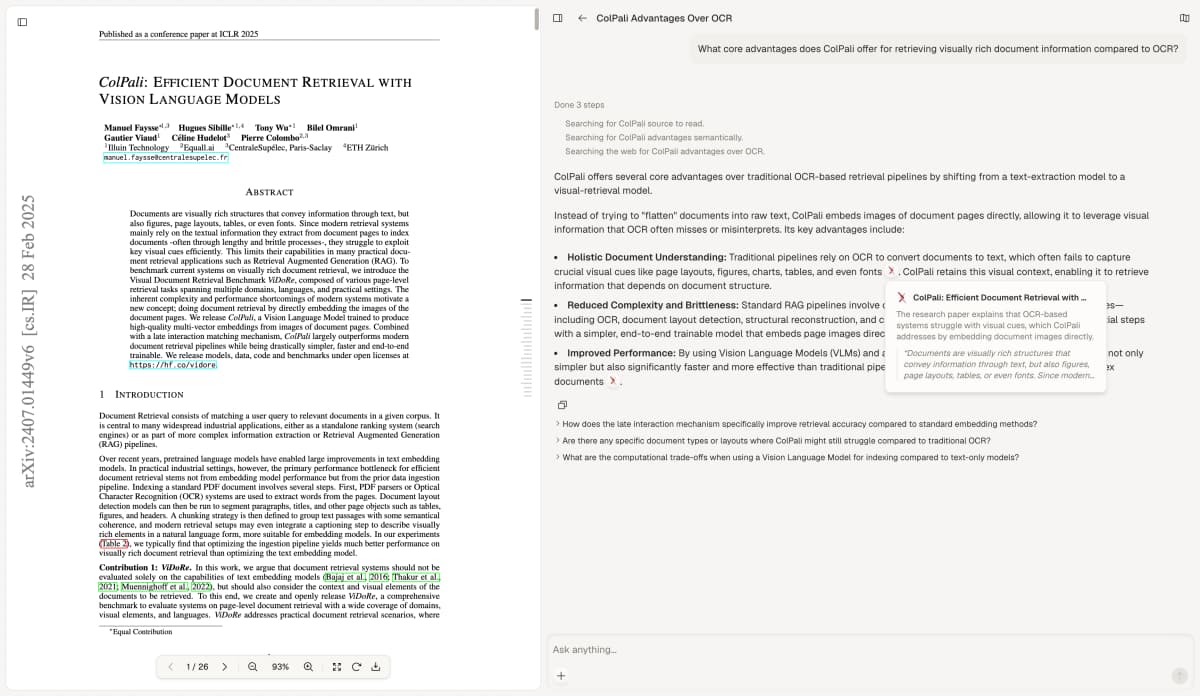
Check the passage and nearby text before you treat it as support for a boundary. The displayed ColPali paper by Manuel Faysse and colleagues is available under CC0 1.0. Its first page appears unchanged within this losslessly converted Atlas capture.
If a citation is missing or opens an unhelpful place, find the item by name and inspect it directly. The AI citation checker workflow explains this claim-to-passage check.
A source that mentions first-year students may still leave its recruitment or exclusion rules unstated.
Review the scope against the plan
Follow the required local format
The APNTS handbook places scope and delimitations in the first chapter. Check your own programme's structure. Salford's proposal guidance notes that supervisors may give more specific instructions than a general guide. Check the required headings, location, and length before you draft.
Use the scope paragraph to make coverage clear. Put the details of recruitment, measures, and analysis where your format requires them. A short scope section still needs to agree with those details elsewhere in the plan.
Read the question, scope note, and methods together. For each important noun in the scope, locate the corresponding plan or source: who the group is, what the evidence measures, where it comes from, and which period it covers. Portsmouth's question guidance and Salford's proposal guidance both link the proposed work to what is achievable.
Check the draft with your supervisor or methods team. Keep unresolved access, sampling, and review requirements in the working note rather than turning them into settled facts. If the plan is approved only in part, the scope should show the part you can actually carry out.
When you compare your planned work with prior studies, use the research synthesis workflow to keep each study's coverage separate. That makes it easier to explain why a useful prior result does not automatically apply to your group, setting, or period.
Check the evidence behind your scope
Compare source boundaries, open citations, and save a checked scope note.