

The significance of the study explains why your research question matters, what the work could help us learn, and who could use the findings. In a proposal, it makes a case for doing the study. It does not report gains that have already occurred.
Start with what your sources show. Then explain what you plan to add, who could use it, and where the claim stops. An outline that keeps those parts clear is easier to defend than a paragraph that promises to help everyone.

Build a source-linked significance outline
Compare your selected literature and project notes before drafting the argument.
What the significance of the study explains
Your reader needs a reason to care about the answer, beyond the fact that you can collect data. A study might test a disputed idea, check whether a finding holds in a new place, describe a group's views, or guide a local choice. Explain which of these jobs your project can do.
The UConn Writing Center's science proposal guide separates three questions: what you plan to study, how you will study it, and why it should be done. Use them to check that your case for the study does more than repeat its methods.
A statement of the problem names what you need to understand. Objectives name the work you plan to do. Significance explains why the answer would be worth having. These parts should agree, but they serve different purposes. “Interview ten students” is an action; it still needs a reason that those students' accounts would matter.
Study significance also differs from statistical significance. Here, you explain why a question and its answer matter, rather than judge a statistical test. A finished paper can discuss what its results mean. A proposal must describe what the work could add without implying that results already exist.
Find evidence for the question's importance
Gather sources that show why your question matters. Look for an issue still in doubt, a harm worth understanding, or a choice that needs better data. A broad statement such as “education is important” gives your reader little reason to fund or approve this project.
Keep the scope of each source
For each source, keep the passage and its page number. Record who or what was studied, where it took place, what was measured, and any limits on your claim. If a paper tests short-term recall, do not quietly turn its result into proof of better grades or lasting career skills.
The NIH's Forms I research-plan instructions give one grant example. They ask writers to explain why the problem matters, assess strengths and flaws in prior work, and describe what the project would add. Those are NIH instructions, so use your own program's rules for the final format.
Check the gap before claiming it
Treat a research gap as a claim that needs support. Not seeing your exact topic in two papers does not show that nobody has studied it. A literature review process helps you search more widely, inspect reviews, and look for other terms before writing “no research exists.”
Keep the scope of your search clear. You can say a paper did not study your planned setting without claiming that the whole field ignored it.
If papers disagree, compare their questions, groups, tests, and follow-up times. Those details may explain the difference and suggest a question worth studying. Use a cross-paper synthesis to make that comparison before you draft.
Name the contribution and its possible users
State what your project plans to help us learn. “This study will improve teaching” skips the link between the answer, the person who could use it, and the choice it could inform.
A clearer claim might be that the study will compare two study routines in one course, giving its teachers data to review when planning practice tasks.
Theoretical significance concerns an idea or how we explain it. Practical significance concerns a use in a real setting. A study can have both, but do not add a theory claim just to fill a heading. If you are not testing or adding to a theory, describe the facts you plan to learn instead.
The Harvard research-proposal guidance asks why the project matters and how it adds to the field or society. It treats the detailed research plan as a separate part. Keep your case focused on the value of the answer, with enough detail about the study to show that the claim fits.
Name people who could use the findings. A teacher might review a class routine; a researcher might plan to repeat the study. Students might gain later if a sound choice changes their learning tasks.
Explain each route to use instead of listing everyone touched by the topic.
Ask what must happen between a result and the claimed gain. Someone may need to review the findings, choose a change, fund it, and check whether it works.
The ResearchMethod guide likewise separates practical value from immediate impact. Describe the next use rather than promising that the whole chain will succeed.
Significance of the study worked example
Suppose you are planning a study in one adult evening course. You plan to compare a brief written recall task with rereading course text and check recall a week later. This local project is hypothetical: no students have joined and no results have been collected.
Read the prior result within its limits
As one starting source, read Roediger and Karpicke's 2006 paper. Experiment 1 studied undergraduates learning short prose passages. Additional study produced better recall at five minutes; an initial recall test produced better recall at two days and one week. That gives a reason to examine delayed recall, within the paper's scope.
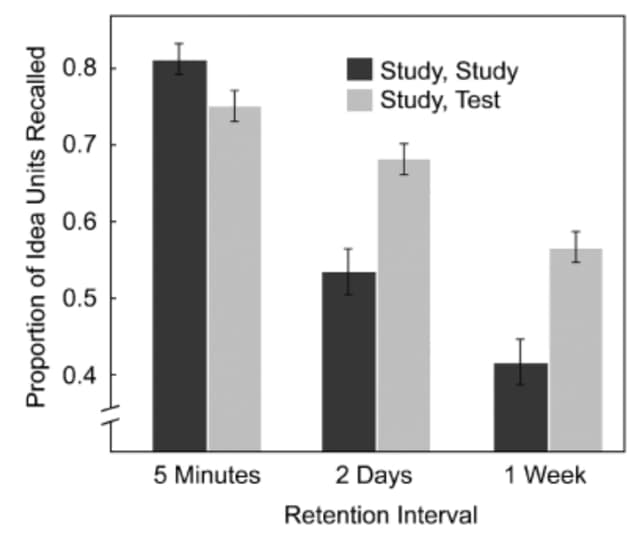
Original graph excerpt from Figure 1 on page 250 of Roediger and Karpicke's source paper (2006); copyright Association for Psychological Science.
The dark bars show additional study; the light bars show initial testing. Their order reverses after the first interval. The vertical axis starts above zero and includes a break, so read the labeled values rather than treating the bar heights as full proportions from zero. The figure measures recall, not course grades.
The source does not show that your local project is new or predict its result. A wider search is needed before claiming a gap, and you must check whether your planned tests suit the question.
Map the planned value to a use
The outline below shows how the prior finding connects to the study plan and which claims still need support.
| Part of the argument | Supported or proposed statement | Limit to retain |
|---|---|---|
| Prior evidence | The paper's Experiment 1 found better delayed recall after initial testing than after additional study. | Short prose passages and an undergraduate sample; see pp. 250–251. |
| Proposed contribution | Compare the two routines on week-later recall in one adult evening course. | This is a plan, with no observed local result. |
| Possible user and use | Course teachers could review the evidence when choosing practice tasks. | The findings would inform a decision, not compel a change. |
| Wider value | Other researchers could examine the described setting and method when planning further work. | One course cannot establish a benefit for all learners. |
Table 1: Each row has a clear job: the source supports the question, the plan states what the study would add, and the uses depend on its findings.
Turn the outline into a careful paragraph
Draft the section from the checked outline. Give your reader the reason, what you plan to add, and how it could be used. Avoid copying a stock paragraph and changing only the names of the groups it claims to help.
Draft from the checked outline
For the hypothetical project above, a short draft could read:
Roediger and Karpicke (2006) found that initial testing led to better delayed recall of prose than further study in their experiment. This planned study will compare written recall practice with rereading in one adult evening course. It will add local data on week-later recall that teachers could use when choosing practice tasks. The project will not test whether either routine raises course grades.
Use your required citation style for the study link. The next sentences describe the plan, not proven results. Any broader gap claim needs a wider review.
Remove promises the study cannot test
Now test a weak draft: “This study will improve students' grades and transform adult education.” Neither gain follows from the planned recall test. Replace it with the narrower claim about local recall data and a teaching choice.
Changing “will” to “may” alone would still leave the grades claim without a basis.
Read each sentence as a reviewer. Can you point to a source for its factual part? Does the method test what you say it will? Can the named user do something with the answer? Would the study still help you learn if the expected difference did not appear?
Keep room for doubt. A sound study could help a course team rethink a belief even if it finds no clear difference. Explain the value of answering the question rather than requiring the result you hope for.
Follow your department's rules for the heading, location, and length. Some guides call this work “rationale”; others separate the two. No single word count suits every proposal or paper.
Keep a cited significance outline in Atlas
Use Atlas to keep the sources, plan, and checked outline in one place:
- Add the source set. Put your chosen papers and study plan in the same project. Label the plan as work you intend to do. Add real local context if you have it, such as a course outline or a written teaching question. Do not invent local findings to make the case sound stronger.
- Check the source text. Wait for sources to finish processing, then open them and check that the text you need is there. If you add a website, inspect what was imported. Read graphs in the source paper yourself and keep what they show in a note. This workflow compares text; it does not assume Atlas has read the figure.
- Request a cited outline. Choose Ask a question, type
@to mention the sources, and enter the prompt below. Select Send. - Check each claim. Open each numbered citation and compare the source passage with the claim beside it. Check who was studied, what was tested, and when. If the outline says the source proves better grades, correct that to the recall result. If it calls your study the first of its kind, require support from a wider search or remove the claim.
- Save the checked outline. Choose New, then Note. Give it a clear title and save the outline, source links, paragraph draft, and questions for your supervisor. Wait for Saved before leaving it.
For the third step, use a prompt that keeps facts and plans distinct:
Build a significance outline from these sources and my study plan. Show what prior work found, what I plan to add, who could use it, and each claim's limits. Cite claims about prior work. Flag any claim that my study is new, missing local facts, or promised gains that my planned tests cannot show.
This is also where a source-checking workflow helps: a linked passage can support one sentence while leaving the next claim unproven. Keep that difference in your own notes.
Atlas helps keep the sources and your reasoning together; you check and approve the final case for the study.
Build a source-linked significance outline
Compare your selected literature and project notes before drafting the argument.