

A research proposal outline sets out what you will study, why the work matters, and how you will do it. It links prior work to your question, methods, time, and resources. Sheffield's proposal guide explains these parts and asks you to give reasons for your choices.
Start with the outline below, then fit it to your course rubric or funding call. Keep a source beside each claim about prior work. Mark choices you still need to make so your supervisor can review the plan behind the headings.

Build a source-grounded proposal outline
Compare your rubric and preliminary sources, then check the proposed sections.
An adaptable research proposal outline
Use this outline to plan each part of the draft. Keep the section names and order your course asks for. Birmingham's guide covers aims, methods, likely results, costs, and sources. It also sets out how the rules differ across programmes.
- Working title and summary, if needed. Name the topic and scope. Write the summary last so it reflects the full plan.
- Background, problem, and rationale. Explain the context, the problem, and why it is worth studying. Cite sources for factual claims.
- Literature and framework. Group prior findings, debates, concepts, and limits around your question. Show how your study relates to them.
- Research question, aim, and objectives. State what you want to find out and what you will do. Add hypotheses if the design and rubric call for them.
- Design, methods, and analysis. Explain who or what you will study, how you will choose and obtain the data, and how you will make sense of it. Give reasons for these choices.
- Ethics, access, and data handling. State which reviews or permissions you need. Explain how you will protect people and store or use their data.
- Schedule and resources. Plan the work within your time, skills, access, and funds. Add a budget if asked. Show which steps must happen before others can start.
- Contribution and limits. Explain what the work could add and what it will leave unanswered.
- References and attachments. List cited sources in the right style. Add tools, consent forms, or other files where the rubric calls for them.
Some parts may share a section in a short proposal. A longer draft may give each part more space.
For example, Georgetown's fellowship guide asks you to show skills suited to the work and links to your goals. Those parts help its panel judge the plan. Add them to your own draft if they serve its purpose or meet its rubric.
Start with the actual requirements
Before you write, save the current rules with their programme name, date or version, headings, marking criteria, and word limit. Check whether the limit counts the source list and any extra files. If a general guide and your rubric conflict, ask the department which rule to use.
For a grant, the call can change the section plan. NIH's advice usually groups the Research Strategy under Significance, Innovation, and Approach. It points you back to the guide and funding notice that apply to the grant. Use those rules to reshape a general template.
Check the scope and date of examples too. AUT's April 2017 Art and Design guide gives a plan for work based in creative practice. It asks for a 10-word title, 150-word topic overview, and 350-word thesis statement.
These old limits show how much a course can shape an outline. Check the current rules before applying there, and use your own programme's limits elsewhere.
A rubric may ask for more detail within a section. The excerpt below comes from Stellenbosch's clinical-research framework. It asks where the study will take place, who it will cover, how the sample will be chosen, and which data will be used. Each prompt calls for a choice that a methods heading alone would hide.
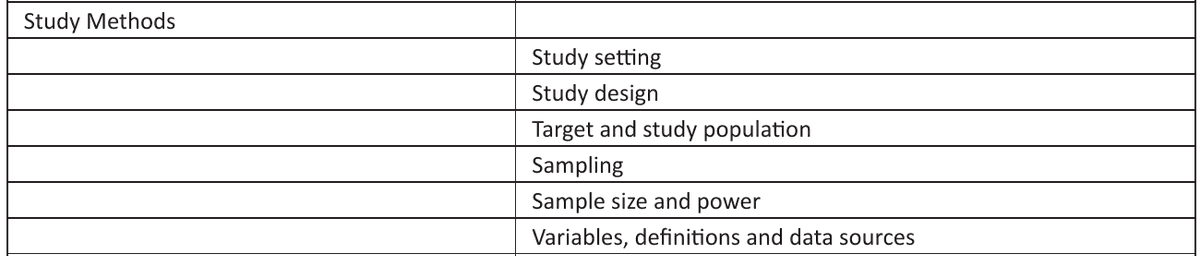
This clinical framework names specific parts of the methods plan. Use your own programme's prompts for the type of study you intend to do.
Do not copy every clinical prompt into a qualitative or humanities proposal. Work out which choices fit your question and which your rubric asks you to defend. Keep a link to the rule beside each item in your notes. That helps you tell a course rule from a useful tip.
Connect background, questions, and methods
The sections need to make a joined-up case for the work. Trent's guide flags broken links between the problem, aims, and methods as a common flaw. Check those links while the draft is still an outline.
For each question, state which data you need to answer it. Explain how you will get or choose that data, then how you will use it to reach an answer. A label such as interviews or document analysis leaves much of this open. Give reasons why the method fits the question, including the limits of what it can show.
Keep three kinds of statement clear in your notes:
- What sources show: what a named source says, with a passage and citation you have checked.
- What you plan to do: the work and choices that still need review or approval.
- What you hope to learn: what the study could add, without making up its findings.
This also helps you state a research gap with care. A few papers cannot show that nobody has studied a topic. Name the specific limit or debate you found in those sources. Search more widely before making a broad claim.
Wollongong's guide notes that a study may build on or challenge prior work, with no need to claim a wholly unstudied topic.
If the aims are still vague, work on them before adding more sections. The research objectives guide shows how to turn a broad aim into tasks you can carry out. Use the literature review workflow to group sources by the questions they address.
Worked requirement-to-section outline
In this teaching example, both the rubric and study plan are fictional. Assume the rubric asks for background, a research question, reasons for the methods, a timetable, and a source list. Its limit is 1,500 words, excluding the source list.
The question is: How do four university proposal guides explain the link between research questions and methods? The starting sources are the opened guides from Trent, Sheffield, Wollongong, and Georgetown.
Trent asks for links between questions and methods. Georgetown asks how data will be gathered and analyzed. These points give a reason to compare the guides in more depth. They do not show how students use the advice or whether it helps them write better proposals.
Match the five rubric items below to draft content, source support, and a choice still to make before you submit.
| Rubric requirement | Proposed section content | Supporting material | Open decision |
|---|---|---|---|
| Background | Explain why question-to-method guidance merits comparison | Trent's continuity discussion and Georgetown's methodology prompts | Which related writing research should frame the comparison? |
| Research question | Compare how the four selected guides explain the link | Named question and bounded set of guides | Include only general guides or programme-specific ones too? |
| Justified methods | Propose document selection, coding, and cross-guide comparison | Saved guides and a methodological source still to select | Define coding rules and justify the document sample |
| Timetable | Sequence source capture, method review, coding, and writing | Available course period and supervisor-review dates | Confirm access and allow time for feedback |
| References | List each cited guide and the chosen methods sources | Checked titles, URLs, versions, and citation details | Confirm required referencing style |
Table 1: The map shows which sources you have and which choices still need reasons. The study remains a plan. The methods outline could start with a plan to compare documents. Save the guide versions and explain why you chose them. Draft fields for question wording, data choice, collection, analysis, and reasons for each method.
Read methods sources suited to this task before deciding how to code the text. These draft fields still need a basis and review.
The study would cover the chosen documents. These guides alone cannot show how a whole university teaches or how its students perform.
If you want to ask how students read the advice, you will need different data and a design to match. When drafting the background, use the literature review and annotated bibliography comparison to turn separate source notes into a claim that connects the guides.
Keep the timetable open to review, with method checks before coding and time for supervisor feedback before you submit. A study with people would also need time for access and the relevant reviews. Ask which ethics or permissions process applies, since the outline cannot establish that your project is exempt.
Check the proposed outline in Atlas
Use Atlas once you have a rubric and sources to compare. In the example, these would be the fictional rubric note and four real guides. For your own study, use the actual rules and sources you have permission to use.
- Open the project and select Add a source, then Upload files, to add a PDF or DOCX rubric and source files. Check what Atlas has read from each file. Create a Note for your question and known limits if they are not in a source.
- Start a chat. In Ask a question, type @ and select the rubric, question note, and preliminary sources. If an item is absent, check that it is in the current project and has finished processing.
- Ask for a focused comparison with the prompt below.
Match each item in the named rubric to a section of my proposal. In each section, keep background supported by the named sources apart from work I plan to do and choices still to make. Cite the rubric passage for each rule and the source passage for each background claim. Flag missing support. Do not invent results, approvals, sample sizes, or a claim that no prior research exists.
- Open the numbered citations beside rules and background claims. Check that each opens the right source and that the nearby text supports the claim. If a citation is missing or unhelpful, ask for support from the named source or correct the draft yourself.
- Review each planned method on its own merits. A rubric can ask you to give reasons for a method. That does not prove the suggested method will answer your question.
- Choose New, then Note, and save the checked outline with its rules, sources, and open choices. Wait for Saved after editing.
Bring the note to your supervisor. Atlas can help compare source text and shape a draft. You and your supervisor must judge whether the method fits, whether you can get the data, and which approvals you need. The format of a response does not settle those points.
Review before writing the full proposal
Check that each rubric item has planned content and each key claim has support. Then trace one research question through the data, how you will choose it, and how you will analyze it. If those steps do not lead to an answer, fix the design before polishing the prose.
Ask your supervisor to review what could make the work hard to finish: scope, access, skills, funds, and time. Georgetown recommends a faculty mentor's feedback on your question and methods in its proposal guide.
Check the source list against the passages you used and the rubric against the current rules. Remove any sentence that treats a hoped-for finding as a known result. Then build the draft from the outline, keeping checked sources and open choices in view.
Build a source-grounded proposal outline
Compare your rubric and preliminary sources, then check the proposed sections.