

Qualitative research questions ask how people experience, understand, or make sense of something in a defined setting. They guide a study that seeks rich accounts rather than an estimate of a numerical effect.
The wording should tell a reader whose experience matters, what is being explored, and where the study is bounded.
For example, “What makes mentoring good?” is broad. “How do first-year teachers in one district describe using a new mentoring program during their first term?” gives a group, place, process, and period without assuming the program helped.
The question is still a proposal. A researcher must check prior work, access, design, and ethics before using it.
Atlas can help compare selected background studies with citations, so the researcher can inspect what those sources do and do not establish before choosing wording.

Check the basis for your question
Compare selected studies, inspect citations, and save your rationale.
What makes a question qualitative
A study question names the experience or process the research aims to understand. It does not start by predicting a measurable difference between two groups.
“How do new teachers describe adapting to a mentoring program?” invites accounts. “Does the program raise retention by 10%?” asks for an effect estimate and needs a different design. An evaluation-question guide covers how to frame a question about whether a program met its aims.
There is no single required stem. “How” and “what” often leave room for description, but a question can still be leading: “How did the successful program improve teachers' confidence?” assumes success and improvement before anyone has been heard. Remove the assumed outcome and ask what people experienced.
Agee's paper on question writing treats it as a part of study design that may change as the work develops. The JKMS methods paper links the question to the study's purpose and approach. Neither offers a word pattern that replaces a sound design.
Separate the study question from interview prompts
The research question says what the whole study tries to understand. An interview question is one prompt used to collect material that may help answer it.
A researcher might study how first-year teachers adapt to mentoring, then ask an interviewee, “Tell me about a time you sought help from your mentor.” The prompt should be clear to the participant; it need not repeat the study question word for word.
A study can use several interview prompts, observations, or records to address one central question. A polished prompt list, though, does not fix a vague aim.
If you choose group discussion to explore the question, the focus group questions guide shows how to turn the objective into neutral prompts and probes while leaving room for different views.
The UT Tyler research-question worksheet helps separate the problem, purpose, and question before data collection begins.
Start with the problem and prior studies
Write a short problem statement in plain language. State what is already known from the sources you checked and what remains uncertain for your chosen people or setting. A gap is bounded by your search and reading. Three papers that do not discuss one district do not prove that no one has studied it.
For each background source, note the people, setting, method, and finding relevant to your proposed question. Then note what it cannot tell you.
A paper about experienced teachers in urban schools may help define mentoring, but it cannot stand in for first-year teachers in a rural district. The Litmaps guide also connects question refinement to reviewing prior work.
Keep a source locator beside each claim in your rationale. If a study describes participants' accounts but not mentoring outcomes, do not cite it as proof that mentoring works. A literature review guide covers the wider task of finding, appraising, and synthesizing studies.
Name the people, phenomenon, and context
Four details can make a broad topic answerable: the people, the experience or process, the setting, and the time boundary. These are choices to justify, not fields that every question must repeat mechanically.
In the teacher case, the people are first-year teachers, the process is adapting to mentoring, and the place is one district during the first term. Yet “first-year” could mean first year in the job or first year in the district. The team must choose: that definition changes who could take part.
The Qualtrics guide uses examples to show how wording can focus a topic. Use them as prompts for a new question; do not inherit another study's people or assume its design suits yours.
A research objectives guide can help align the question with the study's stated purpose.
Refine a broad question step by step
The table below is hypothetical. No teacher was interviewed, and the source-basis notes describe what a researcher would need to check; they are not findings from a completed review.
| Stage | Candidate question | Source basis and unresolved assumption |
|---|---|---|
| Topic | “Does mentoring work?” | “Work” could mean retention, confidence, or help with daily teaching. The team has not chosen an outcome or approach. |
| First qualitative draft | “How do new teachers experience mentoring?” | Prior papers may describe mentoring experiences, but “new” and the setting are unclear. Check whose accounts the reviewed studies include. |
| Scoped candidate | “How do first-year teachers in one district describe using the mentoring program during their first term?” | This names people, place, process, and period. Check that access and the program timeline make it feasible. |
| Alternative angle | “What helps or hinders first-year teachers when they seek mentoring support in one district?” | This may fit an implementation question better. It assumes support seeking is a useful lens; test that assumption with the team. |
Table 1: The scoped candidate does not win merely because it is specific. A team studying barriers may prefer the alternative. A team without access to first-year teachers may need a different setting or a different question altogether.
Write a short choice note: “We propose the scoped candidate because it concerns an experience participants can describe. We have checked relevant prior studies but have not established a complete literature gap.”
Add what remains: “We still need to confirm participant access, program timing, and review requirements.” The note makes those decisions visible.
Test the question against the study design
Use an evidence and method check before treating the wording as final. Can the people you hope to study speak to the topic? Can the planned talks, field notes, or records answer the question? Can the team cover this setting in the time it has?
Ask whether the plan can handle cases that do not fit an early view. If some teachers never used the program, the question should not force them to describe a benefit.
Agee's discussion is useful here: the question and design can evolve together, but changes need a reason. A negative-case analysis offers a way to examine accounts that challenge an early reading.
The team owns this check. A cited summary of past work can expose guesses, but it cannot approve a design, get access to people, or decide ethics rules.
Check the source basis in Atlas
Add the background studies and a short scope note that you are permitted to use to an Atlas project. Select the relevant sources with @. Ask: “For each selected study, identify the people, setting, and aspect of mentoring it examined. Cite the passage. What remains unclear for our proposed first-year-teacher question?”
Open each citation and read the surrounding section. Check whether the paper studied teachers, mentors, or administrators; whether it reports an experience or an outcome; and whether a proposed gap is only a gap in this small source set. Correct any overstated claim before saving it.
Save the checked comparison, two candidate questions, the reason for the current choice, and unresolved assumptions in a project note. Atlas helps trace the rationale to selected sources; the researcher decides what the sources mean and whether the question fits the study.
The screenshot shows an Atlas source beside a cited answer. Its visible paper is unrelated to the invented teacher example and does not support the table above.
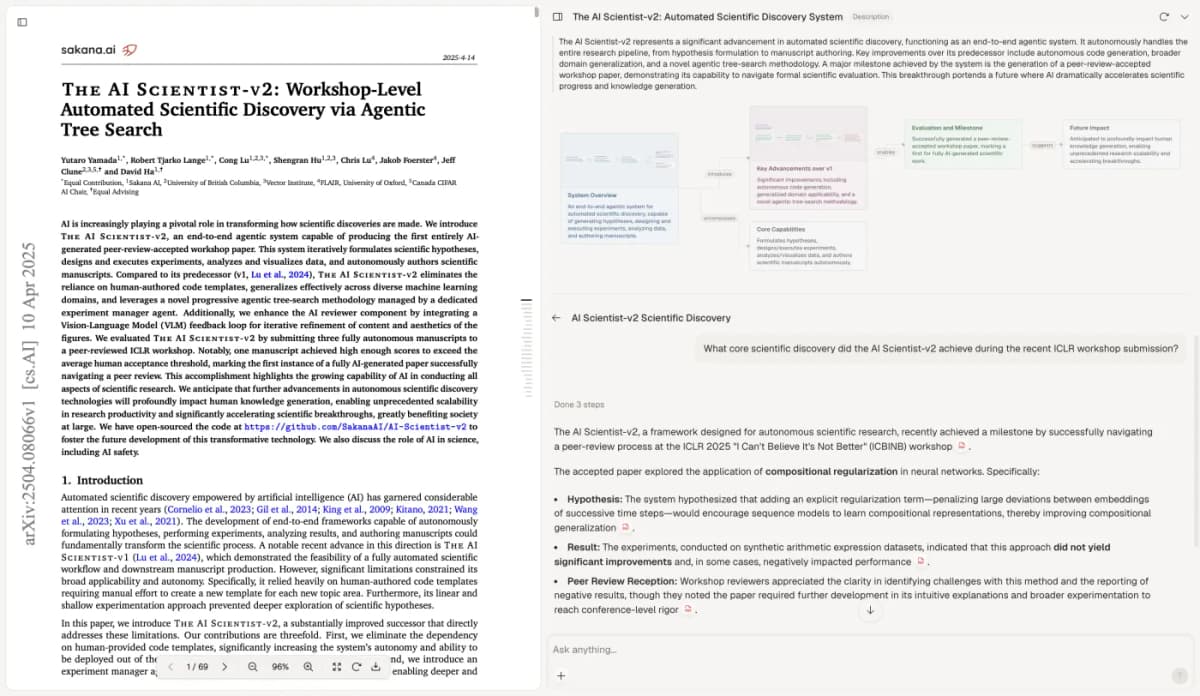
Atlas displays The AI Scientist-v2 by Yutaro Yamada and colleagues, licensed CC BY 4.0. This reused capture is unchanged. The paper supplies no evidence for the hypothetical mentoring study.
Review feasibility, ethics, and wording
Take the draft to a supervisor or research team. Check access to participants, time, the meaning of key terms, potential burden, permissions, and the review process that applies to the study. If the question changes, record why and check whether recruitment and analysis plans must change too.
Avoid a claim that one source set proves an untouched topic. Also avoid wording that asks participants to confirm an expected benefit. The final question should be open enough to learn from their accounts and narrow enough to guide a feasible study. A research implications guide covers the later task of relating findings to a decision.
Once the question is reviewed, place it in a research proposal outline with the planned method, source support, access needs, and open ethics decisions. Wording alone cannot establish that the study is feasible.
If the study instead uses existing records as its main evidence, the qualitative document analysis guide shows how to select, appraise, and compare a bounded file set. That method has its own limits and should be chosen for the question, not as a shortcut around participant access.
Check the basis for your question
Compare selected studies, inspect citations, and save your rationale.