

Good focus group questions invite people to describe a shared topic and discuss how their views differ. They are open, clear, and tied to what you need to learn. Ask one question at a time, then use a probe to seek detail rather than guessing what a short answer means.
For example, “What happened when you last looked for help?” leaves room for a smooth experience or a difficult one. “Why was the help page so confusing?” assumes a problem before anyone has described it.
Build the guide around your research objective, with space for accounts you did not expect.

Check the purpose of each prompt
Connect draft questions and probes to your research objective.
Start with the group research objective
State what the discussion needs to explore and who can speak to it. In a fictional library project, the objective might be to understand how new students find help with accessing course readings. That is narrower than asking whether the library is good, and it does not assume a particular cause of difficulty.
The CDC methods manual describes focus groups as guided discussions with room for probes and group participation. The interaction matters: people can build on an account, question it, or explain why their experience differs. A guide should support that exchange.
If you need detailed knowledge of a process from particular roles, compare a key informant interview before choosing a group format. Check each person’s direct involvement and keep their knowledge limits with the account.
Turn the goal into research objectives before choosing topics. A question belongs if its answer could help address the objective. An interesting topic that cannot change your understanding of the goal may consume the time needed for a more useful discussion.
Example focus group questions and probes
These examples belong to the fictional library-help project. No one has used them to collect data or tested them in a pilot. Adapt the words to the people you will hear from, your actual goal, and the study permissions.
A main prompt opens a topic. A probe follows up only when needed, while an invitation to the group can reveal other experiences. Choose among these examples instead of asking every follow-up as a fixed script.
| Purpose | Main prompt | Optional probe or group invitation |
|---|---|---|
| Open a familiar topic | Where do you usually start when looking for a course reading? | What makes that a useful starting point for you? |
| Hear a concrete account | Tell us about the last time you needed help getting a reading. | What happened next? Has someone had a different experience? |
| Explore the choice of help | How did you decide whom or what to ask for help? | What other routes, if any, did you consider? |
| Clarify a point in the process | What made the next step clear or unclear? | Can you give an example of what you saw or heard? |
| Check what was missed | What else should we understand about finding help? | Is there a view or experience we have not heard yet? |
Table 1: Each prompt serves the same objective, while probes add detail and invite difference without assuming a problem.
Start broad, then follow the account
Begin with an accessible question before asking for a detailed account. Ask participants to describe what happened in their own terms, then follow the part that bears on the objective. An optional “What did that word mean to you?” can clarify a term without imposing the researcher's definition.
Northwestern's original sample guide groups questions by topic and adds follow-ups. Its questions serve specific training-program goals.
Borrow that organizing principle rather than assuming every question in an institutional example fits your own study.
Invite comparison without demanding agreement
After one account, you might ask, “Who has taken another route?” or “What was different for you?” Avoid asking everyone to endorse the first speaker's view. People may agree because they share an experience. They may also want to be polite, fear a dispute, or feel pressure from someone with more power.
CDC's group discussion guidance explains both the value and the limits of group dynamics. Ask for differences as part of the inquiry, and keep them in the notes. A minority view is not an error to remove from a summary.
Repair questions that steer the answer
Read each draft question aloud. Check whether it assumes a result, bundles topics, uses unfamiliar terms, or asks people to guess what someone else thinks. Keep the useful topic but remove the assumption. A neutral prompt can still be specific enough to guide a discussion.
Remove the implied cause
“Why does the confusing website stop you getting readings?” assumes confusion, a failed task, and a cause. Try: “Tell us how you looked for a reading online.” Then ask, “What, if anything, helped or got in the way?” This allows people to describe help, barriers, or no problem at all.
Typeform's question-writing guidance also emphasizes open, neutral prompts about one idea. Treat its examples as starting points. A library group, product-feedback group, and workplace group have different purposes and different risks.
Split a bundled question
“How clear and helpful were the website and the staff?” asks about two qualities and two sources of help. You cannot tell which part a short answer addresses.
First ask, “How did you use the website?” Follow with a question about a relevant point of clarity. Ask about staff help separately if it serves the objective.
Keep probes distinct from the main prompt. A guide that prints every possible probe as a required question can become an interrogation.
The discussion-guide article by Theertha Raj links objectives, topic flow, and follow-ups. Rehearse that flow for your actual session rather than adopting its example timing as a rule.
Check the discussion guide in Atlas
Bring your study goal, background sources, and draft guide into an Atlas project. Upload only material you are allowed to use. You can plan the guide without people's names or a completed transcript. Use the sources behind the topics you want to explore.
- Open the project and wait for the selected sources to finish processing.
- In Ask a question, type @ and select the objective, background research, and draft discussion guide.
- Ask: “For each main prompt and probe, show which research objective it serves. Cite background passages that motivate the topic. Flag leading assumptions, bundled questions, and missing support. Separate wording suggestions from findings.”
- Open the cited passages. Check whether the source motivates asking about the topic or actually establishes the stronger claim in the proposed question.
- Revise the guide yourself. Keep useful topics with neutral wording and mark assumptions or source gaps that still need discussion with the research team.
- Select New → Note, save the corrected objective-prompt-probe guide with source references, and wait for Saved before closing it.
Check the suggested rationale
Suppose an answer says a background paper proves new students find this campus's website confusing. Read the paper's setting and who it studied. If it concerns another institution, the supported rationale may be to ask about website use, not to tell participants it is confusing.
The capture below shows a source beside a cited answer. This arrangement helps you check that distinction. The visible AI research paper is unrelated to the library example; it does not show a tested discussion guide or a completed focus group. Read the source context before keeping a proposed rationale.
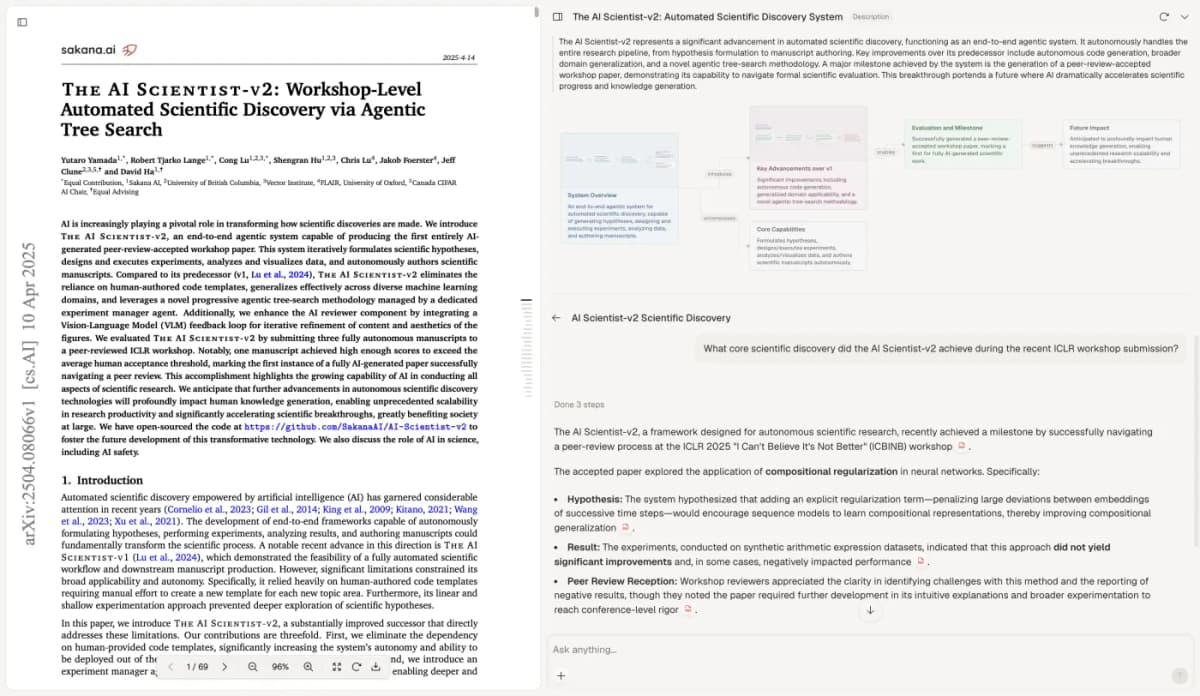
Compare the proposed interpretation with the source before turning it into a prompt.
Embedded paper: Yutaro Yamada et al. (2025), The AI Scientist-v2: Workshop-Level Automated Scientific Discovery via Agentic Tree Search, CC BY 4.0. The existing Atlas screenshot is reused unchanged; its original framing and compression are retained. The paper license applies to the embedded work.
When background papers disagree, synthesize their separate contributions and retain the disagreement. The guide may need to explore different experiences instead of choosing the explanation favored by one paper.
Plan for group dynamics and privacy
A well-written prompt cannot make a group safe or useful on its own. Felice Billups's methods article describes the skills needed to plan and lead groups of college students.
The moderator leads the exchange, watches for pressure, and lets people skip a question.
Other people in the group hear what is shared. CDC's manual warns that groups have limits on privacy, especially for sensitive accounts.
Discuss ground rules and consent. You cannot promise that each person will keep what they hear private. If the topic needs privacy, consider a suitable one-to-one method and seek the ethics review it needs.
Record how people respond to each other as well as the words said. Keep the speaker and context clear in any permitted transcript analysis.
A forceful speaker can shape what others say next. Keep that pressure in mind when you read their accounts. Silence is not proof of agreement.
After fieldwork, focus group analysis helps you examine agreement, dissent, and turn sequence while keeping each account tied to its source.
Rehearse the guide before fieldwork
Review the objective, prompts, probes, consent, and recording plan with the research team. Rehearse the guide to check whether the questions make sense, the transitions feel natural, and the available time allows discussion. Remove lower-priority questions if they crowd out the main topic.
Then test the wording through an appropriate pilot or review process and record what changes. Ask whether each prompt leaves room for an unexpected answer.
CDC's interviewing guidance puts human judgment at the center of probing and following relevant leads. Keep the guide flexible enough for that judgment while preserving the study's scope.
Check the purpose of each prompt
Connect draft questions and probes to your research objective.