
Focus group analysis examines what people say and how the group discussion shapes it. A useful reading note keeps each speaker's account beside the turns that prompted, supported, or challenged it. A list of quotes alone can lose the shared context that makes a group discussion distinct.
This guide builds a fictional speaker-theme-interaction note from a workshop-booking discussion. It shows how a condition on agreement, a dissenting view, and an absent response can change a claim. Use the note to inspect sources within your chosen research method.

Compare group passages in Atlas
Check speaker accounts, dissent and source context before sharing a theme.
What focus group analysis keeps visible
A focus group is a guided discussion whose participants respond to one another. GOV.UK's methods guide explains the role of group dynamics. People can build on a point, challenge it, or use the same word in different ways. Their sequence of replies can matter as much as a striking standalone quote.
The content tells you what was said. The interaction tells you how one turn relates to others. In their original methods paper, Hermann and colleagues developed a way to make these links visible during thematic work. Their proposed scheme was developed for a defined study context, so check its fit before adopting it for another project.
In reflexive thematic analysis, a theme captures a pattern of meaning that serves the study question. Braun and Clarke's guidance distinguishes such themes from topic summaries. Your research approach shapes how you develop and judge themes. State that approach before treating a comparison table as the full analysis.
A source-reading note traces the passages that support or limit a proposed finding. For wider study appraisal, a CASP qualitative checklist asks broader questions about the research. Neither a tidy note nor a checklist label can show that every relevant view has been captured. Keep the task and its limits explicit.
Prepare the transcript and source context
Begin with the actual research question and the set of files you are allowed to use. A full transcript, a short summary, and an observer's note offer different kinds of support. Keep their roles clear before grouping passages.
The CDC methods chapter stresses source organization and version control. A changed speaker label or an edited transcript can alter which account a claim rests on.
- Check permission. Confirm that consent and your data rules allow the material to be processed in the selected tool.
- Name the source. Keep a file version, group label, date, and stable turn or paragraph location.
- Preserve speakers. Use permitted labels that distinguish people without exposing restricted names or details.
- Keep nearby turns. Retain the prompt and replies needed to understand the excerpt, including a challenge or qualification.
- Mark missing context. Note unclear words, overlap, missing speaker identity, or unavailable recordings instead of filling the gaps.
- State the method. Record how this reading note will support, rather than replace, the study's chosen approach.
If a transcript records laughter or a pause, keep that notation with its source. Do not infer what it meant without enough context. Text alone may leave open whether a pause followed a joke, a hard question, or an interruption.
Hermann and colleagues discuss ways to inspect uncertain interactions. Use permitted recordings or notes when available, and record the limit when they are not.
Keep the original source intact while building the note. A short excerpt can be useful, but its stable location should lead back to the full exchange. This allows another researcher to test your reading later.
Compare accounts without flattening the group
Read one exchange in its setting before comparing groups. Who raised the point, who replied, and did the next speaker support the same idea or add a condition? A shared topic does not always mean a shared view. The Grønkjær and colleagues abstract reports work on interaction and the moderator's role. Its findings give you a reason to examine group context while leaving each exchange's meaning to be checked.
Review a claim against its source support, speaker identity and turn sequence. Agreement, dissent and missing context can each change the reading. Choose criteria that fit the research question without treating them as a score that certifies research quality.
A speaker who repeats a point three times is still one speaker. Repetition can signal emphasis within the discussion, but it does not create three independent accounts or show how common a view is outside the group.
Explicit agreement also needs care. “Yes, if it is optional” supports a narrower view than “yes.” Keep the condition attached to the account, even when it makes a summary less neat.
A dissenting turn may challenge the whole claim or only part of it. Read what the person rejects before writing that the group is split. A reply may add a second concern without opposing the first.
The CDC chapter discusses the risk of shallow consensus. The source check here preserves what speakers say instead of assuming that an unchallenged statement speaks for the room.
Across groups, compare the question, prompt, composition, and task context. If a second group never discussed reminders, that absence is not evidence that its members rejected them. The topic may not have been raised.
For the larger task of building patterns from data, our inductive thematic analysis guide explains why theme development needs more than grouping similar words. Preserve meaning as well as topic labels.
Build a fictional group evidence note
Imagine a made-up focus group about booking community workshops. All speakers, quotations, turn numbers, and records below are fictional teaching material. They describe no real people, Atlas study, or measured booking outcome.
The moderator asks what would help people remember a booking. A draft summary says, “Everyone wants reminder messages.” The note keeps the replies and their links visible so that summary can be checked.
| Fictional source location | Speaker account | Link to the exchange | What it supports or limits |
|---|---|---|---|
| G1 transcript, turn 18 | P1: “A message the day before would help me.” | First reply to the reminder prompt | P1 supports a reminder in the stated setting. |
| G1 transcript, turn 19 | P2: “Yes, but only if I choose it.” | Qualified reply to P1 | P2's support depends on being able to choose the reminder. |
| G1 transcript, turn 20 | P3: “I already use my calendar. I do not want another message.” | Dissent from the reminder proposal | P3 does not share the preference in this exchange. |
| G1 transcript, turns 18–21 | No reply attributed to P4, with audio unavailable | Missing response and context | The text does not establish P4's view or reason for silence. |
Table 1: The fictional speaker and interaction note uses invented quotations, labels and locations to teach source checking. No participant data or study results are shown.
The first two accounts share a concern with remembering the booking, but P2 adds a choice condition. P3 offers a different route through a personal calendar. The absent P4 reply remains a gap.
The transcript leaves open whether P4 agreed, disagreed, was interrupted, or chose not to speak. Without a recording, the reason remains unresolved.
The interaction methods paper makes agreement and other interaction visible in its scheme. The original teaching table above uses plain labels for source reading. It does not reproduce or validate the authors' method.
A full study might include other groups, prompts, or later turns that change the reading. Keep those possibilities beside the note. The four rows show why this excerpt cannot support “everyone,” not the final findings of a completed analysis.
Correct a claim of shared agreement
Review the evidence for who spoke and what view each turn supports, retaining any conditions and gaps in the source. Here, dissent and missing response both limit the claim of full agreement.
The note supports this revision: “In this exchange, P1 favored a reminder, P2 favored one only by choice, and P3 preferred an existing calendar. P4's view is not established by the supplied transcript.”
The corrected statement does not estimate how many customers want reminders. It describes these fictional turns under this prompt. It also does not prove that a reminder would improve attendance, bookings, or understanding.
GOV.UK's example shows why the people studied bound the scope of a finding. Name the relevant group and context in a real note before widening the claim.
The next question might concern choice, existing reminder habits, or why a message is unwanted. That is a decision for the study team. Keep it distinct from the finding, so a proposed product change does not become a supposed result.
Use Braun and Clarke's guidance on research-question fit to review relevance. A reminder-preference note may serve a booking question, but it cannot settle an unrelated claim about trust or overall service quality.
Inspect group passages in Atlas
Add only permitted transcripts and notes to the project, then wait for processing. Start a chat and mention the relevant sources with @. Clear file versions help keep a summary from standing in for the original exchange.
Choose Project only beside + to stop new outside retrieval. Earlier context remains available, including outside material already present. A fresh chat can help when that context would blur the intended source set.
Ask for a bounded comparison:
Compare the speaker accounts in these named sources for the reminder-preference claim. Cite the speaker label, source location, nearby prompt, agreement or dissent, and any condition on the view. Keep missing responses open. Do not infer consent from silence or count repeated turns as independent people.
Open the citations and read nearby turns. Our citation-tracking guide explains why a source link still needs review. Check that a quoted reply refers to the proposal under discussion.
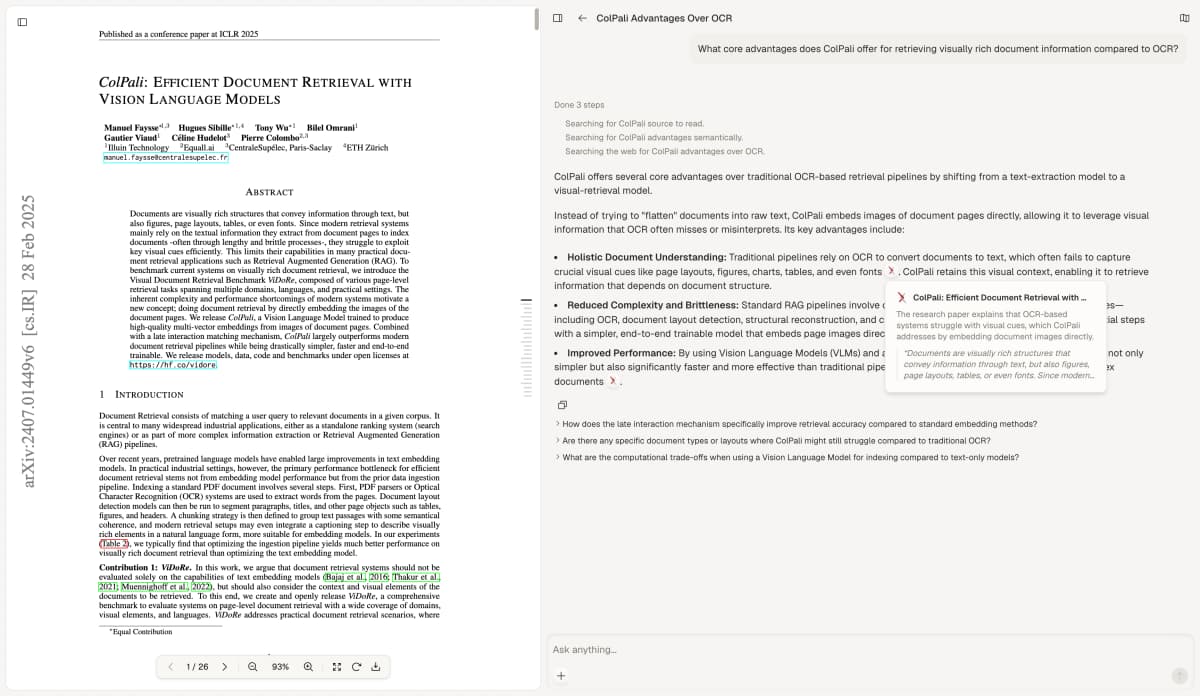
Atlas displays Faysse and colleagues' ColPali paper, released under CC0 1.0, beside an answer and open citation. The screenshot illustrates source inspection. The fictional workshop discussion and its analysis are not shown.
Correct a row if it drops P2's condition or turns P4's silence into agreement. Ask for the exact passage behind that reading. If none is found, keep the gap rather than accepting a fluent explanation.
For larger sets, our research synthesis guide explains how to keep comparisons tied to sources. Atlas helps read and compare text, while researchers maintain the formal coding database and check for missed material.
Save the theme with its limits
Before saving, trace one claim through the speaker turn, nearby exchange, and source version. Ask a researcher familiar with the session to review the meaning where possible. A clear note should also be inspectable by someone who was not in the room.
Select New, then Note, and wait for Saved before closing. Keep the corrected scope, dissent, missing context, and links with the note. The team should be able to see why the “everyone” claim was narrowed.
Choose the next source check before sharing a recommendation. When new material arrives, inspect it and revise the finding with its limits. Preserve the earlier reasoning so the change can be understood, rather than leaving only a polished final line.
Compare group passages in Atlas
Check speaker accounts, dissent and source context before sharing a theme.