

The CASP qualitative checklist helps you appraise a qualitative study by working through 10 questions and recording your reasons. Start with the official checklist download. Then keep each response linked to what the paper reports and what you judge from it.
A completed form should help another reader follow your reasoning. A tick beside a question gives little detail on its own. A checked passage, your response, and a reason show why you found a method suitable or why a gap leaves you unsure.

Find appraisal passages in Atlas
Read cited study passages, then save your own appraisal reasons.
Start with the official CASP checklist
CASP stands for the Critical Appraisal Skills Programme. You can get the form in Word or PDF from its official page. The PDF linked there is the 2024 qualitative research checklist, with space to sum up your appraisal.
Use the form that matches the study you are reading. An interview study and a systematic review need different appraisal tools. A study cited in a review is still a study in its own right. If your review covers several designs, the Mixed Methods Appraisal Tool has criteria for qualitative, quantitative, and mixed methods studies. Use CASP's qualitative checklist to appraise a qualitative study. Choose the tool that fits the study design and your review protocol.
Record the version you use
Keep the checklist title, version, and access date with your notes. Archived forms and research adaptations also appear in search results. If a course or review protocol calls for a particular version, check that requirement before starting.
CASP's referencing guidance gives a reference format with the organization, year, checklist title, URL, and access date. Cite the version you used. A modified tool in a methods paper should be identified as that adaptation, with the changes explained.
Understand what the 10 questions cover
The current form covers these areas. The list names each topic in brief; read the official form for the full questions and prompts:
- Research aims
- Fit of qualitative inquiry
- Fit of the design
- Recruitment
- Data collection
- Researcher relationships and influence
- Ethics
- Analysis
- Findings
- Value and use of the research
The text you need may be outside the methods section. Check the discussion and any linked extra files too.
Use prompts with the study design
Consider what the authors set out to learn and how their methods serve that aim. A technique that helps one kind of qualitative study may not be needed in every other kind. Judge the fit of the work described rather than searching for a fixed collection of method names.
Long, French and Brooks's methods paper warns that checklist hints can be misused as boxes that every study must tick. It also explains the authors' own adaptations. Those changes show how researchers debate the tool's use; they do not replace the current official form.
For instance, finding the phrase “thematic analysis” is a starting point for reading how the authors worked with the data. It does not settle whether the analysis supports the findings. The guide to inductive thematic analysis explains the link between codes, themes, and source evidence.
Link each response to study evidence
For each item, locate the passage that bears on the question. Keep a page, section, or other stable reference so you can find it again. Then write what the passage establishes before deciding how to respond.
Use a note such as “The methods describe who was invited, but not why that group suited the aim.” It identifies both the reported method and the part you still need to assess. “Recruitment was appropriate” jumps to a judgment without preserving the basis for it.
Keep evidence and judgment apart
Your evidence note records what the authors say. Your reason explains how you interpret that statement in relation to the item. A source may report an interview method clearly while leaving its fit with the question open to appraisal.
CASP's use guidance asks you to record reasons alongside responses. This lets a second reader challenge a judgment by looking at the same text, rather than guessing which passage led you to it.
Preserve unclear reporting
The official form allows an uncertain response when the report does not let you tell. Keep the gap open and record any linked materials you checked.
Suppose the paper says interviews were recorded but gives no account of the interviewer's relationship with those interviewed. Recording says something about the form of data. It does not establish that the researcher examined their influence on the interview.
An absent account is not proof that reflection never occurred. Revise the entry when new evidence resolves it.
Work through an appraisal evidence table
Consider a hypothetical paper about how students use a campus support service. Imagine that it describes interviews, consent, and themes, but says little about who was asked to take part or who interviewed them.
The example uses invented study details to show how a reviewer might record what is known and what remains open.
Read the fictional paper cautiously
The imagined methods say that current service users were invited to interviews and that recordings were transcribed. Another paragraph says people gave consent and their names were removed. The results group quotes under themes about access to support.
Use one row per selected item to keep the reported detail, your own response, and the reason for it visible.
| Area being appraised | Fictional passage reference and reported detail | Example reviewer response | Reason or open question |
|---|---|---|---|
| Recruitment | Methods, recruitment paragraph says current users were invited. | Can't tell | The report does not explain why only current users suited the aim or whether former users' views were needed. |
| Data collection | Methods, interview paragraph describes recorded, transcribed interviews. | Can't tell | The format is stated, but the reason for choosing interviews and the interview guide remain unclear. |
| Researcher influence | No account found in the fictional methods or discussion. | Can't tell | Who conducted interviews, what relationship they had with students, and how they addressed that role remain unknown. |
| Ethics | Methods, consent paragraph describes consent and removal of names. | Can't tell | Those steps are reported, but the account does not address whether users felt free to refuse without affecting access to support. |
Table 1: Each response is tied to the missing detail in this fictional report, rather than to a general rule that interviews or service-based recruitment are poor methods.
For a real study, use checked passages. Its aim, context, and reporting may support different judgments from these fictional entries.
Correct a claim that exceeds the passage
An early note might say, “The interviewer was independent, so students could speak freely.” The fictional passage does not name that person or their role. Correct it to “The study reports recorded interviews, but does not state who led them or how they knew the students.”
Record why the gap matters: students may feel less free to speak if the interviewer also controls access to the service. This raises a concern to examine, though the imagined report gives no finding that such pressure occurred.
The guide to reflexivity in qualitative research explains how a researcher examines their role in the work. In appraisal, you read the paper's account of that role and judge what it lets you understand.
Make judgments without an automatic score
Explain which strengths and limits matter for the study's findings. Two studies with the same number of Yes responses could raise quite different concerns.
If a paper says little about how its themes were drawn from the data, that gap may affect how you use a key finding. Keep that concern visible even when other parts of the study are reported well.
The Cochrane Handbook's qualitative-evidence chapter advises against scores for each domain or a total quality score. It asks reviewers to assess strengths and limits. Describe the concern so a reader can see more than a point deducted.
Explain the consequence of each concern
In the fictional paper, the sample may be suitable for understanding current users' experiences. It may tell you less about people who tried and failed to access the service. State which use you have in mind before deciding how much that limit matters.
This also separates study appraisal from inclusion in a synthesis. Follow the review's justified protocol for how appraisal informs use of findings. A missing detail should not become an improvised exclusion rule after you see whether you agree with the results.
When reviewers disagree, compare their cited passages and reasons. One might have found an explanation in a supplement that the other missed. They may also differ in how they interpret the same account. Keep that distinction visible when resolving the entry.
Find and check passages in Atlas
Use Atlas to help locate reported methods in the full paper you are appraising. Add permitted material to a project, open a chat, and type @ to select the paper. Choose Project only if new web or literature search should stay outside the task.
Ask for text before an appraisal
Ask a question focused on the paper's statements:
For this paper, find passages about who was recruited, how interviews were carried out, and the interviewer's role. Give a citation for each reported detail. Mark details you cannot find as not located. Keep the author's statements separate from possible appraisal questions, and do not assign a study grade.
Open each numbered citation and read the passage with the nearby text. If the answer claims an independent interviewer but the passage only mentions recordings, correct the entry and ask for the actual source of the independence claim.
The image shows a real Atlas citation preview beside a paper. Its visible ColPali paper is unrelated to the fictional campus study. It illustrates the source-opening step you use to check whether a statement is supported.
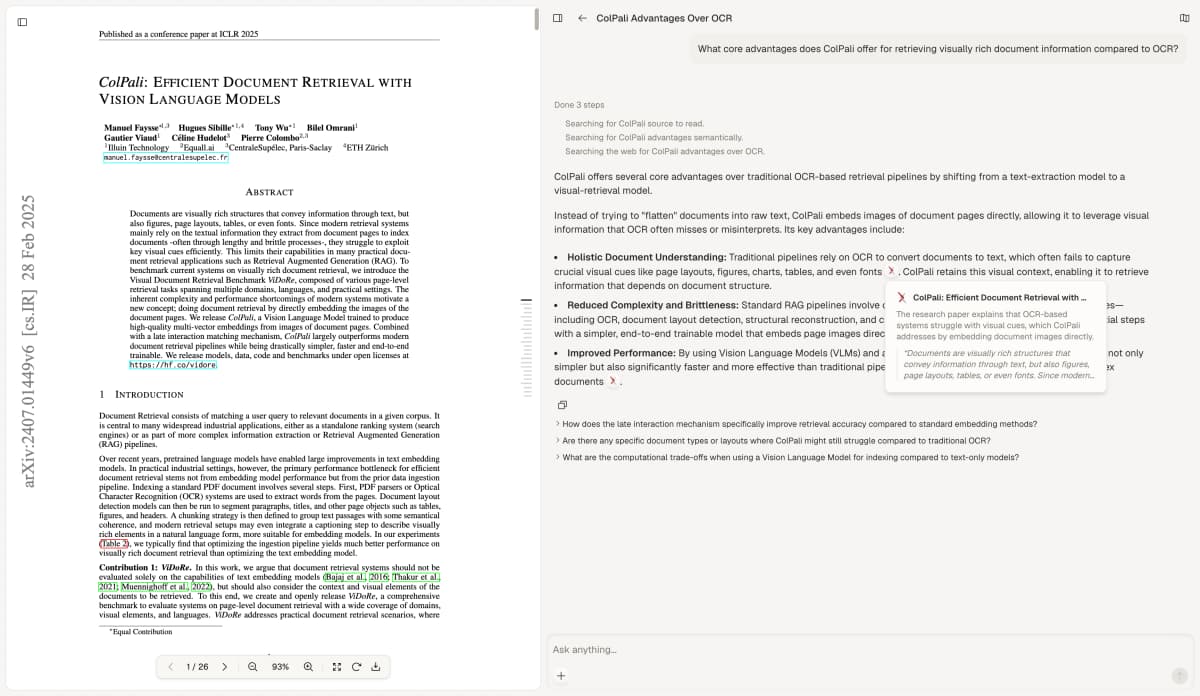
The screenshot includes ColPali by Manuel Faysse et al. (arXiv:2407.01449v6, 2025), released under CC0 1.0 Universal. The existing Atlas image is copied unchanged.
Save your checked reasoning
Use New, then Note, to keep the checked evidence table and your own responses and reasons. Include unresolved questions, linked supplements, and the checklist version. Wait for Saved before closing the note.
Atlas supports finding and comparing the text. The reviewer applies the appraisal tool and decides what the reported strengths and limits mean. A passage marked “not located” also needs your check before you treat it as a reporting gap.
Write an appraisal summary you can defend
Use the CASP appraisal-summary prompts to bring strengths, limits, and unknowns together. State what the paper helps you understand, linking each key concern to its evidence entry.
For the fictional campus paper, a summary might note the reported interviews and consent. It would keep the choice of sample, the interviewer's role, and the analysis process open. Unclear reporting alone would not show that the study was unethical or its findings were false.
Keep the appraisal useful later
When you use a finding in a research-paper synthesis, carry the relevant appraisal concern with it. Keep a claim about current service users in that context when a reader considers people who could not access the service.
Keep the appraiser's name and date with the note, and record the reason for any revised judgment. If a linked methods report fills a gap, preserve both the new evidence and the change it supports. This makes the appraisal usable when the paper returns in a later review.
Check coverage against the official form, with a reason and source basis for each response. Keep unknowns distinct from evidence of a flaw.
Find appraisal passages in Atlas
Read cited study passages, then save your own appraisal reasons.