

Confirmability in qualitative research asks whether a finding has a basis you can trace in the sources. You check how the researcher moved from accounts to claims and how prior views shaped that move. The aim is a reading others can inspect, while keeping the researcher's role in view.
A quote can be correct while the meaning assigned to it goes too far. To check the finding, read the passage in context, the reason for the claim, and other possible readings.
This guide builds a finding-excerpt-assumption trace note. The staff accounts below are fictional. They show how to correct one claim without pretending to audit a whole study.

Trace a finding to its sources
Compare the claim, excerpt, and assumptions behind a qualitative reading.
What confirmability asks you to inspect
Jensen's confirmability entry links findings to participants' accounts while acknowledging the researcher's perspective. The question is how that perspective is made visible and how the reading is justified.
This matters when a researcher expects one pattern. That view may help frame a question, but it should not stand in for what the text shows. Look for the link between the account and the stated meaning.
An audit trail can record decisions along the way. Confirmability asks you to assess those decisions against the material. A record of a choice and a sound reason for that choice are different things.
Follow the path from material to claim
Start with one finding rather than a broad claim that the study is objective. These four parts make the interpretive path easier to inspect from the sources you have.
| Part of the trace | What to inspect | What to retain |
|---|---|---|
| Passage | Full excerpt and its setting | What the speaker actually said |
| Reasoning | How the account becomes a finding | The stated analytic reason |
| Assumption | The researcher's prior view or role | How it could shape the reading |
| Alternative | Another reading or contrary account | What the first claim leaves out |
Table 1: The trace keeps text support, analytic choices, and open questions visible without assigning a quality score.
Carcary's audit-trail guidance distinguishes records of the work from the development of the researcher's thinking. A reader needs both to follow why a conclusion was reached.
The SRQR reporting resource is useful when you need to identify the reporting guidance behind a study. Reporting detail enables scrutiny; it is not a certificate that every interpretation is sound.
Keep each source location in the trace. If you cannot locate the memo or passage behind a claim, say so. The gap limits what you can check; it does not establish that the researchers never made that record.
Worked example of an assumed motive
Imagine a fictional workplace interview about a new scheduling tool. A staff member says they did not use it during a busy shift because entering the same details twice took time. An analytic memo labels this “resistance to change.”
The excerpt supports a report of duplicate entry and time pressure. It does not by itself show a dislike of change. The label adds a motive that needs further support.
Compare the label with the account
Read what question was asked and what came before the reply. Was the speaker discussing a particular shift, the tool in general, or a wider team practice? That context affects how broadly you can use the account.
Suppose a reflexive note says the researcher expected staff to resist new software. Reflexivity means checking one's own role and prior views. The note shows a possible source of bias, but does not settle the best reading.
Shenton's methods discussion treats beliefs and method limits as part of what readers should be able to inspect. Use the reflexive note to ask a sharper question about the label.
Write a narrower finding
Replace “Staff resisted change” with “This account describes duplicate entry as a barrier during a busy shift.” That wording fits the fictional excerpt. It leaves open whether other accounts show a broader pattern or another reason.
If a second account welcomes the tool when duplicate entry is removed, retain it. Negative case analysis can help examine what such a case challenges. Do not hide it merely because it conflicts with the first label.
The saved trace now includes the excerpt, the motive label, the researcher's expectation, the other reading, and the corrected claim. It shows a change in reasoning rather than a cosmetic change in words.
Read quality practices in context
Named practices give you questions to ask, not automatic guarantees. A reflexive journal may contain rich reflection or only brief notes. An audit log may show decisions without linking them to passages.
Jensen's discussion of perspective helps frame the issue. Judge how the practice addresses the study's aims and approach. Do not require multiple coders or agreement from participants in every tradition.
Credibility asks about the fit of findings with the accounts and setting. Transferability asks about use elsewhere. These concerns can interact, but neither replaces the trace from material to interpretation.
A report with selected excerpts permits only a bounded check. It may not expose all interviews, memos, or contrary cases. State the material you reviewed and avoid implying that your source check covers the full corpus.
Check the finding sources in Atlas
Open the project with the finding, relevant excerpts, analytic memo, and authorized reflexive notes. Follow the study's consent and data-sharing rules. In a chat, type @ in Ask a question and select those sources.
Ask: “Trace this finding to the excerpts and memo. Separate what the text says, the analytic reason, researcher assumptions, and another plausible reading. Cite each part and identify missing support.”
Open the citations for the key claims. Read the full passage and enough surrounding text to check the scope. The reasoning focus in Carcary's account is a useful reminder to inspect more than stored text.
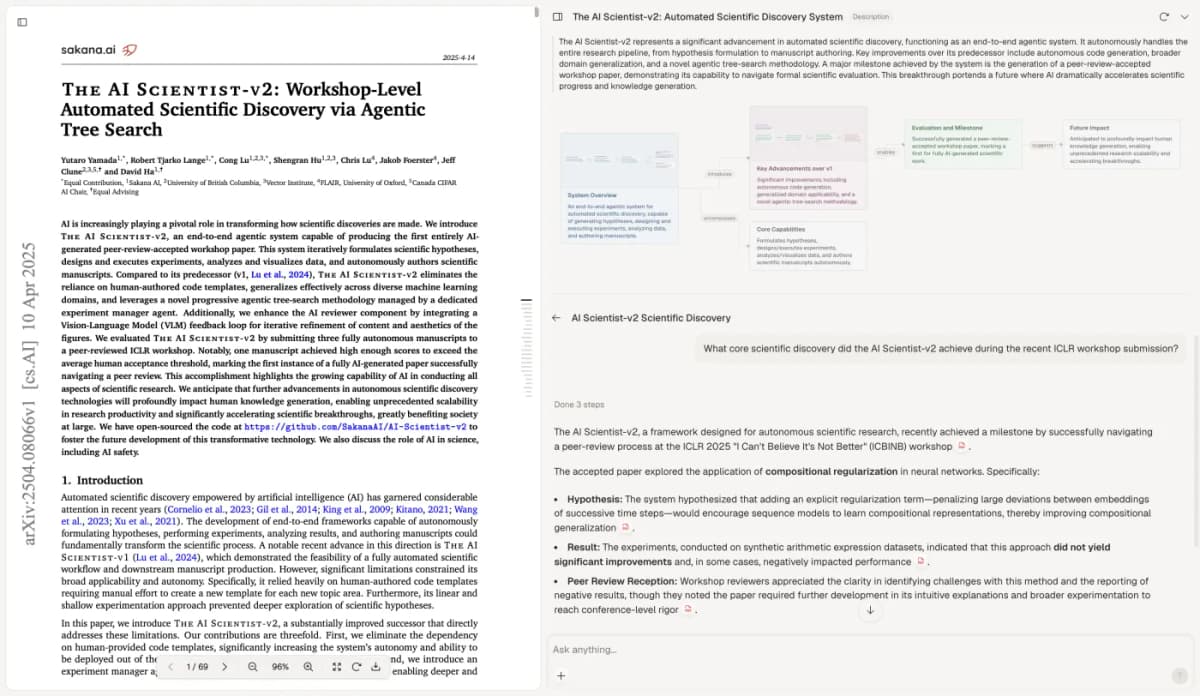
The cited answer can be checked beside the source. This real capture uses an unrelated AI paper, not the fictional interview; apply the same passage review to your finding sources. Paper shown: Yamada et al., The AI Scientist-v2, CC BY 4.0. The paper is displayed unchanged.
If the answer treats “resistance” as the speaker's own words, correct it. The memo supplies that label, while the excerpt supplies the time constraint. Keep the source contribution from each document separate.
Select New, then Note, and save the checked trace with source links. Wait for Saved. Atlas helps compare supplied material; you retain responsibility for the interpretation and the limits of the review.
Save support and uncertainty together
The final note should let a reader retrace your choice. Keep the claim, source passage, reason, prior view, other reading, and any gaps. A research log can record what you plan to check next.
For the fictional interview, retain the narrower time-constraint claim and the unresolved question about other staff accounts. The reporting-guideline owner helps distinguish transparency about that limit from proof of validity.
Return to the trace when another passage or reviewer comment changes the picture. Revise the claim where needed and preserve why it changed. A justified reading may remain provisional without losing its value.
Trace a finding to its sources
Compare the claim, excerpt, and assumptions behind a qualitative reading.