

Transferability in qualitative research asks how findings from one context may help you understand another. The task is to judge fit for a specific finding and a stated new setting. A study may offer useful insight without showing that its findings hold for every group or that the same action will work elsewhere.
Start with the claim you want to use. Then describe where you want to use it. Comparing two broad labels, such as “students” or “workplaces,” leaves out the conditions that may give the finding its meaning.
Use a comparison note to connect the study setting with the setting where you want to apply its findings. The workshop case below is fictional. It shows how to make a bounded judgment and keep gaps visible, rather than how to certify transfer.

Compare the contexts behind a finding
Check a study's setting against the context where you want to use it.
What transferability asks you to judge
Drisko's methods discussion examines transfer as applying insight from particular people, places, and times to others not directly studied. It also warns against treating transfer and universal generalization as the same claim.
A case-to-case judgment differs from statistical inference about a population. That does not mean all qualitative research is barred from broader claims. Name the kind of claim and read the reasoning that supports it.
Within a common trustworthiness framework, Shenton's context discussion emphasizes detail that lets a reader compare settings. The judgment needs both sides: what the study reports and what you know about the new setting.
Compare what matters to the claim
Choose context dimensions because they could change the meaning or use of the finding. The following prompts give you a starting point, not a scorecard for every study.
| Dimension | Study context | Target context | Why compare it? |
|---|---|---|---|
| People | Roles and selection described | Roles you plan to consider | The same label may hide different experience |
| Setting | Rules and resources reported | Local rules and resources | Constraints may shape the response |
| Process | What people did and with whom | What would happen here | Similar topics can involve different tasks |
| Time | Period and stage of the activity | Current stage and conditions | A finding may depend on a particular moment |
Table 1: The comparison records relevant conditions on both sides before you decide what the finding may mean elsewhere.
Rich description can support this work. Thick description explains how context gives an account meaning. A long report, however, may still omit the one condition that matters to your decision.
Read the study's qualitative research design to see who was included and how accounts were gathered. A shared role does not ensure a shared experience. Check the actual task and relation between the people involved.
Keep source locations in the note. The original context guidance points to study boundaries as useful detail. Your comparison should show which passage supplies each condition and which remains unknown.
Worked example across two study settings
Imagine a fictional report about optional peer-feedback workshops. It says students felt more willing to discuss unfinished work when peers could not affect their grades. You want to use that finding in a course where peer feedback forms part of the grade.
Both settings involve students and peer comments. But the finding concerns the stakes of sharing, so the grading difference matters. A match on the broad topic cannot settle that issue.
Separate insight from a recommendation
The source finding may suggest a question for the new course: how do students weigh the risks of showing unfinished work? It does not yet support the recommendation that the same workshop format will make them more willing to share.
A checked note could say: “The source describes low-stakes sharing. Our setting includes assessed feedback. The concern about judgment may be relevant, but the source does not establish that its format will work here.”
This keeps an insight while narrowing its use. The transfer discussion is useful for thinking about such context-sensitive claims. The fictional course still needs its own evidence before a practical change is justified.
Identify the missing condition
Suppose the source does not say whether feedback was anonymous. The target course uses named comments. Record anonymity as unknown on the source side; do not assume it matches or differs.
The next step is to seek a fuller methods account or ask for that detail. If it remains unavailable, keep the gap in the judgment. Read limitations of the study when the report's scope affects your intended use.
Keep missing context visible
An unreported condition is not proof that it was absent. A short article may omit details found in a supplement or earlier report. State what your available sources let you check.
You also need a trustworthy source-side finding. Credibility in qualitative research asks how well the original claims fit the accounts. Strong context similarity cannot repair a finding that is poorly supported in its own setting.
The path from material to interpretation also needs checking. Confirmability in qualitative research examines that path. Keep it separate from whether the finding is useful in a new setting. A research log can retain both checks and what each leaves open.
Avoid adding up matching dimensions to create a transfer score. One difference tied closely to the claim may matter more than several background similarities. Explain why each match or difference matters.
Check context sources in Atlas
Open a project with the study report, any context supplements, and a description of the target setting. Use sources you have permission to share and wait until processing finishes. Start a chat and use @ in Ask a question to select the materials. Choose Project only to prevent new web or literature retrieval. Earlier conversation context remains available, so name both the study report and the target-setting description in your question.
Ask: “Compare the context behind this peer-feedback finding with our course description. Show relevant matches, differences, and unknown conditions. Cite each side. Keep possible insight separate from a recommendation.”
Open the citations for the key context claims. Check whether the source discusses the right group and activity. The methods paper's context cautions help you keep unreported detail distinct from an established mismatch.
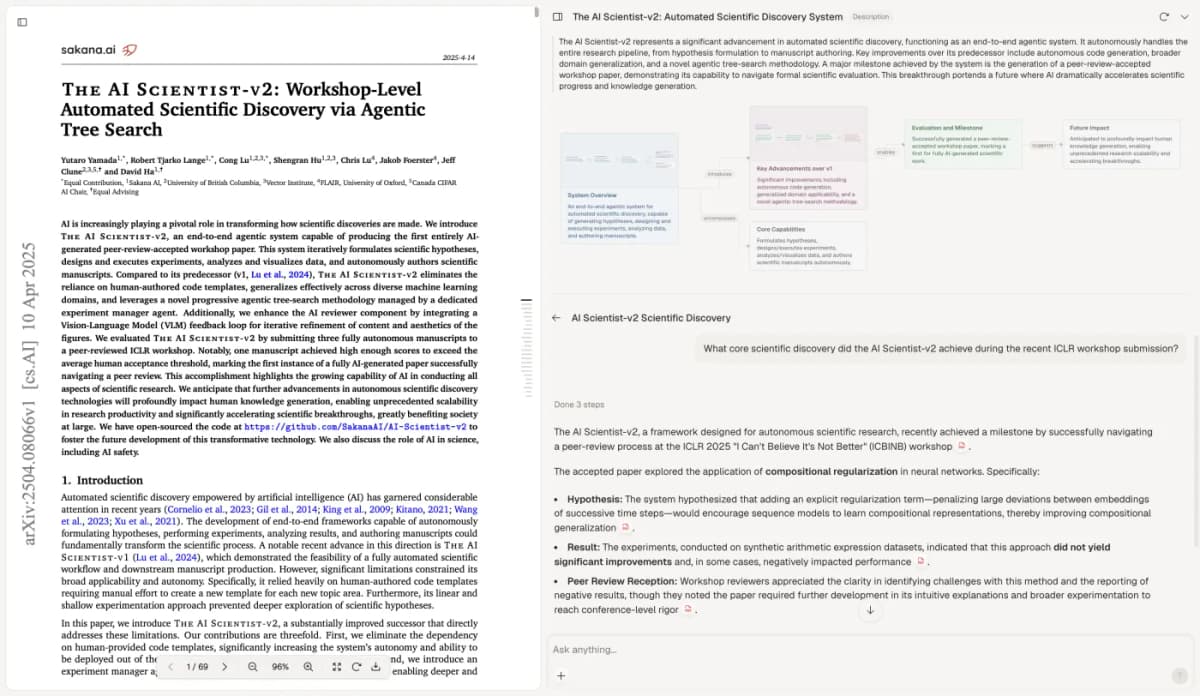
Read the cited answer alongside its source. This real capture uses an unrelated AI paper, not the fictional workshops; the source-review task is the same. Paper shown: Yamada et al., The AI Scientist-v2, CC BY 4.0. The paper is displayed unchanged.
If the answer says both settings match because both involve students, correct it. Keep the grading difference and unknown anonymity visible. The note should explain how those conditions bear on the particular finding.
Select New, then Note, and retain the checked comparison with source links. Wait for Saved. Atlas can help compare supplied descriptions, while you judge which differences matter and whether an application is justified.
Save a conditional transfer judgment
Write the decision as a claim with conditions. For the fictional case: “The finding raises a relevant concern about sharing unfinished work. Applying the workshop format in an assessed course needs further evidence about grading stakes and anonymity.”
The published transfer framing supports keeping the destination and kind of transfer explicit. Your saved note should also name the target setting so later readers do not treat it as a universal conclusion.
Revisit the judgment when either context changes or another source fills a gap. Keep what matched, what differed, and what you could not tell. Those details make the decision useful even when the answer remains conditional.
Compare the contexts behind a finding
Check a study's setting against the context where you want to use it.