
Meta Synthesis: Compare Qualitative Study Findings
Learn how meta synthesis brings qualitative studies together, preserves each study's context, and develops a new interpretation without pooling effect sizes.
- Byline

Summary
Meta synthesis reads findings from several qualitative studies to answer one question. It keeps each study’s setting in view.
It differs from meta analysis. It compares reported findings and authors’ views; it does not pool numerical effect estimates.
State how you searched, chose and checked studies. Show how you read them together, including cases that challenge your main claim.
Meta synthesis brings findings from published qualitative studies into a new, reasoned account of a shared question. It works with reported themes, concepts, and interpretations. It does not pool effect sizes the way a statistical meta analysis does.
The context of each study matters. Imagine two reports that both use the label “trust.” One studies people choosing a new clinic; the other studies staff who must carry out a new policy. The shared word may point to a different process in each setting.
A reviewer has to read how each study used it before proposing a cross-study idea.
A useful first step is a source-linked table: what each study asked, whose accounts it includes, what the authors concluded, and what you infer across them. Keep those layers apart while you test the new account.

Atlas

Compare qualitative studies in Atlas
Add papers, inspect cited differences, and save a checked synthesis note.
How qualitative studies become a synthesis
Meta synthesis is one family of qualitative evidence synthesis. It interprets findings across studies, often to explain how an experience or process changes with context. The usual input is the published report, including its author’s analysis, rather than raw interview transcripts gathered for a new primary study.
The Cochrane Handbook’s qualitative-evidence chapter describes methods that bring qualitative findings together. It stresses choosing an approach that fits the question and the reports. A repeated theme label is a clue to check, not a vote.
Separate three voices in your notes: what a participant said in a study, what that study’s authors made of it, and what you infer across studies. A quote may support an author’s reading, but it does not by itself establish your new claim.
An original psychiatric metasynthesis method paper shows question setting, study choice, appraisal, extraction, and analysis in one field. Its steps are an example of accountable conduct, not a fixed recipe for every discipline.
Meta synthesis and meta analysis
The terms sound alike because both bring studies together. Their inputs, methods, and outputs differ.
| Check | Qualitative meta synthesis | Statistical meta analysis |
|---|---|---|
| Main input | Reported qualitative findings, concepts, and study context | Numerical results that can answer a shared question |
| Main task | Interpret how findings relate, differ, and may form a new account | Estimate a combined effect and its uncertainty |
| Key risk | Flattening unlike meanings or losing context | Pooling studies whose measures or questions do not fit |
| Output | A traceable interpretation with supporting and divergent studies | A pooled estimate when the analysis is justified |
Table 1: An integrative review can bring empirical and theoretical work together under one question. Meta synthesis here focuses on findings from qualitative studies.
Counting papers that name a theme does not make a stronger synthesis. A numeric pool does not show how people understood an experience.
The scholarly review of qualitative synthesis methods distinguishes several kinds of interpretive work; their products are not interchangeable.
For review plans and pooling, see our systematic review versus meta analysis guide. A narrative synthesis may compare study results without a pool. State its goal and study types; do not assume it is a qualitative meta synthesis.
Choose the qualitative synthesis approach
Choose the method from the question and available reports, then state what kind of new account you aim to make. The Cochrane method guidance links method choice to the question, the depth of the material, team skills, and the intended use.
If the reports give detailed descriptive findings and your aim is to group them under a clear question, thematic synthesis may fit. If they offer rich concepts and you aim to translate ideas across studies into a new interpretation, meta-ethnography may fit better. Neither wins by default. Thin reports may not support the new account you hoped to make.
Check the study reports before you commit. Can you find the authors’ analytic claims, the participant context, and extracts that show what those claims mean? If one paper offers only a short conclusion, note that limit. Do not invent detail to fill the gap.
The Cochrane chapter’s method section describes the choice of a synthesis and extraction method.
A scholarly qualitative meta-synthesis discussion also stresses the judgment needed to read published findings across reports.
Select and appraise qualitative studies
Write a focused question and a plan for searching, screening, and analysis. Define what counts as a qualitative study for this review, which settings matter, and what kind of finding you will extract. Keep a record of where you searched and why each report was included or excluded.
Read each included report as a whole before extracting a few quotes. Note its question, participants, setting, method, author interpretations, and stated limits. Then appraise its methods with criteria suited to that design. The review team owns those judgments.
Cochrane’s chapter on study strengths and limits places appraisal alongside the choice of studies to synthesize. A thin methods account is a limit on what you can claim, even when the reported finding sounds vivid.
Build a source trail at extraction time. Give each claim a report ID and a page or section. Note whether a phrase is a participant’s words, an author’s finding, or your memo. These levels are easy to blur when all three appear in one table cell.
Revisit the question if the studies cover very different groups. Note the change in the review record. The Frontiers method example shows a staged process, while the team remains responsible for its own eligibility and appraisal rules.
Build a cross-study interpretation matrix
The matrix below is fictional. The study IDs, summaries, and quotations are invented to show a checking method. They are not published findings or an Atlas test. Imagine a review of how people seek help in a new service.
| Study and context | Reported finding | Study-author interpretation | Reviewer's provisional inference | Source trail and challenge |
|---|---|---|---|---|
Q-1: first-time users at a walk-in service | People asked a familiar staff member before booking | Familiar contact made the first step feel safer | Trust may be built through a known person | Check Q-1 findings and setting; does this hold where no staff member is known? |
Q-2: remote users booking online | People used a clear step-by-step guide before asking for help | Predictable steps reduced uncertainty | Trust may also be built through a clear process | Check Q-2 author discussion; do not relabel this as personal trust. |
Q-3: repeat users after a poor earlier visit | Some avoided the service despite knowing staff and steps | Prior experience outweighed current access routes | The first two claims need a history boundary | Check the divergent case in Q-3; revise the cross-study account. |
Table 2: The first draft might be “familiar contact builds trust.” Q-2 narrows it, because a clear process can also help. Q-3 challenges both as a general rule. A more careful synthesis could ask how a credible path to help is shaped by contact, process, and past experience. That is a new idea to test, not a result these fictional studies proved.
Keep the study-author claim and your own higher-order claim in separate columns. If a report lacks the context needed to compare it, mark that limit. Do not treat a divergent study as a nuisance to delete; it may change the account.
The critical methods review compares synthesis approaches that make different interpretive moves. The point of this matrix is to show the move you made, not to imply one tool or table can validate it.
Check study interpretations in Atlas
Add the selected published reports to an Atlas project if their use is permitted. Mention the reports you want to compare and ask for a source-separated account: each study’s question, setting, author finding, source passage, and a case that might challenge a proposed synthesis.
Open every citation. Read the surrounding passage and confirm whose view it represents. If Atlas quotes a participant but your table calls it an author’s conclusion, correct the row. If a report is missed, go back to it. An absent chat result does not mean the report lacks that finding.
Save only checked rows and a memo that states your own inference and open questions.
Atlas can compare files and show source links. It cannot search every database, check study quality, choose the method, or prove your reading is sound. Our paper synthesis guide covers the broader task of comparing sources.
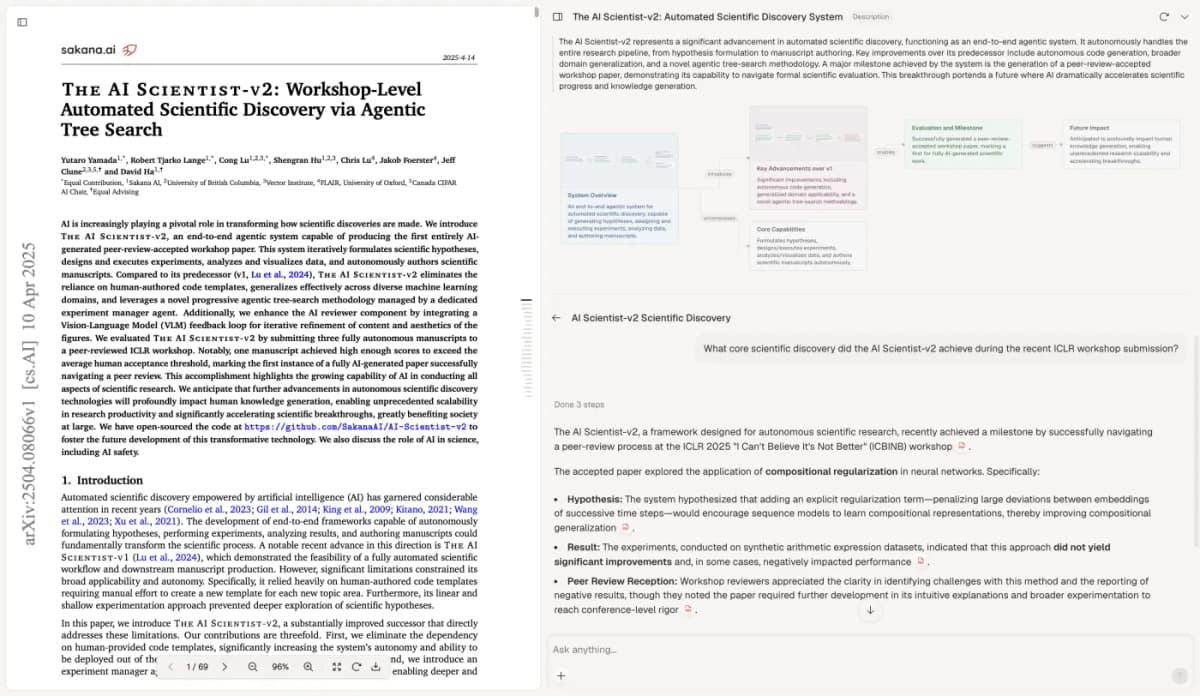
The screenshot shows an Atlas answer beside an open research paper. It shows where a reviewer can inspect a cited source. It does not show the fictional service studies or a completed meta synthesis.
Next steps after meta synthesis
Report the question, search and selection record, appraisal approach, chosen synthesis method, and how you moved from study findings to a new account. Show a study that supports it and one that limits or contradicts it. Keep each source’s setting close to the claim.
ENTREQ is a reporting statement for qualitative research synthesis. It helps authors disclose aims, methods, search and selection, appraisal, and findings. It does not choose or carry out the synthesis method for you.
Say what the reports cannot answer. If most come from one setting, the account may need testing elsewhere. If author interpretations are thin, a bold new theory may overreach. The review team should state how it handled such limits before readers use the conclusion.
Atlas
Compare qualitative studies in Atlas
Add papers, inspect cited differences, and save a checked synthesis note.
Frequently Asked Questions
It is a structured interpretation of findings across qualitative studies that aims to answer a shared question while retaining the studies' context.