
Integrative Review: Compare Different Kinds of Evidence
An integrative review brings studies and theory together. Use a mixed-evidence matrix to check each source's claim, type, and limit in your synthesis.
- Byline

Summary
An integrative review addresses one question using methodologically diverse literature, including empirical studies and relevant theoretical work.
A sound review shows how sources were found, chosen, checked, and read together. Different source types do not offer equal proof.
Record each source's design, contribution, limitation, and passage before writing a cross-source interpretation.
An integrative review brings different kinds of literature to one clear question. It may include studies with observed results and papers that build or explain a theory.
The reviewer compares their contributions, checks each source by standards that fit its type, and shows how the final account was formed. Whittemore and Knafl's method paper sets out this aim. It also warns that a broad source set can hide weak analysis.
For example, a study might report what participants did, while a theory paper proposes why. The theory is an explanation to examine, not another observed result.
In Atlas, you can bring selected papers into one project, ask for a source-by-source comparison, and open the citations. That check keeps the claims apart. It does not decide which source is sound.

Atlas

Compare your selected sources in Atlas
Compare mixed evidence and inspect citations before writing your synthesis.
What an integrative review does
An integrative review asks what a varied body of work says about one topic. Empirical sources draw on observed data, such as a trial, survey, or interview study. Theoretical sources propose concepts or links that may explain observations. The review must label which kind of claim each source makes.
The method is more than placing summaries side by side. The reviewer sets a purpose, searches for relevant work, judges the sources, and compares their contributions. The final account should reflect both agreement and tension.
In their original method paper, Whittemore and Knafl describe five broad stages and the challenge of combining unlike sources. Their nursing examples are not rules for every field.
The name “integrative” does not grant a free pass on search or quality. A theory paper may help explain an empirical finding, but it cannot stand in for data showing that an effect occurred. A weak study may still be discussed, yet its flaws should shape how much weight the review gives it.
When this review type fits
Choose an integrative approach when the question needs several kinds of knowledge. Imagine asking how a program is adopted in daily work.
An outcome study may show whether use changed. Interviews may show how staff experienced the change. A theory paper may propose why setting and incentives matter. Read them together while keeping their different limits visible.
If the job is to estimate one effect from comparable numerical studies, a meta analysis may be part of a suitable review. If the job is to map what research exists, a scoping review may fit better.
The right label depends on the question and planned method. Our systematic review and meta analysis comparison explains the pooling decision in more detail.
A qualitative meta synthesis brings findings from qualitative studies into a new interpretation. An integrative review can also bring conceptual papers and other empirical designs into the same question, with each source type assessed on its own terms.
Do not treat “integrative” and “systematic” as opposites. Some systematic reviews include varied designs. Here, the team plans to bring empirical and conceptual work into one account.
That plan needs rules for finding, checking, and reading both types of source. A scholarly guide ties the review type to its question and calls for a clear account of how sources were chosen.
Plan the five review stages
Whittemore and Knafl's framework gives a useful order. The stages are problem identification, literature search, data evaluation, data analysis, and presentation.
Later practical guidance and a worked nursing guide show why each stage needs a record a reader can inspect.
- Define the problem. Write the review question and say why both data-based and conceptual work belong. Name the people, setting, and ideas in scope. Keep a record of those limits before reading for conclusions.
- Search for literature. Record where and when you searched, the terms you used, other routes such as reference lists, and the rules for including a source. A broad question can still have a search that readers can follow.
- Evaluate the sources. Ask whether each paper is fit for the claim you need from it. A trial needs checks suited to its design; an interview study needs other checks; a theory paper needs a critique of its concepts, logic, and scope. Do not apply one crude score as if all papers were the same.
- Analyze the material. Extract the same core fields from each source, then compare where findings and concepts meet or conflict. Keep a link or page locator with every extracted claim. Put the reviewer's new idea in a separate note from the source's stated claim.
- Present the account. Show the search and selection trail, how sources were judged, the pattern you found, and the limits of that pattern. Explain where the account rests on observed data and where it rests on theory or reviewer inference.
These steps make the review open to scrutiny. In an audit of ten nursing reviews, Hopia and colleagues found that search, evaluation, and analysis were often weakly described.
That result concerns their sample. It is a reason to make your own trail clear, not a claim about all integrative reviews.
Compare mixed evidence in one matrix
Build a small matrix before drafting the main claim. Give each source a row and type its contribution.
The example below is fictional. E1, E2, T1, and T2 are made-up source IDs, not papers found in a search. The bracketed locators show where a real reviewer would record page, table, or section links after checking the full text.
| Source and type | Question and contribution | Appraisal concern | Passage to check |
|---|---|---|---|
| E1, outcome study | Did program use change? Reports a measured change in one setting. | Check the measure, follow-up, and what else changed. | [E1, results table] |
| E2, interview study | How did staff describe use? Reports accounts of time pressure. | Check sample, interview context, and how themes were built. | [E2, findings section] |
| T1, theory paper | Why might time pressure matter? Proposes a link between work load and uptake. | Check the logic and where the theory may not apply. | [T1, model section] |
| T2, theory paper | What else could explain uptake? Proposes a role for local incentives. | Check how the concepts were defined and bounded. | [T2, propositions] |
Table 1: This matrix holds an observed result, participant accounts, and two proposed explanations in one view. The rows do not have equal force.
E1's measure might support a narrow claim about its setting. E2 may add context from its participants. T1 and T2 offer ideas to test against the data; they do not show that time pressure or incentives caused the change.
When you use real papers, replace every placeholder with a checked passage. Keep the source question and appraisal note beside the claim. A table without those checks is only an outline.
The original method paper calls for a clear search record and quality check. Later guidance recommends a steady form for taking notes from each source.
Write a qualified synthesis
Start with the types of claims, then write the link you think they may have. In the fictional set, a careful draft might say:
E1 reports a change in use in its setting. E2's staff accounts point to time pressure as a possible part of the context. T1 offers one account of that link, while T2 suggests that local incentives may also matter. These sources do not show which account caused E1's result.
The first two sentences report what the made-up sources would contribute. The next names competing concepts. The last bounds the reviewer's inference. It leaves a question for future work instead of forcing one story.
If E1 and E2 seem to disagree, compare their samples, time spans, terms, and methods. A trial's outcome and an interview participant's account may answer different parts of the question. If a real tension remains, report it and explain what each source can support. Do not average unlike claims into a false consensus or convert a theory into a measured effect.
The matrix can change as new sources enter the review. Record why a row changed and what new passage supports it.
For a general way to organize those notes, see our literature review process and research paper synthesis guide. This task adds source-type and claim-strength checks to that broader work.
Check source contributions in Atlas
After the search and inclusion choices, use Atlas to compare the selected papers and check a draft matrix:
- Add the selected papers to a project. In chat, type @ and select the reports you want to compare.
- Ask: “For each source, identify its paper type, question, reported finding or proposed concept, stated limit, and a citation. Keep observed results separate from theory.”
- Open the citation for each row that matters. Read the passage and nearby text. If the answer merges sources or misses a qualifier, ask for a source-by-source account.
- Correct the matrix, then save the checked comparison and your separate interpretation in a note.
Atlas helps you work with the source set you bring to the project. The researcher still owns search coverage, inclusion, design-specific appraisal, and the final argument. A cited answer is a place to start checking, not a certificate that a claim is sound.
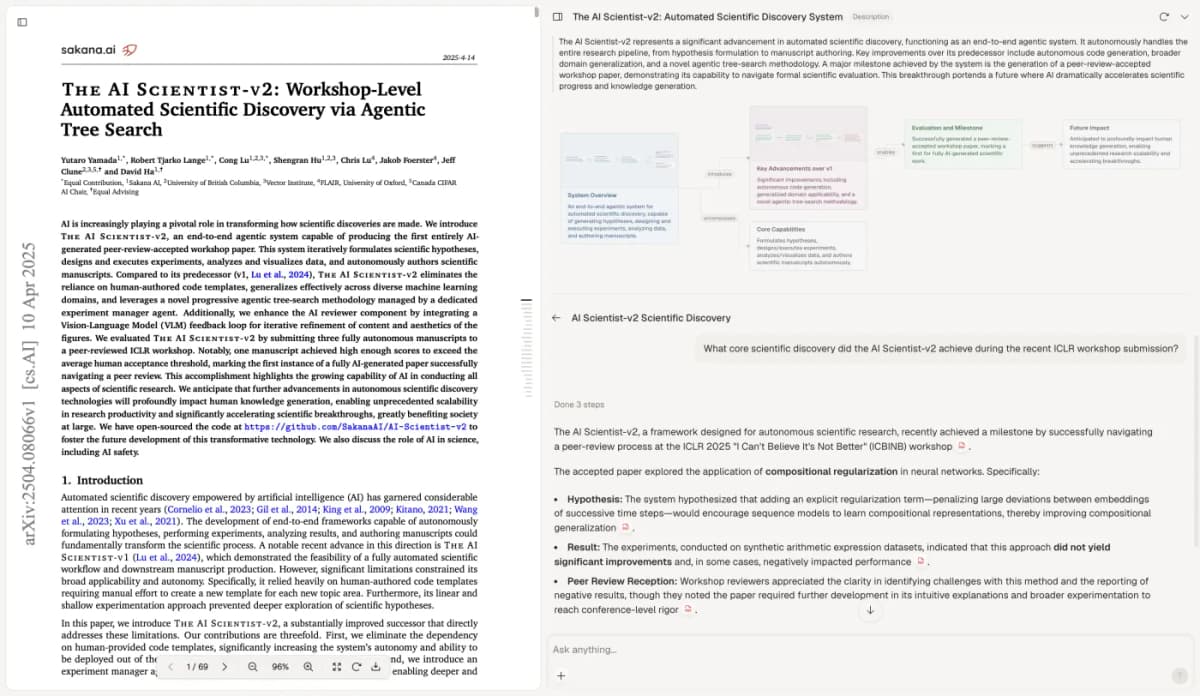
The image below shows Atlas beside an open paper, where a reader can inspect a source while checking a draft. The visible paper is about another topic; it is neither one of the fictional E1–T2 sources nor a tested integrative-review result.
If your next task is choosing a tool for the full writing process, the AI literature review guide covers that broader job. This page is about keeping unlike claims straight while you build the review.
Keep method and evidence limits visible
A finished matrix is not a finished review. Readers still need the search dates, source rules, exclusions, checks, analysis steps, and links behind the final claims.
A clear account also says which relevant work might have been missed.
The review may connect findings to concepts, but that link is an interpretation. Say where data end and the reviewer's explanation begins.
If papers disagree, give the source and method behind each side. If the review spans one field, setting, or language, state that limit when drawing a wider lesson.
An integrative review is strongest when its breadth creates a better question or a more precise account of the evidence. Breadth alone does not make a claim stronger. The value comes from showing how each kind of source contributes, where it is weak, and what remains open.
Atlas
Compare your selected sources in Atlas
Compare mixed evidence and inspect citations before writing your synthesis.
Frequently Asked Questions
It is a structured review that combines relevant literature from different research designs and, where the question calls for it, theoretical work. The author explains the search, selection, appraisal, analysis, and synthesis so readers can judge the conclusions.