

A sampling strategy in research explains how you will choose the people, cases, sites or sources that can answer your question. Start with the claim you want to make. To learn how common an event is, you need a different kind of sample from one used to learn how people lived through it.
Before writing your methods section, compare questions, target groups and selection reasons in prior studies. Keep their findings separate from your choice. An interview study can seek varied views without claiming those cases represent everyone.
You still decide which method fits, which people can be approached and what you can conclude from their accounts.

Check your sampling rationale in Atlas
Compare prior methods and open the cited passages behind your working note.
What a sampling strategy explains
The strategy connects four choices: the research question, the target group or setting of interest, the source of accessible cases and the selection method.
A sample-size number tells a reader how many cases you plan to study. It leaves unanswered why those cases belong in the study. Your target population is the group your question concerns, while the survey sampling frame is the list or source from which you choose cases.
A register of enrolled students may omit people who left before it was compiled. Record that gap rather than treating the register as identical to the target group. Statistics Canada's guidance connects design choices with inference and practical constraints.
For qualitative work, state who has helpful first-hand knowledge and how you will reach varied cases. Explain entry in terms of the question. A rule that all students must have finished the course could fit a study of course completion. It would leave out those who quit, whose views you need to study why people leave.
Match selection to the intended claim
If the question asks what proportion of a target group withdrew, selection needs to support a target group estimate. Probability sampling uses random selection with calculable selection probabilities.
Simple random, stratified and cluster designs have varied requirements for frames, costs and analysis. Random selection still needs attention to nonresponse and coverage.
Statistics Canada sets out these probability designs and their constraints.
If the question asks how people experienced withdrawal, you may need deliberately chosen cases that can describe that process. Purposive selection seeks cases expected to illuminate the question.
Range in course format or working hours might matter, but the researcher must explain why. Choosing varied views does not estimate their frequency in the target group.
Convenience sampling selects cases that are easy to access. That explains access but cannot show that the chosen cases reflect all views that bear on the question.
Official non-probability guidance explains how unknown selection probabilities limit target group inference.
As you study views and meanings, you may need new cases to test an idea that arose in your analysis. That iterative choice belongs to theoretical sampling. Keep it separate from the first reason for whom you will approach before analysis begins.
Compare prior studies without copying them
For this source-evidence check, read a prior study's question and methods together. Two papers can both use purposive sampling while pursuing varied aims or reaching varied target groups. The purposive-sampling study illustrates why the shared label does not show that either selection rule fits your project.
For each study, record the question, suitable cases, setting, selection reason, route for reaching people and stated gaps. Add a source location for each item.
If the paper names a technique without explaining why it was chosen, mark the reason as unreported. Do not infer what the authors planned.
The paper Purposive sampling: complex or simple? shows why context matters. Its stroke-service redesign example used stakeholder-defined rules to seek a range of views.
Some transfer-between-hospital cases were harder to recruit because fewer admitted patients fit that group. In that purposive sampling case, a planned group did not guarantee a filled group. Explain your choice of cases and track access gaps rather than copying the study's given groups or numbers.
Compare those observed gaps with your planned access route. If a gatekeeper reaches only current service users, accounts from former users may be absent. That gap changes the scope of your claim, even when reaching people follows the original plan.
Work through an interview study
Consider a made-up project asking how part-time students describe leaving an online course. The researcher suggests interviews with people who withdrew during the previous academic year.
They seek accounts from students with varied work hours and course formats because those conditions might change the withdrawal process.
An early reason says, "We will interview former students we can reach to obtain a representative picture of all part-time students." The problem is the jump from access to a claim to speak for all.
Neither an accessible contact list nor a range of work hours shows known selection probabilities across that broader target group.
A revised reason says, "We will seek former students with varied work hours and course formats to explore views of withdrawal. We will state those views in their own settings."
It adds, "This study will not estimate withdrawal prevalence among all part-time students." The narrower claim matches the question and choice of cases.
The working source note can now contain four connected entries:
- Question and target group: views of withdrawal among part-time students in the specified course setting and period.
- Selection choice: seek varied work hours and formats, with the reason each contrast might illuminate the process.
- Source basis: link the methods guidance and the read prior-study passage backing deliberate selection and attention to access gaps.
- Open gap: the contact route may omit people who are no longer reachable through the institution; discuss a route they can use or narrow the resulting claim.
This is a teaching example, not a real study. Assess access, permissions and support needs with the research team before proceeding. The fact that an earlier study used a certain sample count does not, on its own, justify using that count here.
Check the rationale in Atlas
Select the comparison sources
Create a project and add the allowed prior-study methods, sampling guidance and your question-and-target group note. Name each file so you can see its role. Keep private details about people out of this source check unless your research rules allow their use.
In chat, mention the exact sources with @ and choose Project only for new retrieval. Earlier outside evidence in the same chat remains available. Check that each cited passage comes from the sources you named.
Ask: "Compare how these studies connect questions, suitable target groups and sampling choices. Cite each stated reason and mark missing reasons as unreported. Which differences prevent transferring their method to my withdrawal study?"
Read and keep the reason
Open each numbered citation and read the methods passage with its surrounding context. Check any claim that calls a purposive sample statistically representative, then separate inclusion of views that bear on the question from target group estimation in your revision.
Before you keep the note, ask what each case could tell you. A former student who left while working nights may help explain a barrier that someone who finished the course never faced. That does not make the former student a stand-in for all night workers. Keep the reason for seeking that case beside the claim you can make from it.
Now ask who the contact list leaves out. If only people with an active school account can be reached, those who left long ago may not see the invite. The note should say so. A blank field is useful here: write “Not stated in this source” rather than guessing how the study dealt with that gap. If you find a source that fills it, add its page and change only the claim it supports. This keeps a broad label such as purposive sampling from hiding the choices that shape whose stories you hear.
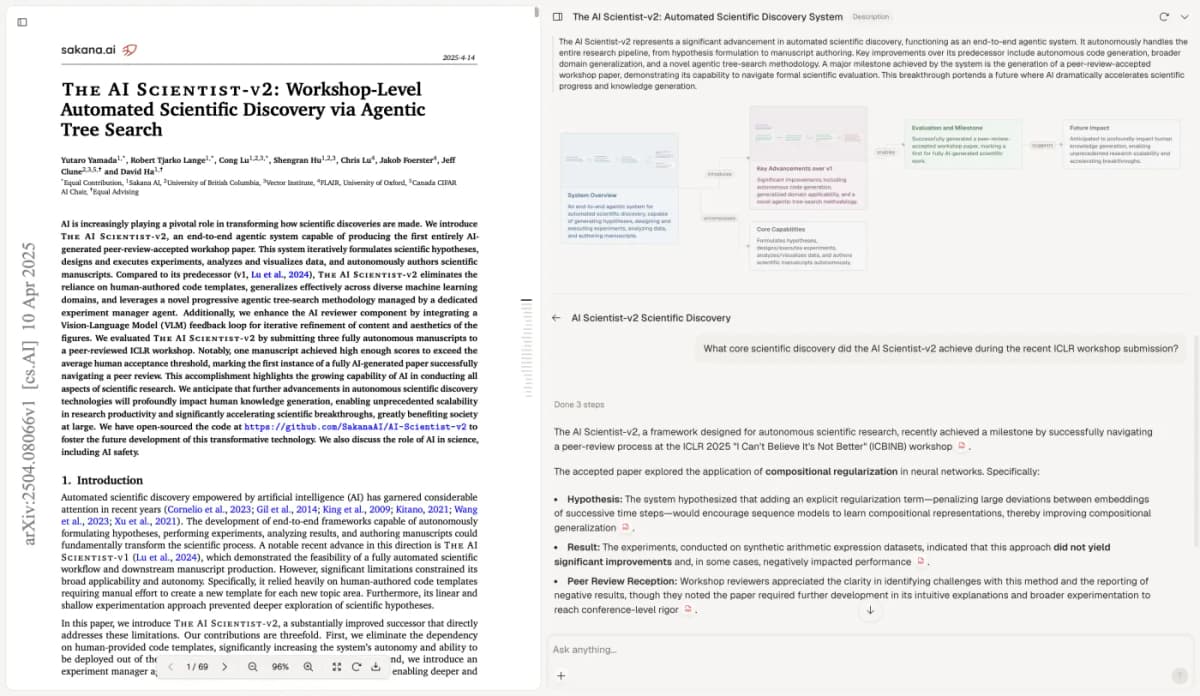
The source file and answer remain visible together during source checks. The displayed AI research paper contains no data about the made-up course-leaving scenario. In your own sampling note, keep the source passage's limits beside your reading. Visible paper: AI Scientist-v2, Yutaro Yamada et al., CC BY 4.0. Capture copied unchanged.
Select New, then Note, and save the revised source check with your researcher-written choice. Wait for Saved before closing it. Include a field marked unreported or not known wherever a source does not answer the question.
Write the rationale and its limits
Turn the checked note into a short methods paragraph. State the question, rules for entry, range sought, selection method and reason it fits the intended claim.
Follow it with the access route and known exclusions. Those details let a reviewer assess the choice.
For the made-up project, the reason might continue: "Suitable cases are part-time students who withdrew within the specified period. We seek range in work hours and course formats to explore differences in withdrawal views."
It would acknowledge that institutional contact routes may miss unreachable former students and explain how that limits interpretation.
Keep source locations in your working note to support changes when the question or access conditions change. Checking planned outcomes against a report needs a different source check, covered in reporting bias. Use a research paper outline for the broader methods section.
Check your sampling rationale in Atlas
Compare prior methods and open the cited passages behind your working note.