
Systematic Review vs Meta Analysis: The Method Choice
Compare a systematic review with meta analysis, see when pooling belongs in the review, and check study differences before choosing a synthesis method.
- Byline

Summary
A systematic review follows a plan to find, check, and bring together studies. A meta analysis pools results with statistics. It may be part of a systematic review.
A systematic review can be complete without meta analysis. If the team does not pool results, it must still explain how it brought them together.
Check who was studied, what was done, what was measured, and when. Then the review team can judge whether pooling answers its planned question.
A systematic review follows a plan to find, select, check, and bring together studies on one question. A meta analysis uses statistics to pool results from studies that fit the same analysis.
A review may contain a meta analysis, but it does not need one. If the team does not pool results, it still needs to explain how it brought them together. Cochrane's review guide puts a check of the studies before any pool.
Say two reports track the same outcome but at different times. One checks after six weeks; the other checks after a year. The results may not answer the same question.
The team must read its plan and the reports before it decides what to pool. Atlas can help show the differences in those texts. It cannot make the stats call.

Atlas

Compare review evidence in Atlas
Add included studies, check cited differences, and save a method note.
The difference in one sentence
Systematic review names the process; meta analysis names a way to pool results. The first term tells you how the team sought and checked studies. The second tells you how it combined their numbers. Cochrane defines meta analysis as pooling results from two or more studies.
The labels can overlap. A review may pool one outcome and describe another without a pool. It may use no meta analysis at all. A team could also pool a chosen set of studies without doing a full systematic review. The math does not make the search systematic.
When a deadline forces the team to streamline review steps, the rapid review guide shows how to record each restriction and its likely consequence.
That last case needs care. A pool can produce a number even when the team did not find all the studies or check their flaws. A reader needs to see how those studies were chosen.
Systematic review vs meta analysis
Use this table to see what each label means. Then read the paper's methods. A pooled result cannot stand in for a clear search and study check.
| Question | Systematic review | Meta analysis |
|---|---|---|
| Main job | Answer a defined question through a planned evidence-review process | Statistically combine suitable study results |
| Typical inputs | Protocol, eligibility rules, search results, study reports, extracted data, and risk-of-bias assessments | Compatible numerical results and analysis assumptions |
| Output | A transparent synthesis of the included evidence, with or without pooling | A combined estimate with uncertainty and an interpretation of variation |
| Required relationship | Can be complete without statistical pooling | Can occur within a systematic review or outside one |
| Who decides | The review team sets and documents the question, search, selection, appraisal, and synthesis | Qualified reviewers and statistical methodologists judge the comparison and analysis |
Table 1: The table sets the review steps beside the math. Neither label proves that the work was done well.
For a practical three-case check, ask what the authors actually did:
- Review with pooling: the team followed its review process and combined suitable results for a specified comparison.
- Review without pooling: the team followed its review process but used and reported another synthesis method for the available evidence.
- Pooling without a systematic review: the authors combined selected results, but the selection process needs its own description and limitations.
The first two can both be systematic reviews. The third can be a meta analysis, but its label says nothing about the search. If pooling is not possible, a review still needs a named way to bring findings together. Cochrane explains several such methods.
Where pooling fits in a review
First, the team writes a protocol: its plan for the question, search, and tests for which studies belong. It finds and checks the studies, then pulls out the data it needs. Cochrane's planning chapter explains why those choices belong in the plan.
Next, it asks which studies fit each planned group. Who took part? What care or program did they get? What was the other group? What did the team measure, and when? Those details can change what a pooled result would mean.
Only then does the team choose how to bring the findings together. It might pool one group of studies and give a clear text account of another. The method can differ by outcome. Cochrane Chapter 9 puts study grouping and data checks before the pool.
That is why “we used meta analysis” is not a full methods account. A reader needs to know which reports the team included, what it took from them, and why they fit one group. If the team changed its plan after seeing the studies, it should say so.
Criteria before pooling studies
Start with the question each study can answer. Similar titles are not enough. Two trials may study different people, types of care, or outcomes. One may check at six weeks and the other at a year.
Those gaps can change the meaning of a pool. Cochrane advises teams to compare study details before they group results.
Next, check the data and the planned math. The same way to score an effect may not work for every type of outcome. A report may also lack data needed for the pool. That does not mean the study must leave the review.
Cochrane Chapter 10 asks teams to deal with missing data and gaps between studies. The team should say which reports enter each pool and why.
Last, look at how much the studies and their results vary. This is heterogeneity. A pooled mean can hide large gaps, even when some results point in opposite ways. No math model can fix studies that answer different questions.
Cochrane Chapter 12 warns about a misleading pool when results vary widely. It also gives other ways to present findings.
A trained review team must make this call. It must weigh the question, the plan, each study's flaws, and the data at hand. If it does not pool, it still owes readers a clear account of the findings and their limits.
When to choose each approach
Choose a systematic review when the job is to answer a set question through a planned search, study checks, and a fair account of what the studies show. The plan should say how the team expects to bring findings together.
Add a meta analysis only for a group of results that can answer a shared question. The team may pool one outcome and leave another unpooled. If the data do not support a useful pool, keep the review and explain the other method used. A pooled number is a tool, not the goal of the review.
If the question is to map what evidence exists before narrowing it to an effect estimate, plan a scoping review instead. A scoping review protocol sets out the search, selection, and charting decisions before the map is made.
Check study differences in Atlas
Imagine a fictional review of a program. Its plan calls for a six-month check. Report A checks after six weeks; Report B checks after one year. They also use different scales.
These are made-up reports. They have no real results to pool. The point is to show what a team should check in the source texts before it makes a stats call.
- Add the protocol, both permitted reports, and any notes from data extraction to one Atlas project. Keep the full reports close at hand.
- Mention those sources in Atlas chat. Ask for one row per report: who took part, what was done, what was measured, how, and when. Ask Atlas to cite each item and mark gaps as unknown.
- Open each citation. Check the date, scale, and nearby text. If Atlas cites the wrong page or leaves a claim bare, fix the note or ask again with the right source named.
- Save a note with the checked facts and the open question. For example: “Report A: six-week check [Report A, outcomes passage]. Report B: one-year check [Report B, outcomes passage]. Protocol: six-month target [protocol, planned outcomes passage]. Question for the methodologist: Do these reports fit one planned pool, or should they stay apart?”
The citations in brackets are placeholders. Replace them with links to your own source pages after you check them. You can add gaps in the people studied, care given, and risk of bias. The note records facts and questions; it does not certify a pool.
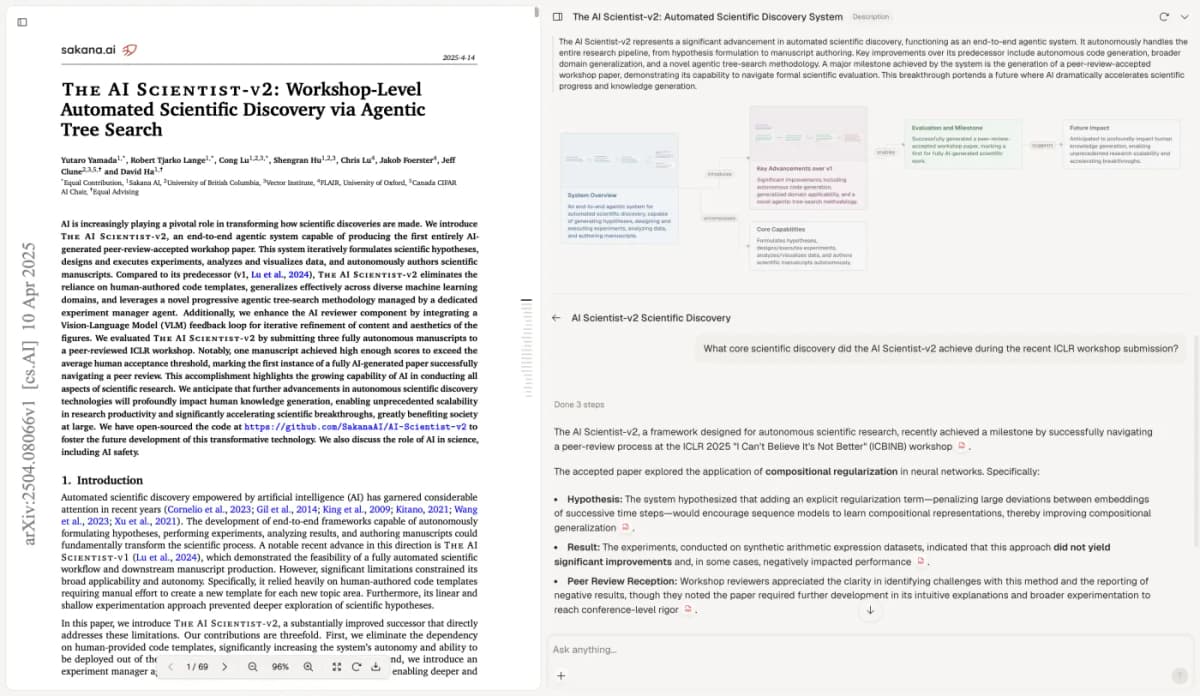
Atlas lets you compare source texts in a chat, open citations, and save a checked note. It helps with the document check. It does not run the full search, screen studies, rate risk of bias, pool results, or give clinical advice. The review team owns those steps.
This image shows the Atlas source-check surface beside an open paper. The paper shown is about a different topic. The image illustrates where to check a cited passage, not a systematic review result or a pooling decision.
Need tools for the search and screen? See AI systematic review tools. To sort claims before you write, use the paper synthesis guide or a synthesis matrix. The stats call still belongs to the review team.
Report the chosen synthesis clearly
Tell readers how you searched, chose, and checked the studies. Show how you grouped them and brought the findings together. Say where the work changed from the plan.
If you used a meta analysis, name the group and outcome it covers. Do not claim its pooled result speaks for every study in the review. If you did not pool, name the method you used and explain why.
PRISMA guides how to report why the review was done, what the team did, and what it found. It does not pick a stats model or tell a team which studies can be pooled.
A reader should be able to trace the path from the planned question to the studies and the final account. If that trail is clear, the reader can judge the work. The words “systematic review” and “meta analysis” cannot do that job on their own.
Atlas
Compare review evidence in Atlas
Add included studies, check cited differences, and save a method note.
Frequently Asked Questions
No. A systematic review is the planned evidence-review process. Meta analysis is a statistical synthesis method that may be used within it.