

The abstract sounds complete until a coauthor asks where the search dates, uncertainty interval, and registration number went. A tidy set of headings can hide those gaps.
Start with the reporting items, then find the words that support each one.

Keep the reporting item beside its passage
Compare checklist and abstract passages before saving a checked note.
Use the current twelve-item abstract checklist
The PRISMA abstract checklist is a twelve-item reporting guide for systematic review journal and conference abstracts. Download the PDF or Word file from the official Abstracts page. The current document is PRISMA 2020 for Abstracts, which updates the earlier 2013 guidance. Check the document title before using a saved copy.
Use the abstract checklist PDF to check the abstract, and the full PRISMA 2020 checklist to check reporting across the review. These documents serve different reading tasks. Filling in the full checklist does not show where an item appears in the short version you will submit.
Start by putting the abstract and checklist side by side. Mark the exact sentence for each item and flag any part you cannot find.
This is an author's reporting check. Study quality needs its own assessment. The PRISMA statement sets that boundary: reporting guidance does not replace review conduct or a method-quality assessment.
Check the requirements for each item group
Title and question
Items one and two ask you to identify the work as a systematic review in the title and state its objective or question. Keep the question narrow enough that a reader can tell what the review addressed. The official abstract document is the numbering source; a writing template is not a substitute for it.
Methods and evidence
Items three through six cover inclusion and exclusion rules, searched sources with each last-search date, the method for judging risk of bias, and how results were presented or combined.
Items seven through ten cover study and participant totals with key features, main results, limits of the included evidence, and interpretation. Evidence limits might involve bias, inconsistency, or imprecision.
For pooled results, report the estimate and a confidence or credible interval; for group comparisons, make the favored direction clear. Outcome-level study and participant counts are preferred. Check these details against the numbered requirements.
Think of this group as a chain: what could enter, where you looked, how you judged and combined it, and what the evidence lets you say. A heading such as Methods or Results does not supply a missing link.
For heading choices, the structured abstract guide covers format; this check asks whether the needed content is present under that format. You can have the right headings and still need to add facts.
Funding and registration
Item eleven concerns the review's primary funding source. Item twelve asks for the register name and registration number. Verify both in the official checklist, then check the review's own records.
A register name alone does not locate the record. Do not fill a blank field with a plausible identifier or assume that an unnamed funding source means there was no funding.
Build an item-to-passage map
Use a simple evidence criterion: can another reader find the words you marked and see how they address this item? In your working note, record the item number, abstract passage, source for any missing fact, and next action.
This method keeps the reporting decision tied to text rather than a vague impression that the abstract looks polished. The EQUATOR registry helps confirm that you are using abstract reporting guidance.
Read each sample passage as written. If it says that several databases were searched, do not infer their names from a familiar review template. If it gives a broad month range, check whether the review's search log supplies the dates you need. The official item list defines the question; your review records supply the answer. They have different jobs, and one cannot stand in for the other.
Separate two kinds of gap. A fact may be recorded in the review but absent from the abstract, in which case the author can draft a concise addition. Or the fact may be absent from the supplied records, in which case the next action is to ask the responsible author. Writing more fluent text does not resolve that second gap. Leave a visible request rather than turning an assumption into a statement of what the team did.
Keep a third status for text that is present but needs checking. A result can look precise yet use a different outcome, comparison, or time point from the full review. Cochrane's reporting guidance calls for agreement between the abstract and the full review. Match the meaning of each result to its full context before you accept the wording.
Record which version you read. A shared draft can change after your check, and an editor may shorten it again. A note that says which file and version supplied the passage is easier to use than a bare tick. The research note workflow can help you keep the abstract text, source facts, and open author questions together.
Worked abstract reporting gap map
Consider a fictional teaching draft about library training and source use. It contains the phrases “we searched education databases,” “pooled results favored training,” and “the review was registered with a review register.”
These are invented excerpts for a writing exercise. There is no actual review dataset, pooled effect, registration record, or claim that the training worked.
The first check does not rewrite those phrases. It asks what each one leaves a reader unable to trace. Use the official abstract numbering to make a short gap map, then send each open fact to the person who can verify it.
The following next actions are our teaching procedure. They show how an author can investigate each gap while using the official item list.
| Item | What the fictional text leaves unresolved | Next author action |
|---|---|---|
| 4: information sources | Which databases were searched and when each search ended | Check the search log; add only verified names and dates. |
| 8: synthesis results | The pooled estimate and its uncertainty interval | Check the final analysis output and outcome; do not create a number. |
| 12: registration | The register name and the record identifier | Check the actual registration record before adding the identifier. |
Table 1: For the search phrase, a coauthor might find a saved log in the review folder. Read that log rather than recalling when the team last met. Check that it belongs to this review and covers the searches used in the submitted analysis. Then write the needed facts in the abstract.
If the log is not available, the row stays open; a guessed date would make the abstract look more complete while making it less trustworthy.
For the result phrase, first ask whether the team really pooled results. The systematic review and meta-analysis distinction helps explain why a review need not include a pooled estimate. In this exercise, the draft uses pooled-result wording, so the author must verify the underlying analysis or correct that wording.
The table does not authorize a new analysis or supply its result.
For the registration phrase, locate the record itself. A title match may help the author find it, but confirm that the record belongs to the review and that the number has been copied correctly. If no record can be found, ask the review team what was registered and where. Do not borrow an identifier from a nearby paper or change the draft to imply registration that did not occur.
The checked note can now say: “Three reporting questions remain open; the relevant records have been requested.” That is a useful outcome even before the text is ready. It tells the next author what is missing and where to look. Once the records arrive, replace each request with verified text and check it in the abstract itself. For an actual submission, use your review as the factual anchor. The PRISMA scope statement defines the reporting task; this teaching map supplies no review findings.
Resolve gaps without inventing review facts
Reporting cannot repair review conduct
A complete-looking abstract can still describe weak methods or uncertain evidence. Conversely, an omission in a short abstract does not by itself show that the underlying method was never performed.
The PRISMA scope statement keeps reporting apart from method appraisal.
Preserve that distinction when you write a review comment: name the missing text before drawing a conclusion about the team's work.
Do not convert your passage map into a percentage of “PRISMA quality.” Finding twelve passages would tell you that text was located under your criteria. The soundness of the studies and certainty of the conclusions need separate assessment.
Cochrane separates conduct and reporting for the same reason. A reporting check should make the next review action clear without replacing the judgment that action requires.
Confirm format and scope with authors
Check the intended journal or conference instructions for length and headings. Cochrane's own abstract guidance has its own context; do not turn its length advice into a rule for every journal.
The structured abstract guide explains the format decision.
If the word budget is tight, revise with the review team so that the final version still communicates the essential facts and caveats.
Confirm that the guidance fits the review type. Protocols concern planned work, while a completed review reports what was done and found. Some review types need added or specialized guidance; the EQUATOR abstract entry and PRISMA statement scope are useful starting points.
Do not resolve that choice by silently treating planned methods as completed findings.
Check abstract passages in Atlas
Use Atlas to help read supplied text and keep your checks traceable. Bring the official checklist, current abstract, and relevant review documents into the project, then wait for processing. The literature review workflow provides broader source-reading context. Here the task stays small: locate one reporting passage, inspect it, and decide what still needs an author check.
-
Choose the current sources. In the chat, use
@to select the processed checklist and abstract. Add the full review or search log when it is needed for a specific gap.Name the abstract version in your request so an older file does not become the quiet basis for the check.
-
Ask one bounded question. For example: “Compare abstract item four in the supplied checklist with this abstract. Locate the relevant passage and list any requested detail you cannot find.”
Ask for cited passages rather than a blanket compliance verdict. A narrow question gives you a clearer source check to perform next.
-
Open the citations. Read the cited source and nearby text. Exact passage navigation may be available; otherwise find the wording in the source yourself.
Check which document supplies the cited text. A similar sentence in the full review can be mistaken for an abstract passage. A fact found elsewhere can support a revision without showing that it is already reported in the abstract.
-
Classify the gap yourself. Mark it as found, absent from the abstract, or needing author verification. If the answer supplies a date or result you cannot trace, remove it from the draft note and return to the source. Keep the open question visible instead of accepting a neat sentence whose factual basis is unclear.
-
Check the proposed revision. Read each added fact against its review record, then read the sentence as part of the whole abstract. Does the new wording change the outcome or overstate the conclusion? Use the passage map to focus your check while retaining the review's actual limits and the author's decision about what to report.
-
Save the checked note. Create a New Note, include the item number, reviewed passage, source version, and unresolved questions, and wait for Saved.
The next author should be able to retrace your decision without repeating the whole chat. Recheck the note if the abstract changes before submission.
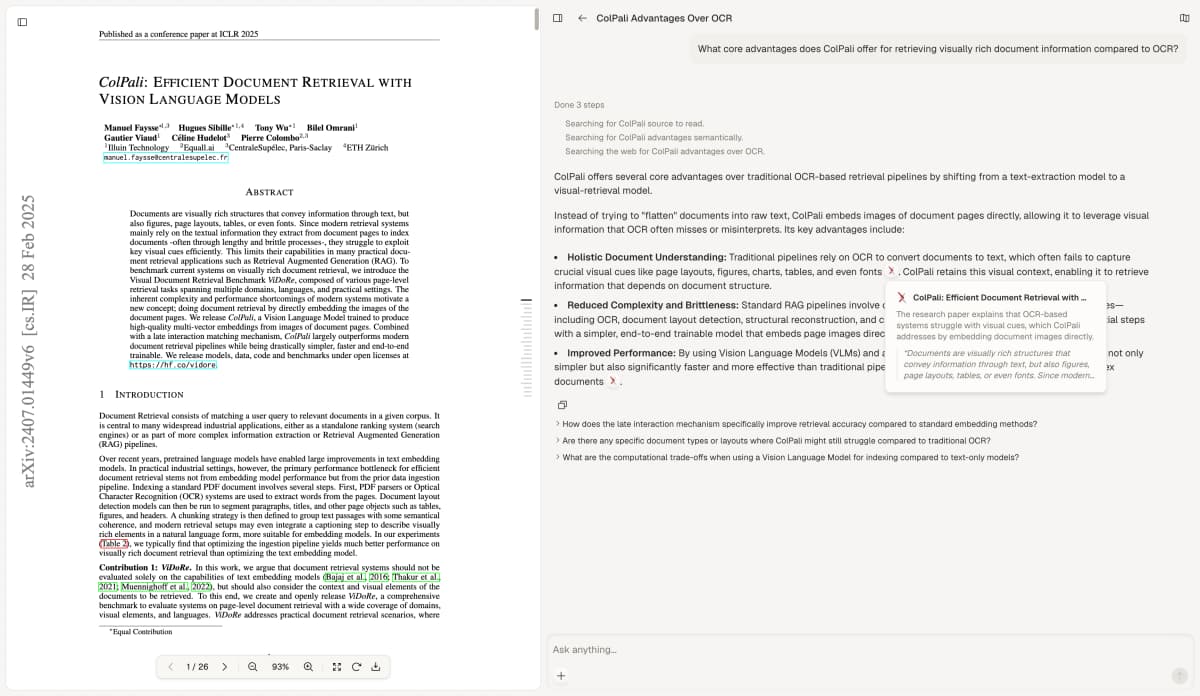
Actual Atlas citation view using an unrelated paper to illustrate source inspection. No PRISMA abstract check or compliance test is shown.
The screenshot places the ColPali paper on the left and a cited answer on the right, with a citation preview open over the answer. Use that view to compare an answer with its source text. The paper concerns document retrieval; it supplies no review facts or abstract-checklist judgments.
Atlas can help compare passages and preserve a checked note. The authors still decide whether the text addresses the item and whether a missing fact has been verified. Keep the official checklist available as you review; a confident answer should not replace reading it.
Verify the final submitted version
Run the item check on the version you will actually submit. Compare its wording with the note, especially after shortening text to meet a word limit. A useful last pass reads only the abstract first: can a reader understand the question, methods, findings, limits, and record details without opening your working files? Then return to the files to verify the facts you retained.
Close an open row only when the abstract contains the checked text or the review team has recorded a clear decision about the unresolved item. Keep the reason beside that decision.
This makes the official abstract reporting check useful during revision instead of becoming a sheet of unexplained ticks. It also gives a coauthor a concrete question to answer before submission.
Finish by reading the main review and abstract together for the strength of the conclusion. Cochrane's consistency guidance is a useful check: the short version should not promise more than the review supports. Save the final passage map with the abstract version so the check remains tied to the text that was submitted.
Keep the reporting item beside its passage
Compare checklist and abstract passages before saving a checked note.