
Scoping Review Protocol: Plan the Question, Search, and Charting
Scoping review protocol guide: align a PCC question, eligibility, search, selection, and charting. Use a worked decision table and record later amendments.
- Byline

Summary
A scoping review protocol is the team's plan for its question and methods, written before the review begins.
Align the question, PCC scope, eligibility, search, selection, charting, and planned display of results.
Record each later change and its reason. Atlas can help compare supplied sources with citations; the review team owns the plan and the review.
A scoping review protocol is the team's plan, written before the review starts. It states what they will map, which sources may count, how they will search and select them, what data they will chart, and how they plan to show the results.
JBI scoping review methods require an a priori protocol. A journal may have different rules.
Here is one early choice to make clear. If the question asks how adults use home blood-pressure checks in primary care, the team must decide whether hospital-only programs belong.
The JBI guidance on eligibility says that rules about which sources count should follow from the question's population, concept, and context.
Atlas can compare supplied guides and protocol examples with citations. The team must inspect those sources and approve the hospital rule. This example is fictional; no review was registered.

Atlas

Compare protocol sources in Atlas
Compare guidance and protocols, then keep checked decisions.
What a scoping review protocol fixes
A protocol records intended choices while they can still guide the work. The final review report says what the team actually did and found. Keeping both makes later changes visible. JBI calls the protocol a key first step for a well-planned scoping review and asks teams to justify departures in the final report.
The protocol should answer a linked set of questions: What is the review for? What is its question? Which sources fit? Where and how will the team search? Who will screen and resolve disagreements? Which fields will be charted? What form will the evidence map take? A list of section names alone cannot show whether those choices fit together.
PRISMA-ScR serves a different point in the process. It is a checklist for reporting a completed scoping review. Its items include protocol and registration, eligibility, search, selection, and data charting. It can help you anticipate what you will later report, but it is not a substitute for the method decisions in a protocol.
An a priori plan does not forbid learning during the review. Scoping work can change as evidence is found. The key is to keep the old plan, date the change, explain why it was needed, and say where the final report will disclose it. That is the transparency rule in JBI's protocol chapter.
Align question and PCC scope
Start with a one-sentence aim and a matching question. The aim says what the review will map. The question sets the limits for finding and choosing sources. A test sample can show if the terms are clear enough to apply. JBI says this match guides the rules, search, screening, charting, and display of results.
The PCC frame stands for population, concept, and context. In this fictional review, the group is adults with high blood pressure. The concept is home readings sent to a care team; the setting is primary care.
The question could ask: “What models of home blood-pressure checks with clinician feedback have been described for these adults in primary care?”
That question is broad enough to map models of care, yet it has a boundary. A device-only accuracy study with no care-team feedback may be out of scope. A home-monitoring program run by a primary care clinic may fit.
The team should settle what counts as “clinician feedback” before screening, or mark it as an open choice to resolve in the protocol.
The JBI question guidance recommends PCC for scoping reviews. It also notes that some questions need a different frame or can leave out a PCC element. A review that maps a concept, for instance, may have no population element.
Set usable eligibility rules
Turn each part of the question into a rule a screener can use. In this fictional review, “adults with hypertension” could include mixed-age studies only when adult data can be separated. “Home readings sent to a care team” could exclude self-tracking apps with no care link.
“Primary care” could include community clinics but exclude a hospital ward. Each rule needs a reason tied to the question.
Name the types of evidence sources as well.
A scoping review may include reports, guidelines, theses, and other documents when they help answer the question; it is not limited to trials. JBI's eligibility chapter asks teams to describe these types and to spell out each PCC element.
If the team includes reviews as sources, it should plan how to avoid counting the same underlying studies twice.
State language, date, publication status, and setting limits with reasons. A convenient English-only search may miss care models described elsewhere. A date cut-off may make sense if the technology or policy context changed, but “recent studies” is too vague to screen. The protocol should state the cut-off and why it fits the question.
Pilot the rules on a few candidate records before the full search and screening. If two reviewers read the same abstract differently, write down the disputed term and clarify it together.
This early test helps the team write a rule that two people can apply in the same way. Any later change belongs in the amendment log.
Plan search, selection, and charting
Once the question and rules match, state what the team will do. JBI's methods chapter asks who will search, select, and chart sources, how disputes will be settled, and how results will be shown. Another reader should be able to see the plan's reach and limits.
Search sources and terms
List the databases and other sources you plan to search, with dates and limits. For this health question, a health sciences librarian should help choose databases and search terms.
Record a draft search for at least one source and how you will adapt it elsewhere. Say if you will check reference lists, trial records, websites, or gray literature. Do not call the search exhaustive without good grounds.
Selection and disagreements
Name who will screen titles and abstracts, who will read full texts, and how they will settle disputes. Say if reviewers will work on their own and when a third reviewer will decide a case.
Keep reasons for full-text exclusions. The final report will need actual counts and reasons, as the PRISMA-ScR reporting list makes clear. Leave counts out of the protocol until screening has taken place.
Charting and display
Name the fields you plan to collect: year, place, source type, care setting, device or monitoring model, clinician feedback, and outcome type. Test the form on a few sources and note unclear fields.
State how the team will refine the form and show the map. It might use a table of care models by setting and a text account of gaps. Do not promise a pooled effect estimate when the aim is to map what has been studied.
Atlas can help a team read and compare documents it has supplied. A formal review still needs a team-owned search, rules for which sources count, a screening record, charting checks, and final reporting. For broader tool choices, see AI for literature review.
Work a protocol decision table
The table below is an invented planning aid for the remote-monitoring question above. No search was run for this example.
Each source column points to method guidance that supports making and reporting the decision; it does not endorse the invented choice. Replace every choice with the team's approved wording and actual cited examples before a real review begins.
| Element | Proposed choice in the fictional review | Guidance and rationale | Open team decision |
|---|---|---|---|
| Question and PCC | Adults with hypertension; home readings plus clinician feedback; primary care | JBI question guidance: the scope drives later methods | Does an asynchronous portal reply count as feedback? |
| Evidence types | Studies, service reports, and guidelines that describe a care model | JBI eligibility guidance: source types should fit the question | Include conference abstracts with little method detail? |
| Search sources | Named health databases plus relevant gray-literature sources; librarian reviews terms | JBI methods guidance: plan a traceable search | Which sites and date limits will be used? |
| Selection | Two team members screen, log full-text reasons, and resolve disputes | JBI methods guidance: assign roles and disagreement steps | Who is the tie-break reviewer? |
| Charting | Source type, place, setting, monitoring model, feedback, and outcome type | JBI methods guidance: plan extraction against the question | Which fields need a pilot definition? |
| Presentation | Table of models by setting plus a narrative map of gaps | PRISMA-ScR: report how results were synthesized | Will figures help show care pathways? |
Table 1: This invented decision table links each choice to a method reason and leaves open questions in view. The review team must answer them before it approves the plan.
A source link beside a row tells readers which guidance to inspect; it does not make the proposed choice a JBI requirement.
To compare real example protocols in Atlas, add guides and protocols you may use to a project. Type @ in chat and select those texts. Ask: “For each protocol, compare its question, rules for which sources count, search sources, screening roles, charting fields, and change plan. Cite each row and mark what is unclear.”
Open each citation and check the surrounding text. Keep a source's actual method distinct from your proposed choice. Then save a checked note for the team.
Atlas's source comparison workflow supports this cited reading step. The review team still owns the protocol and its formal work.
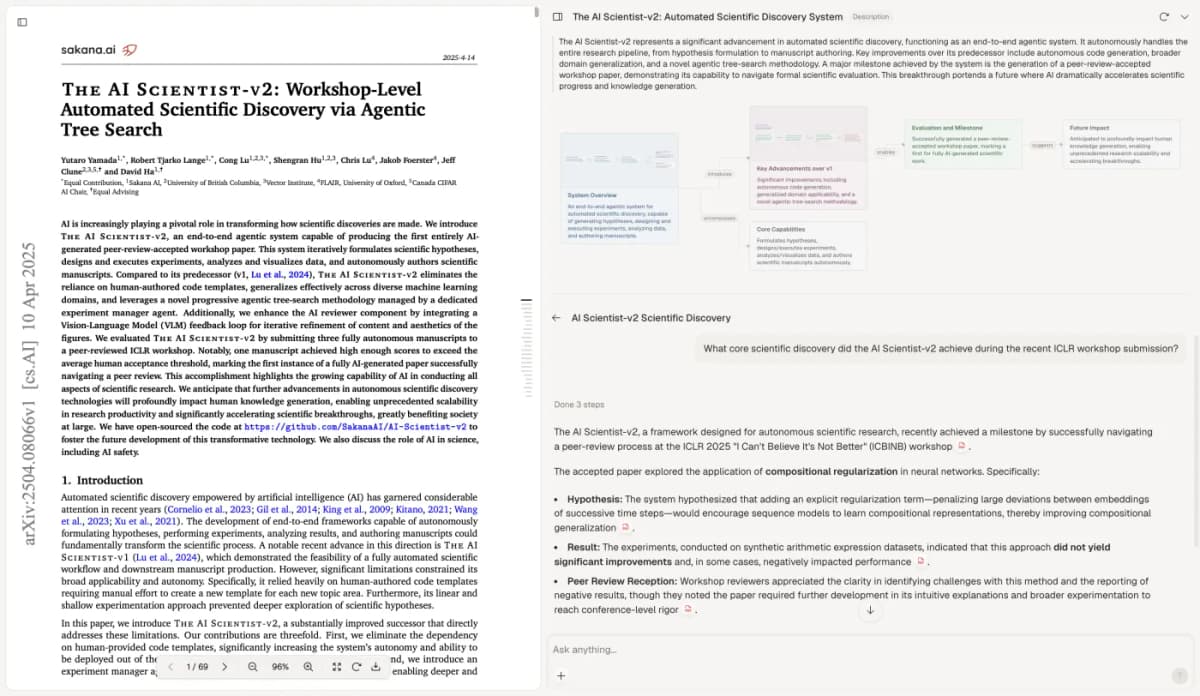
Atlas citation-inspection view: the reader can open a cited source beside a proposed comparison. The paper visible here is unrelated to the fictional remote-monitoring protocol and supplies no evidence for its choices.
Share changes and amendments
JBI distinguishes public posting from peer-reviewed publication. An a priori protocol is required when following JBI methods, but journal rules differ. JBI currently says PROSPERO does not accept scoping review protocols and names public options such as OSF and Figshare.
Check each platform's current scope and your target journal's rules before choosing where to post. A journal article is one route to share the plan; it is not a rule for every team.
Keep an amendment log if a real review changes course. In this fictional case, the 1 June 2026 plan excluded service reports. On 15 July 2026, a pilot search showed that public health reports held much of the program detail. The team could then add reports with enough method detail.
The log should keep both versions, name who approved the change, and explain why. The final review should report it in Methods and discuss its effect on coverage. These dates and events are invented; the new rule was not in the first plan.
Do not rewrite the first version or imply that the reports always fit. JBI's protocol guidance says to show and explain changes in the final scoping review.
The PRISMA-ScR checklist helps the team report the protocol and what happened, while the amendment log explains the path between them.
Next steps for the team
Before the search begins, read the question and each eligibility rule side by side. Check whether every planned search source, screening step, charting field, and result display can answer that question. Have the team resolve open cells in the decision table and record who approved the final protocol.
Then share or submit the approved version through an appropriate route and keep that version. If the work later calls for a change, add a dated amendment instead of erasing the first choice.
A clear audit path will help readers judge the final review. For the distinct task of comparing completed review findings, see research paper analysis.
Atlas
Compare protocol sources in Atlas
Compare guidance and protocols, then keep checked decisions.
Frequently Asked Questions
State the rationale, aligned objective and question, eligibility criteria, planned search and selection, charting fields, analysis and presentation approach, and how changes will be reported.