
Rapid Review: Report the Shortcuts and Their Consequences
A rapid review speeds up evidence work through planned shortcuts. See how to log what each shortcut may miss, check the chosen studies, and state a fair result.
- Byline

Summary
A rapid review uses planned changes to review methods to answer an urgent evidence question, then reports those changes clearly.
The team may shorten the search, screening, data collection, or study checks. Each choice has a risk to record.
Keep a log of those risks beside the study notes, so the final claim stays within the work the team did.
A rapid review uses planned shortcuts to answer an urgent question about research. The team still states the question, sets rules for which studies count, logs its search, and checks the evidence. Cochrane's current guide covers rapid reviews of treatment effects. Each team must fit its methods to its own question.
Each shortcut has a cost. Searching fewer sources may save time but miss studies. One person can copy the key facts from each paper, but an error in that step could change the result. The review should record such risks before it draws a conclusion.
Atlas can compare reports the team has chosen and show links to the cited text. A researcher can open and check those links. The team decides what to search, which papers count, how to judge them, and what remains unknown.

Atlas

Compare selected evidence in Atlas
Compare retained studies and inspect citations before reporting a conclusion.
What makes a review rapid
The key is a planned change to the review method to get an answer sooner. Writing a brief summary in a day does not make it a rapid review. The KU Leuven library guide calls for a clear question, stated methods, and a record of the steps the team cut back.
The team may change where it searches, how it picks studies, which facts it copies from them, or how it checks for flaws. It might focus on one group of people or one result. For each choice, it should explain what it may leave out or make less sure.
For questions about treatment effects, the Cochrane Rapid Reviews Methods Group has a current method guide. Its scope is clear. A team in another field must judge its own question and the cost of a wrong answer before it chooses any shortcuts.
When speed changes the method
Choose a narrow question
A health service may need an answer before a full review is done. Suppose it must choose next month whether to test text reminders for clinic visits. It could ask: In outpatient clinics, what do controlled studies show about missed visits after reminder texts?
That question names a place, a change, and a result. It is far narrower than “Do digital tools improve care?” The team can plan a smaller review around it. It should not use the tight scope to hide studies that cast doubt on the answer.
If the choice needs a sound estimate from many like studies, the team may need a fuller systematic review and meta analysis.
Weigh the risk of a shortcut
Speed has a cost the team must name. Fewer search sites can miss studies. One reviewer may wrongly reject a paper. A brief check for study flaws may leave some results in doubt.
Cochrane's paper on study choice and checks advises teams to test shared rules and have a second person check key work. It also warns against skipping the check for study bias entirely.
The word rapid describes the pace and method changes. It can apply to more than one kind of evidence work. For a question about findings from several interview studies, see meta synthesis.
If the choice can wait, the team can search and check more. The same is true when a missed study could change a high-stakes choice. A Cochrane methods paper on when to use a rapid review asks teams to weigh the need for speed against the harm of an incomplete answer.
Record the question and restrictions
Set the plan
Write a short plan before you start to sort search results. It should tell another reader what the team will do and why. If the plan changes, log the change. The KU Leuven guide urges teams to set out their route in advance because rapid methods vary by question.
- State the question. Name the people, setting, issue, main result, and due date. Say who needs the answer and what level of doubt they can accept.
- Set rules for what counts. Name the study types, dates, languages, groups, and results in scope. Set rules for rejection before you read the first result. Log later changes.
- Plan the search. List each place to search, the search terms, the date, and any other route, such as a paper's cited works. Explain each date or language limit.
- Plan how to pick papers and copy facts. Say who will screen records, how they will resolve a dispute, which facts they will record, and who will check that work.
- Plan checks and the final account. Pick a way to judge flaws that fits each study type. State which results you will check for bias and how that judgment will shape the claim.
Test the shortcuts
The plan records the team's choices. The team must still judge their risks. Cochrane's study-selection guide describes a trial run with the same screening form. Reviewers compare their choices before one person screens the rest. It also calls for a second person to check facts copied from studies and judgments about bias. Each team must decide which steps fit its review.
For the search, Cochrane's search paper asks teams to fit the sources and date limits to the topic. Its handbook on finding studies shows why a wider search matters in a full review. A recent-date cut-off might miss the years when most studies were done. Log that risk before treating the papers found as the full base for a claim.
Example restriction and consequence log
Here is a fictional plan for the clinic-reminder question. It shows choices a team might debate. No search was run for this example. A real team would test each row against its topic, skills, and the cost of a wrong answer.
| Review step | More extensive approach | Proposed rapid change and reason | What it may miss or weaken | Planned check |
|---|---|---|---|---|
| Question | Several settings and outcomes | Outpatient clinics and missed visits only, to meet the deadline | Results may not apply to inpatient care or other outcomes | State the setting and outcome in the conclusion |
| Search | Search several relevant databases and other routes | Search a core database and check references of included reports | Studies indexed elsewhere or unpublished work | Ask an information specialist to review the strategy; disclose sources not searched |
| Selection | Two reviewers independently screen all records | Pilot a shared form; consider single-reviewer screening only if agreement is adequate | Incorrect exclusions, especially for borderline reports | Record pilot agreement and verify uncertain exclusions |
| Extraction | Two reviewers independently collect all relevant data | Collect prespecified outcome and design fields; second person verifies | A missing qualifier or copied number | Keep page or table locators and check critical values |
| Appraisal | Assess each important outcome using a design-suited tool | Focus on the primary outcome; second person verifies judgments | Other outcomes have less certain quality assessment | Limit the conclusion to assessed outcomes |
Table 1: The search row is a choice to test. One search site may be too narrow. Cochrane's search guide shows how the topic affects where else to look. It warns that a date cut-off chosen only for speed can drop useful studies. The team must record what it searched and why it stopped there.
The row on who screens papers is also a choice. In the Cochrane methods series, two reviewers first check a share of records on their own, then compare choices. If they often disagree, they keep two-person screening. The guide also calls for checks on facts copied from papers and on study bias.
The log matters when it shapes the final report. If an unsearched source may hold key studies, say that the answer covers only the sources searched. If a result was not checked for bias, give it less weight.
Compare findings with their limits
Once the team has chosen and checked the papers, compare what each adds. Keep two kinds of doubt apart. A weak way to measure change in a paper is a study limit. A search site the team never checked is a review-process limit.
This example is also fictional. S1 and S2 are made-up report IDs. In a real review, replace the bracketed place marks with the page or table that backs each claim. No such papers were used here.
| Selected report | Claim to verify | Study limitation | Checked locator | Review-process uncertainty |
|---|---|---|---|---|
| S1, controlled study | Reminder messages were associated with fewer missed visits in one clinic | Check allocation, baseline differences, and outcome measurement | [S1, results table] | A relevant trial may sit outside the chosen database |
| S2, observational study | Missed visits changed after reminders were introduced | Other service changes may explain some change | [S2, methods and results] | A single screener may have excluded a borderline report |
Table 2: Do not use these invented findings in a real review. Check a real passage for each claim and judge the flaws in its study design. A page or table link helps you catch a short follow-up or a narrow patient group that a summary might omit.
Bound the final claim
A fair note on this made-up set might say:
Among the sources we searched and screened, S1 points to fewer missed visits in one clinic. S2 reports a change that may have other causes. Sources outside this search may show a different pattern.
That claim gives the two studies different weight. It also leaves room for papers the team did not seek.
If the reports disagree, ask how each defined a missed visit and when it measured change. Check the setting and study flaws too. Then state the split. A short deadline does not make unlike results fit together.
Cochrane's guide to synthesis asks teams to explain how they drew the findings together. Its journal version also discusses when a pooled number fits. Do not pool numbers just because a quick answer is needed.
The literature review process covers the wider path from source notes to an argument. For this rapid review, keep each method limit near the claim it could affect.
Check selected studies in Atlas
After the team has chosen its papers, add the plan and full texts to one Atlas project. Atlas can help compare that known set. The team must still do the search and screening work.
- In chat, type @ and choose the real reports in your project. S1 and S2 in this example stand for those papers.
- Ask: “For each paper, give its study type, main result, key flaw, and a link to the text. Keep each paper's flaws apart from limits in our search plan.”
- Open each cited link that matters. Read the text around it. If the answer blends papers or drops a caveat, ask for one row per paper.
- Fix the table, then save the checked finding and your own view in a note. Keep the shortcut log with it.
Atlas can show cited answers from project sources. Open the paper behind each key claim. A researcher checks values and study flaws, then decides what the result can support. Atlas helps with the source comparison and notes. It has no claim to a full search or a sound study appraisal.
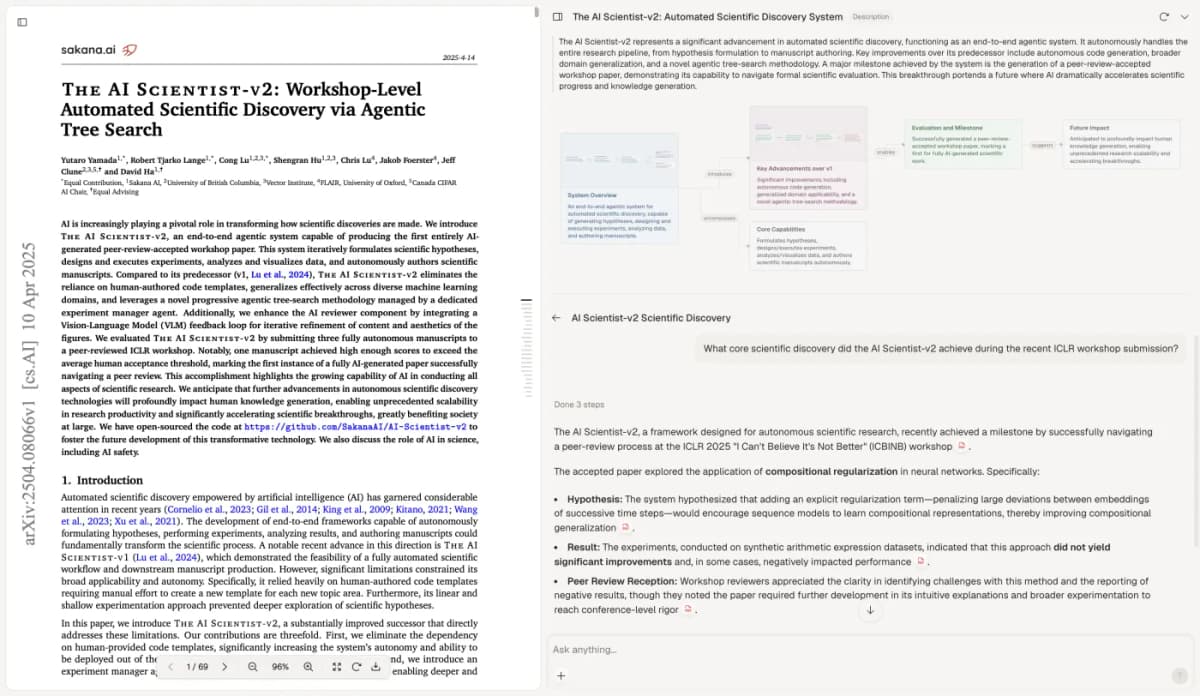
The image shows a paper open beside a cited answer in Atlas. The paper covers AI science. It is apart from the made-up clinic case and shows where to read a source while checking a claim.
For help choosing tools to find and screen papers, see the literature review software guide. Atlas fits the later task of checking claims across chosen reports.
Report what remains uncertain
A reader needs to see both kinds of doubt in the final claim. Study limits come from the papers the team kept: small groups, weak measures, or study bias.
Review-process limits come from what the team did: places it did not search, dates or languages it left out, one-person choices, or results it did not check.
Report the question and plan. Name any change to the plan. List where and when you searched, what papers counted, who screened them, which facts were checked, and how you drew the findings together.
Cochrane's guide to reporting asks teams to show the scope, method, evidence, and limits in a way readers can judge. The updated Cochrane method paper also calls for a clear report of the choices made to save time.
Write a claim that fits the work done. “The studies we found suggest…” can lead to a fair claim if you add the setting, result, and key limits. “All evidence proves…” reaches too far when the team cut back its search or checks.
An unsearched source, a dispute about which papers count, or a result with no bias check might change the choice. Say so. The team can search more, ask for a second check, or hold back a stronger claim. Readers can then see what the fast answer covers.
Atlas
Compare selected evidence in Atlas
Compare retained studies and inspect citations before reporting a conclusion.
Frequently Asked Questions
It is a time-sensitive evidence synthesis that streamlines selected systematic-review methods. The review still needs an explicit question, a documented method, and transparent reporting of changes and limits.